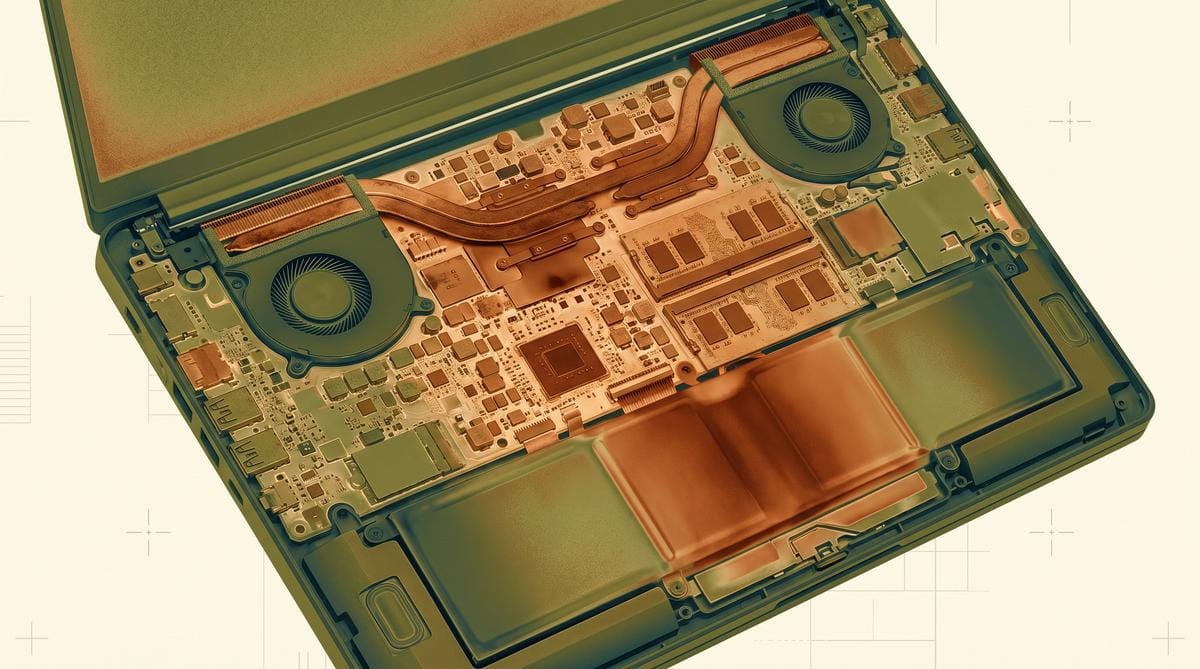
Framework Laptop 12 starts at $599 (approx. 2,400 PLN), but Apple’s MacBook Neo with the M4 processor offers a better price-to-performance ratio. Jeff Geerling, a well-known technology reviewer, admitted that he recommended a MacBook to his nephew instead of the modular Framework laptop. What exactly makes the Framework 12 so hard to justify?
TL;DR: Framework Laptop 12 is the company’s first 12-inch modular laptop, but its price and performance lose out to Apple’s MacBook Neo with the M4 processor. Jeff Geerling tested the device and concluded that for most users, the cheaper MacBook is the better choice. Modularity is nice, but it doesn’t compensate for the price difference.
Why does the Framework 12 lose to the MacBook Neo on value?
The Framework Laptop 12 starts at $599 (approx. 2,400 PLN) for the base configuration, which by itself doesn’t sound like an excessive amount. However, a full configuration with an Intel Core Ultra processor and adequate RAM quickly climbs above $1,000 (approx. 4,000 PLN). At this point, a problem emerges on the market — Apple’s MacBook Neo with the M4 processor costs about the same but offers significantly better performance and battery life.
Jeff Geerling in his review of the Framework 12 clearly states that Apple shouldn’t simultaneously be the cheapest option and the best value in the laptop category. The MacBook Neo simply dominates the budget performance laptop segment. This is a brutal truth for Framework.
What’s more, performance benchmarks consistently show that Apple’s M4 series processors outperform Intel chips in the same price class. So even though Framework offers the ability to swap components, from a pure performance-per-dollar perspective, the loss is evident.
Does Framework 12’s modularity make sense in 2026?
The main argument for buying a Framework is modularity — users can swap ports, expand RAM, or replace the SSD. Additionally, the company offers expansion capabilities within the Framework ecosystem, meaning access to new modules for years to come. In theory, this sounds great.
In practice, however, most users never swap components in a laptop. Market research shows that consumers aged 25-44 readily change purchasing decisions, but impulse purchases depend on age and rarely involve computer components. Meanwhile, younger users, whom the Framework 12 targets, often have no interest in hardware at all.
Framework 12 allows replacement of:
- I/O port modules (USB-C, HDMI, DisplayPort, Ethernet)
- RAM (DDR5 SO-DIMM standard)
- SSD (M.2 NVMe form factor)
- Wi-Fi card (M.2 standard)
- Battery (tool-free replacement)
- Keyboard (modular construction)
- Display (1200p LCD panel)
The above list looks impressive, but it’s worth asking — how many of these elements will the average user actually replace over the device’s lifecycle? Most likely zero or one.
How does the Framework 12 perform in benchmarks?
The Intel Core Ultra processors used in the Framework 12 offer decent performance, but they don’t compete with Apple’s M4 chips in the power efficiency category. In synthetic tests, the MacBook Neo achieves higher scores while also delivering longer battery life. Therefore, for users seeking the longest possible runtime without charging, the Framework 12 is not the best choice.
Jeff Geerling conducted detailed tests of both devices, and the results are clear — the MacBook Neo offers 30% to 50% longer battery life at similar computational performance. Still, the Framework 12 has one advantage — the ability to expand RAM up to 96 GB, which can be significant for developers and content creators working with large language models, like those discussed in the context of the Claude Mythos technique.
| Parameter | Framework 12 | MacBook Neo M4 |
|---|---|---|
| Processor | Intel Core Ultra | Apple M4 |
| Max RAM | 96 GB | 32 GB |
| Battery (tests) | 6-8 hours | 10-14 hours |
| Base Price | $599 | $599 |
| Modularity | Yes | No |
Who is the Framework 12 actually a good choice for?
The Framework 12 is a laptop aimed at a narrow group of users — technology enthusiasts who want full control over their hardware. For example, developers working with Docker containers who need large amounts of RAM may appreciate the ability to expand up to 96 GB. Similarly, Linux system administrators who need specific ports and full hardware control.
However, this target group is small. The average student, university student, or office worker doesn’t need either modularity or 96 GB of RAM. Therefore, Framework’s main selling point — component swappability — is simply useless for most buyers. It’s worth checking Jeff Geerling’s full review before making a final purchasing decision.
Moreover, the Framework module ecosystem is developing slowly. Although the company promises backward compatibility and new modules, the actual choices available in the store are limited to basic ports and a few accessories. As a result, the promise of modularity is greater than its actual realization in 2026.
Why is the Framework 12’s price hard to defend?
The base configuration of the Framework 12 at $599 (approx. 2,400 PLN) is just a barebones kit — the user must add their own RAM, SSD, and operating system. A fully built laptop with 16 GB RAM and a 512 GB SSD costs closer to $850 (approx. 3,400 PLN). Consequently, the price comparison with the MacBook Neo, which is ready to use right out of the box, falls drastically in Framework’s disfavor.
On the other hand, Framework offers longer product longevity thanks to component swappability, which can lower the total cost of ownership over 5-7 years. But as I already mentioned, most users replace their laptop every 3-4 years, so this argument loses significance. The most important thing is to carefully consider your own needs before purchasing.
How does the Framework 12 handle Linux?
The Framework Laptop 12 offers very good compatibility with Linux distributions, which is one of the few areas where the device clearly outperforms the competition. This is an important advantage for system administrators.
The modular hardware architecture allows key laptop functions to work seamlessly in open-source environments. Additionally, installing popular distributions like Ubuntu or Fedora proceeds without errors related to Wi-Fi drivers or power management.
The following elements work for Linux users without additional patches:
- Full support for expansion modules (USB-C, HDMI, DisplayPort)
- M.2 Wi-Fi card operation
- Proper sleep and wake functionality
- Keyboard and trackpad support
- Battery charge level management
This seamless integration with open-source systems is an argument for a narrow group of IT specialists. The average user won’t notice this advantage, since they prefer ready-made operating systems.
Does the Framework 12’s build quality match its price?
The Framework 12’s build quality is decent, but falls short of the standards set by Apple in the $600-1,000 (approx. 2,400-4,000 PLN) laptop segment. Jeff Geerling notes that the plastic chassis and hinges feel solid, but lack the rigidity characteristic of devices with a unibody aluminum construction. Nevertheless, the modular chassis serves its purpose.
The MacBook Neo offers an aluminum chassis with higher build quality at the same $599 (approx. 2,400 PLN) base price. Consequently, the Framework 12 loses not only on performance but also on the physical feel of the hardware. While modularity requires certain design compromises, the difference in tactile quality is noticeable.
The Framework 12’s display is a 1200p panel with a refresh rate suited for basic tasks. The MacBook Neo, on the other hand, offers higher resolution and better color reproduction, which matters for photo editing or watching movies. Therefore, in terms of image quality and chassis alone, the Framework 12 doesn’t impress.
What about warranty support and the Framework ecosystem?
Framework offers a standard warranty with an extension option, but the technical support ecosystem is still smaller than Apple’s or Dell’s. The company provides detailed documentation on GitHub and a community forum where users share problem solutions. For example, finding instructions for replacing a specific module is straightforward thanks to the well-organized knowledge base.
Parts availability is a major challenge. Framework produces modules in limited batches, meaning periodic stock shortages. Furthermore, shipping to Europe extends the wait time for components. So the promise of easy repair is true only when the needed parts are physically available in the manufacturer’s store.
The module ecosystem includes basic accessories:
- Port modules (USB-C, HDMI, DisplayPort, Ethernet, microSD)
- Desktop docks with additional ports
- Storage modules
- Chassis personalization accessories
As a result, Framework’s ecosystem is useful but limited to basic expansion scenarios. Users won’t find specialized modules here, such as dedicated graphics cards or professional audio interfaces.
How does the Framework 12 perform in everyday use?
The Framework 12 is a sufficient device for basic tasks like web browsing, document editing, or working with office tools. However, tests conducted by Jeff Geerling show that the cooling system fans are louder than in the MacBook Neo under similar load. This is an important factor for work comfort.
The Framework 12’s keyboard offers a decent key travel but doesn’t match the comfort of MacBook keyboards. The trackpad is functional, but its surface is smaller than on Apple devices. So the daily experience with the Framework 12 is acceptable, but it lacks the polish that users expect at this price point.
For developers using advanced techniques for working with language models, as described in the context of Claude Mythos, the ability to expand RAM up to 96 GB is significant. The Framework 12 allows this configuration, which exceeds the maximum 32 GB in the MacBook Neo. This is a concrete argument for purchasing the Framework for a narrow group of specialists.
Frequently Asked Questions
How much does a fully configured Framework 12 cost?
A full configuration with 16 GB RAM and a 512 GB SSD costs approximately $850 (approx. 3,400 PLN) according to Framework’s pricing, putting it in direct competition with the MacBook Neo.
Does the Framework 12 support Linux without issues?
Yes, most modules work out of the box with popular Linux distributions — Jeff Geerling confirms full Wi-Fi, port, and power management compatibility in his hardware review.
How long does the Framework 12 battery last?
The Framework 12 battery lasts 6 to 8 hours under load tests, while the MacBook Neo M4 achieves 10 to 14 hours according to Jeff Geerling’s tests.
Who should buy the Framework 12?
The Framework 12 is designed for developers and Linux administrators who need up to 96 GB of RAM and full hardware control — for other users, the MacBook Neo at $599 (approx. 2,400 PLN) offers better value.
Summary
The Framework Laptop 12 is a device aimed at a narrow group of enthusiasts and IT specialists. For most users, it’s hard to justify its purchase given Apple’s better MacBook Neo with the M4 processor. Key conclusions from the analysis:
- The MacBook Neo offers a better price-to-performance ratio at the same $599 (approx. 2,400 PLN) base price.
- The Framework 12’s modularity is theoretically attractive, but most users will never swap components.
- The module and spare parts ecosystem is limited and prone to stock shortages.
- The Framework 12 works well with Linux, which is an advantage for administrators and developers.
- Build quality of the chassis and components is acceptable but falls short of competitors in the same price range.
Before making a laptop purchasing decision, it’s worth checking Jeff Geerling’s full analysis on his blog and comparing the actual costs of a full configuration against ready-made solutions from competitors. If modularity and large RAM aren’t critical, the MacBook Neo will be the better choice.