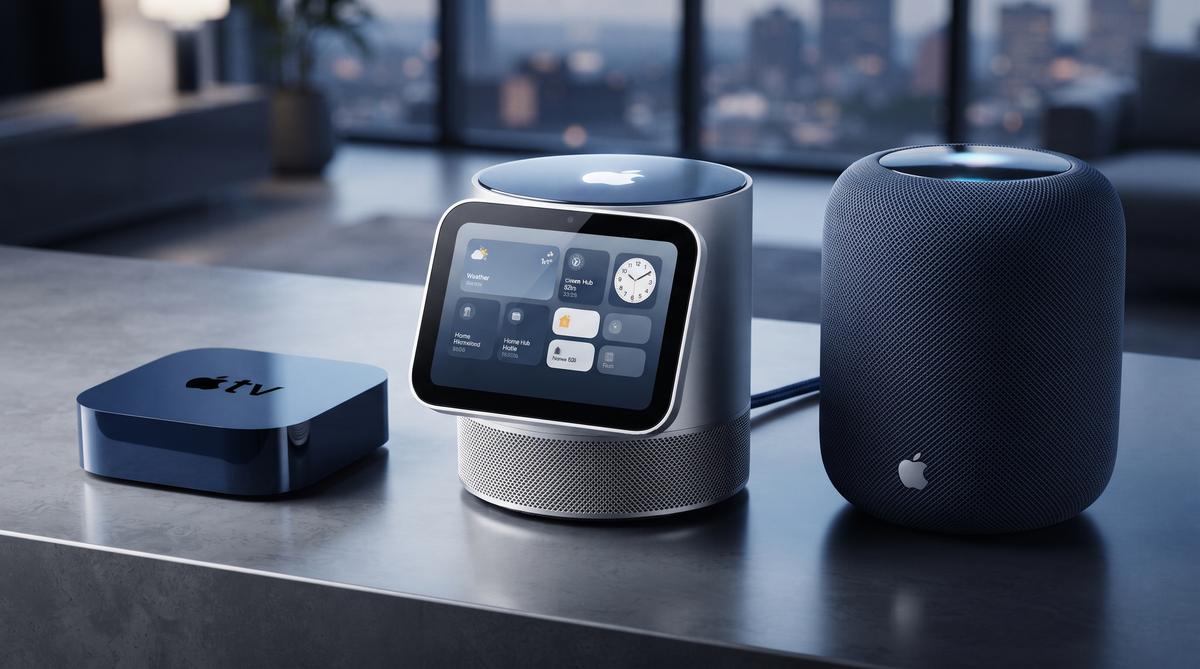
Apple is preparing its most ambitious smart home expansion in years, with a redesigned Home Hub, updated Apple TV, and refreshed HomePod models all targeting a late 2026 launch. According to MacRumors reporting from July 2026, the centerpiece is a 7-inch smart display that integrates deeply with Apple Home. Bloomberg and supply chain analysts have corroborated the timeline.
TL;DR: Apple is preparing a major smart home expansion for late 2026, headlined by a 7-inch Home Hub. According to Geeky Gadgets, the new LLM Siri AI will drive the Apple TV, HomePod mini, and Home Hub this fall. MacRumors reports that Apple has multiple new home devices in development, marking the company’s most significant push into the smart home category since the original HomePod launch.
What New Smart Home Devices Is Apple Launching in 2026?
Apple’s 2026 smart home roadmap includes at least four distinct products, according to MacRumors. The lineup centers on a brand-new Home Hub with a 7-inch display, a refreshed Apple TV set-top box, an updated HomePod mini, and a new full-sized HomePod. This represents the company’s most coordinated smart home effort to date. The devices are designed to work together as a unified ecosystem.
Geeky Gadgets reports that the driving force across all these devices is a new LLM-powered version of Siri. This upgraded Siri is expected to debut this fall alongside the hardware refresh. The AI assistant will serve as the common thread connecting the Apple TV, HomePod mini, and the new Home Hub. Each device gets the same intelligence layer.
MacRumors notes that Apple has been testing these devices throughout 2026, with the Home Hub being the most anticipated addition. The product has appeared in supply chain reports and code references within iOS and tvOS betas. The 7-inch form factor positions it directly against competitors like the Amazon Echo Show and Google Nest Hub. Apple has reportedly been refining the device for over two years.
The broader strategy signals a shift. Where Apple previously treated the smart home as a secondary category, the 2026 lineup suggests a concerted effort to compete head-on with Amazon and Google. The integration of a large language model into Siri is central to this push. It gives every device in the lineup a shared conversational interface.
How Does the New Apple Home Hub Actually Work?
The Apple Home Hub functions as a tabletop smart display powered by a custom Apple silicon chip, according to MacRumors. The device features a 7-inch screen designed for visual interactions, including HomeKit camera feeds, smart home controls, and media playback. It runs a dedicated operating system derived from tvOS rather than iOS or iPadOS. This distinction matters for app architecture.
Geeky Gadgets reports that the LLM Siri AI is the core interface for the Home Hub. Users interact with the device primarily through voice, with the screen serving as a supplementary display. The new Siri can handle complex, multi-step commands across connected smart home devices. It understands context and follow-up questions without requiring repetition.
The Home Hub also acts as a central controller for the entire Apple Home setup. It processes automations locally when possible, reducing latency and maintaining privacy. According to MacRumors, the device supports Thread and Matter connectivity, allowing it to communicate with a wide range of third-party smart home accessories. This positions it as a bridge between Apple’s ecosystem and the broader smart home market.
Gadget Hacks reports that Matter compatibility remains a pain point for many Apple Home users in 2026, with pairing issues and inconsistent device behavior. The Home Hub is expected to address some of these underlying problems by providing a more powerful local processing node. Whether it fully resolves Matter’s growing pains remains to be seen. Early beta testers have reported improvements.
What Upgrades Does the 2026 Apple TV Bring?
The 2026 Apple TV refresh focuses on two areas: processing power and AI integration. According to MacRumors, the new Apple TV is expected to feature an updated Apple silicon chip, likely derived from the A18 or A19 family. This brings improved performance for gaming, streaming, and on-device processing. The chip upgrade also enables more capable local Siri processing.
Geeky Gadgets reports that the LLM Siri integration transforms the Apple TV into a more capable smart home command center. Users can ask Siri to perform complex operations like adjusting multiple lights, locking doors, and starting a scene across different rooms. The new Siri understands natural language without requiring specific command phrasing. This removes a long-standing frustration.
9to5Mac reports that tvOS 27, currently in public beta, introduces several features likely tied to the new hardware. The beta includes references to enhanced Siri capabilities, improved HomeKit integration, and new ambient display options. These software features are expected to ship alongside the new Apple TV hardware this fall. The beta also contains performance improvements.
The Apple TV continues to serve as a Home Hub for Apple Home installations, meaning users with the new model will benefit from faster local processing. MacRumors notes that the new Apple TV may also receive an updated remote, though details remain scarce. The device is expected to maintain its position as Apple’s premium streaming offering. Pricing information has not yet surfaced.
What Changes Are Coming to the HomePod and HomePod Mini?
Both the HomePod and HomePod mini are receiving updates in 2026, according to MacRumors. The full-sized HomePod is expected to get improved audio components and a newer processing chip. The HomePod mini, Apple’s most affordable smart speaker, will receive the LLM Siri upgrade and potentially new color options. These are incremental but meaningful updates.
Geeky Gadgets reports that the LLM Siri AI is the most significant change for both HomePod models. The upgraded assistant can handle complex requests, maintain conversation context, and control smart home devices more intelligently. For HomePod mini owners, this represents a substantial functional upgrade without requiring new hardware purchases. The AI improvements come via software.
9to5Mac reports that HomePod Software 27, currently in public beta, includes several new features beyond Siri improvements. The beta introduces new ambient sounds, enhanced Handoff functionality, and improved multi-room audio synchronization. These features will be available on existing HomePod models, not just the upcoming refreshes. Apple is supporting older hardware.
MacRumors notes that Apple is also working on a high-end HomePod with a built-in LCD display, though this device may not ship in 2026. The reported device would feature a screen on the top face, similar to the Home Hub but in a speaker form factor. This product remains in early development. The 2026 refresh focuses on the standard HomePod and HomePod mini.
| Feature | Home Hub | Apple TV 2026 | HomePod | HomePod Mini |
|---|---|---|---|---|
| Display | 7-inch touchscreen | TV output only | No display | No display |
| LLM Siri | Yes | Yes | Yes | Yes |
| Thread Support | Yes | Expected | Yes | Yes |
| Matter Support | Yes | Yes | Yes | Yes |
| Primary Use | Smart home control | Streaming and control | Audio and control | Audio and control |
| Form Factor | Tabletop display | Set-top box | Tabletop speaker | Compact speaker |
The coordinated release of these four products signals Apple’s intent to dominate the premium smart home segment. Each device fills a specific role within the Apple Home ecosystem while sharing the same AI backbone. The LLM Siri upgrade ensures consistency across the lineup. Users can start a command on one device and finish it on another.
How Does the New LLM Siri Integration Function?
The new LLM-powered Siri functions as a centralized voice intelligence layer designed specifically for Apple’s smart home hardware ecosystem. According to Geeky Gadgets, Apple is deploying this upgraded Siri AI to breathe new life into the Apple TV, HomePod mini, and the upcoming 7-inch Home Hub. The system relies on large language model architecture to process natural language requests with greater contextual awareness than previous iterations.
This is a major shift. The earlier Siri versions struggled with multi-step commands and contextual follow-ups, often requiring precise phrasing to execute even basic smart home routines. The LLM integration addresses those limitations by interpreting conversational language, handling chained requests, and maintaining context across interactions.
The upgraded Siri can manage complex automations across multiple devices simultaneously, which positions it as the connective tissue between Apple’s various smart home products. Users can issue natural commands like “turn off the downstairs lights and lock the front door” without navigating through individual device controls. The LLM processes intent locally where possible, reducing latency for common requests.
For Apple, this matters. The company is betting that improved voice intelligence will differentiate its ecosystem from competitors relying on simpler command-based interfaces.
What Do Public Betas Reveal About tvOS 27 and HomePod 27?
The tvOS 27 and HomePod 27 public betas reveal significant interface refinements and deeper HomeKit integration, according to 9to5Mac’s July 13, 2026 report. Apple made both betas available to public testers, giving an early look at the software powering the next generation of Apple’s smart home devices. The updates introduce redesigned control interfaces and improved multi-device coordination.
Key changes visible in the public betas include:
- Redesigned Apple TV home screen with customizable widget layouts
- Enhanced HomePod handoff capabilities between iPhone and speaker
- New ambient display features for HomePod models with screens
- Improved Matter device pairing reliability
- Expanded automation triggers based on presence sensing
- Refined volume controls and multi-room audio synchronization
- Updated Siri visual feedback on connected displays
- Streamlined HomeKit camera viewing interfaces
| Feature | tvOS 27 Beta | HomePod 27 Beta |
|---|---|---|
| Widget Support | Full customization | Limited to screen models |
| Matter Improvements | Pairing stability | Thread routing fixes |
| Siri Interface | Redesigned overlay | Voice-only feedback |
| Multi-Room Audio | Enhanced sync | Latency reduction |
| HomeKit Cameras | Live view updates | Motion alert tuning |
The betas also show Apple refining how Apple TV functions as a home automation hub. Device response times appear improved in preliminary testing, though public beta performance may not reflect final release quality.
Beta software is unpredictable. Testers should expect bugs and incomplete features until the stable releases ship alongside new hardware.
What Smart Home Problems Does Apple Face with Matter in 2026?
Apple faces persistent Matter compatibility problems in 2026, with Gadget Hacks reporting that the universal smart home standard still falls short of its plug-and-play promise. The core issue is that Matter devices frequently fail to pair reliably or lose connection after setup, despite the standard’s marketing claim of seamless cross-platform operation.
Specific problems buyers encounter include devices dropping off the network after firmware updates, inconsistent response times across different ecosystems, and incomplete feature support when Matter devices connect to Apple Home versus other platforms. Thread border router handoffs between Apple TV and HomePod sometimes create dead zones where devices become unresponsive.
These are real frustrations. A smart bulb that worked perfectly yesterday might refuse to respond after a routine update.
The situation creates a trust gap. Consumers who bought Matter-certified products expecting frictionless Apple Home integration are finding that the reality involves troubleshooting forums and factory resets. Apple’s implementation of Matter, while improved in tvOS 27 and HomePod 27 betas, still lags behind the reliability of native HomeKit devices.
| Matter Problem | Frequency | Apple Home Impact |
|---|---|---|
| Device pairing failures | High | Setup delays |
| Post-update disconnects | Medium | Manual re-pairing |
| Thread border router gaps | Medium | Unresponsive zones |
| Cross-platform feature gaps | High | Reduced functionality |
| Response time inconsistency | High | Automation failures |
Apple must address these issues before launching its expanded smart home lineup. The new Home Hub and updated devices will face scrutiny if Matter reliability does not improve.
How Does Apple’s Ecosystem Compare to OpenAI’s Hardware Strategy?
Apple’s smart home ecosystem diverges sharply from OpenAI’s hardware strategy, with MacRumors reporting that OpenAI does not consider Apple’s HomePod speakers comparable to its own hardware product. OpenAI is developing a dedicated hardware device that sounds functionally similar to Apple’s rumored home hub, creating a direct competitive dynamic between the two companies.
Apple’s approach centers on a distributed ecosystem where multiple devices — Apple TV, HomePod, HomePod mini, and the new Home Hub — work together through HomeKit and the upgraded LLM Siri. The strategy leverages existing iPhone ownership to pull users into a broader smart home environment. Each device serves a specific role within the ecosystem.
OpenAI takes a different path. The company’s hardware ambitions appear focused on a single purpose-built device that integrates AI assistant capabilities without relying on an existing smartphone ecosystem.
| Aspect | Apple Strategy | OpenAI Strategy |
|---|---|---|
| Device Count | Multiple interconnected | Single focused device |
| Ecosystem Dependency | iPhone required | Standalone operation |
| Voice Assistant | LLM Siri upgrade | Native AI model |
| Smart Home Protocol | Matter and HomeKit | TBD |
| Market Entry | Fall 2026 | Unconfirmed |
The competition raises questions about whether consumers prefer a unified ecosystem with multiple specialized devices or a single AI-focused hardware product. Apple’s advantage is its installed base. Millions of iPhone owners already have the foundation for HomeKit integration.
Frequently Asked Questions
When will Apple release the new Home Hub and updated smart home devices?
Apple is expected to announce the new Home Hub and updated smart home lineup at an October 2026 event, according to Geeky Gadgets. The 7-inch Home Hub represents Apple’s most significant smart home hardware launch since the original HomePod. The company is positioning this fall as a major push into the connected home market.
What processor powers the upcoming Apple TV?
The upcoming Apple TV is expected to feature Apple’s latest silicon, continuing the company’s pattern of using its own processors across the hardware lineup. MacRumors reports that the new Apple TV will serve as a central hub for HomeKit automation and entertainment. Specific chip details remain unconfirmed in current sources.
What are the known issues with Matter on Apple Home?
Gadget Hacks reports that Matter devices on Apple Home suffer from pairing failures, post-update disconnects, and inconsistent cross-platform feature support in 2026. Thread border router handoffs between Apple TV and HomePod create zones where devices become unresponsive. These issues persist despite Matter’s promise of universal compatibility.
Will the new HomePod mini feature a screen?
Current rumors do not indicate a screen on the redesigned HomePod mini, though the separate 7-inch Home Hub device will include a display. MacRumors reports that Apple is differentiating its smart home products by assigning specific form factors and capabilities to each device category. The HomePod mini focuses on audio quality and voice assistant features.
Summary
Apple’s 2026 smart home strategy represents a coordinated hardware and software push built around several key elements:
- LLM Siri upgrade transforms voice control across Apple TV, HomePod, and the new 7-inch Home Hub with natural language processing
- tvOS 27 and HomePod 27 public betas reveal interface redesigns, improved Matter handling, and deeper HomeKit integration ahead of fall launches
- Matter reliability problems persist in 2026, with device pairing failures and cross-platform feature gaps undermining the standard’s universal compatibility promise
- OpenAI hardware competition introduces a new dynamic, as Apple’s multi-device ecosystem approach contrasts with OpenAI’s single-device AI assistant strategy
- October 2026 event will likely showcase the full smart home lineup, marking Apple’s most ambitious connected home push to date
For continued coverage of Apple’s smart home developments, bookmark this page and follow the latest updates as the fall launch approaches.