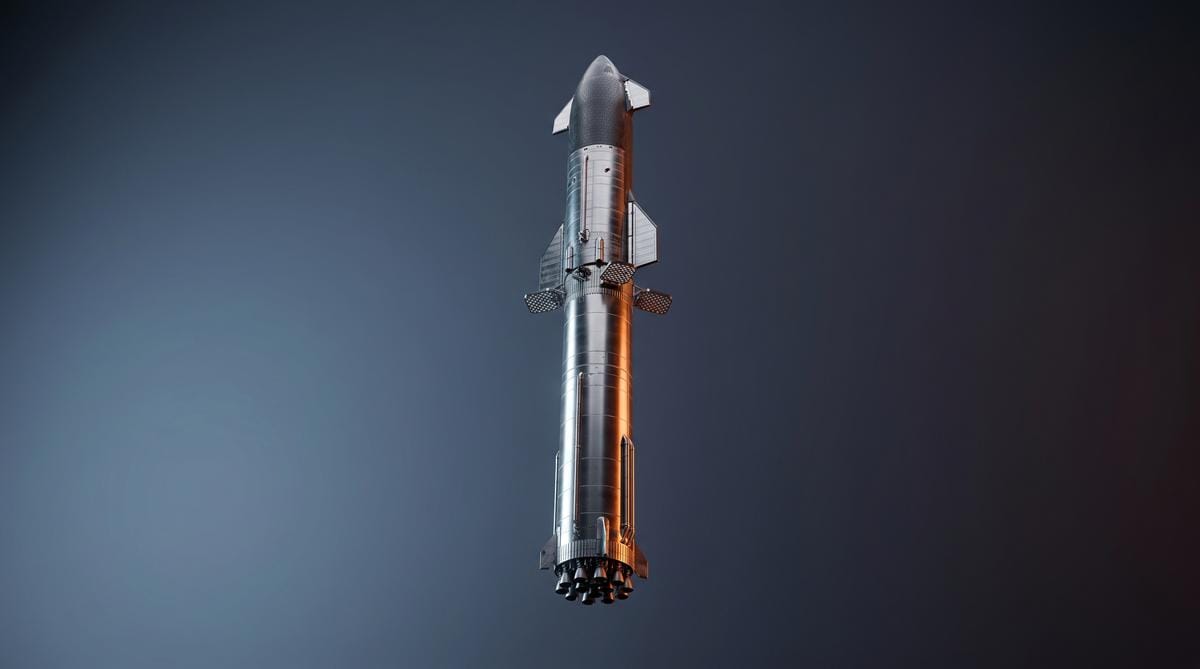
SpaceX launched the Starship V3 rocket on Friday, May 22, 2026, from the new Pad 2 launch site in Texas. This was the 12th test flight of the Starship system and the debut of the upgraded version, standing approximately 150 meters tall. The launch took place after a one-day delay caused by a malfunction in ground support systems.
TL;DR: Starship V3 launched on May 22, 2026 from the new Pad 2 in Texas. The rocket reached its planned trajectory, but the booster failed during landing. The main ship survived atmospheric reentry and exploded after splashdown. SpaceX completed most test objectives from the suborbital flight.
How Did the First Starship V3 Flight Unfold?
SpaceX launched Starship V3 on May 22, 2026, from the Boca Chica launch complex in Texas. This was the 12th test flight of the entire system and the first for the V3 version. The rocket lifted off from the new Pad 2 launch platform, marking a significant operational change from previous missions. The launch was originally scheduled for the day before, but technicians detected a ground support system malfunction and scrubbed the attempt at the last minute.
During ascent, one engine failed. Additionally, the Super Heavy booster failed its landing procedure and was destroyed during the water landing attempt. The main ship, however, reached its planned suborbital trajectory, deployed test satellites, and survived atmospheric reentry. It exploded only after splashdown. SpaceX described the flight as mostly successful, having completed the majority of planned test objectives.
How Does Starship V3 Differ from Previous Versions?
Starship V3 is a larger and more powerful version of SpaceX’s rocket. Changes to the booster design include the removal of one component, which reduces the number of parts vulnerable to failure. The rocket is taller than previous iterations and generates more thrust, enabling it to carry heavier payloads into orbit. SpaceX describes Starship V3 as the most powerful rocket in the history of spaceflight.
The V3 design features improved Raptor engines that deliver better performance and reliability. However, the failure of one engine during flight shows that the system still requires further testing. Reducing the number of structural components is a step toward simplifying production and lowering operational costs. Ars Technica notes that V3 is still a work in progress and SpaceX will continue making modifications based on data from this flight.
Why Did SpaceX Build a New Launch Pad?
The new Pad 2 launch facility at Boca Chica is SpaceX’s answer to the needs of the Starship V3 program. The previous pad was not designed to handle the larger rocket with its higher engine thrust. Pad 2 features reinforced ground infrastructure, improved sound suppression systems, and upgraded clamping mechanisms. SpaceX needed a new platform to safely conduct V3 launches.
The first launch from Pad 2 revealed issues with ground support systems that forced the scrub of the initial launch attempt. Technicians repaired the fault within a day, and the mission proceeded the following day. External sources, including SpaceNews, confirm that the new pad functioned properly during the actual launch. The problems were limited to pre-launch procedures, not the launch infrastructure itself.
What Test Objectives Did SpaceX Set?
SpaceX planned a series of test objectives for the first Starship V3 flight. The mission was suborbital, meaning the rocket did not enter Earth orbit. The main objectives included:
- Verifying Raptor engine performance in the new configuration
- Testing the booster separation procedure from the main ship
- Attempting to deploy test satellites in space
- Evaluating heat shield durability during atmospheric reentry
- Testing the booster water landing system
- Collecting telemetry data across the entire flight profile
- Verifying the new Pad 2 launch platform
- Assessing structural behavior under maximum aerodynamic load
SpaceX completed most of these objectives. The engine failure and loss of the booster during landing were the mission’s primary setbacks. The main ship executed all planned tasks through splashdown, where it exploded. According to TechCrunch, SpaceX considers this flight a milestone in the Starship development program.
What Does the Starship V3 Flight Mean for SpaceX’s IPO Plans?
SpaceX is planning to go public in the near future, and a successful Starship V3 test flight strengthens the company’s position ahead of its public debut. According to Reuters, SpaceX’s public offering is expected to be the largest in history. Successfully demonstrating the capabilities of the new rocket boosts investor confidence in the company’s technology.
The May 22 flight showed that SpaceX can design and launch increasingly large rockets, even when not every mission element ends in success. Investors evaluate space companies based on technological progress and the pace of testing. SpaceX conducts test flights on a regular basis, which speaks to the maturity of its engineering processes. Bankier.pl reports that the flight paves the way both to the stock exchange and to the NASA Artemis III mission scheduled for 2027.
What Technical Problems Occurred During the Flight?
The first Starship V3 flight was not without difficulties. During ascent, one Raptor engine failed, reducing the mission’s safety margins. The Super Heavy booster failed its water landing procedure and was destroyed. Meanwhile, the main ship survived atmospheric reentry but exploded after splashdown. Spiders Web describes it as a typical SpaceX success — full of spectacular moments with a handful of failures.
Additionally, the launch was delayed by one day due to a malfunction in ground support systems at Pad 2. Technicians detected the problem a few hours before the planned engine ignition. The repair required time, so SpaceX rescheduled the launch to May 22. Despite these issues, SpaceX described the mission as mostly successful, having collected telemetry data across the entire suborbital flight profile.
Why Does Starship V3 Matter for NASA’s Lunar Missions?
Starship V3 directly impacts NASA’s Artemis program, including the Artemis III mission planned for 2027. SpaceX is tasked with delivering a version of Starship capable of landing on the Moon and returning to Earth. Scientific American confirms that Friday’s flight represents an important milestone in preparations for this mission. NASA is watching SpaceX’s progress closely, as delays in the Starship program could affect the timeline of lunar missions.
The following table compares Starship test flights:
| Parameter | Flight 11 (V2) | Flight 12 (V3) |
|---|---|---|
| Rocket version | V2 | V3 |
| Launch pad | Pad 1 | Pad 2 |
| Flight type | Suborbital | Suborbital |
| Engine failure | No | Yes (1 engine) |
| Booster landing | Partial | Failed |
| Atmospheric reentry survival | Yes | Yes |
| Post-splashdown explosion | No | Yes |
| Objectives completed | Most | Most |
SpaceX must prove the reliability of its landing system before the Artemis III mission. A lunar landing requires precision that current tests have not yet confirmed. NASA is working with SpaceX to adapt Starship to the requirements of lunar missions, including life support systems and the lander. The outcome of the first V3 flight shows progress, but also makes clear how much work remains before a crewed mission to the Moon.
How Does Starship V3 Affect the Commercial Spaceflight Market?
Starship V3 significantly changes the dynamics of the commercial space market by dramatically increasing payload capacity to low Earth orbit. According to SpaceNews, SpaceX completed most test objectives from the suborbital flight, confirming the company’s readiness to offer new transport services. At approximately 150 meters tall, the rocket can carry satellites with a mass previously unreachable by competitors.
SpaceX plans to use Starship V3 to deploy its next-generation Starlink satellite constellation. Increased payload capacity allows hundreds of satellites to be placed in orbit simultaneously, reducing the cost per launch. The rocket could also serve as a cargo transport for future space stations.
SpaceX competitors such as Blue Origin and Rocket Lab must adapt their strategies to this new reality. Starship V3 offers specifications that exceed the capabilities of currently available rockets on the market. As a result, potential customers are considering switching to the SpaceX platform for heavier payloads.
- Launching next-generation telecommunications satellites
- Resupplying future orbital stations
- Building infrastructure for interplanetary missions
- Deorbiting old satellites and space debris
- Transporting habitat modules
- Deploying global communication systems
- Launching space telescopes
- Logistics for space tourism
When Can We Expect the Next Starship V3 Flight?
SpaceX typically conducts follow-up test flights within a few weeks of a previous mission. Ars Technica confirms that V3 is a work in progress and the company will continue making modifications based on data from the first flight. The failure of one Raptor engine and the loss of the booster are key areas requiring improvement before the next launch.
SpaceX engineers are currently analyzing telemetry data from flight number 12. Engine modifications are necessary for the unit that failed during ascent, and the booster landing procedure needs improvement. For these reasons, the next flight may not take place until late June 2026 at the earliest.
SpaceX must also prepare Pad 2 for another launch. Although the infrastructure survived the first flight without major damage, inspections and maintenance are required. Additionally, the company needs to produce additional Starship V3 units at its Boca Chica facilities.
What Are SpaceX’s Plans for the V3 Version in 2026?
SpaceX has planned a series of Starship V3 test flights for the remainder of 2026. According to TechCrunch, the company treats the first flight as a milestone in the rocket development program. Subsequent missions will include tests of booster landings on land as well as orbital flights.
SpaceX’s 2026 schedule calls for a gradual increase in mission complexity. After suborbital flights, the company plans to attempt reaching Earth orbit and returning through the atmosphere. Successfully completing these tasks opens the door to crewed missions.
SpaceX is working toward full reusability of both rocket stages. The Super Heavy booster is designed to land on a coastal platform, and the main ship at a landing site. Achieving this goal is essential for reducing launch costs and increasing flight frequency.
- Suborbital flights with booster landing
- Separation and return tests of the main ship
- Land-based landing attempts using the Mechazilla tower
- Orbital missions with a full return profile
- In-space refueling tests
- Flights with commercial payloads
- Preparations for the Artemis III mission
- Verification of life support systems
The following table outlines the planned Starship V3 test schedule for 2026:
| Quarter | Test Objective | Flight Type | Expected Outcome |
|---|---|---|---|
| Q2 2026 | Improved booster landing | Suborbital | Successful water landing |
| Q3 2026 | Orbital flight | Orbital | Orbit insertion and return |
| Q3 2026 | Land-based booster landing | Suborbital | Tower catch |
| Q4 2026 | Payload flight | Orbital | Satellite deployment |
| Q4 2026 | Refueling test | Orbital | Fuel transfer between ships |
Frequently Asked Questions
How tall is the Starship V3 rocket?
Starship V3 stands approximately 150 meters tall, making it the tallest rocket in the history of spaceflight. According to Scientific American, Friday’s launch on May 22, 2026 marked the debut of this version.
How many engines does the Super Heavy booster have in the V3 configuration?
The Super Heavy booster in the V3 configuration features Raptor engines in an arrangement modified from the V2 version. Ars Technica reports that one component was removed from the booster structure, reducing the number of parts vulnerable to failure.
Can Starship V3 be used for Mars missions?
SpaceX is designing Starship with interplanetary missions in mind, including Mars. However, Bankier.pl notes that the current test program is focused on orbital flights and the Artemis III mission planned for 2027.
When is SpaceX planning to go public?
According to Reuters, SpaceX’s public offering is expected to be the largest in history. The successful Starship V3 flight strengthens the company’s position ahead of its stock market debut, though an exact date has not yet been announced.
Summary
The first Starship V3 flight provided SpaceX with valuable data on the new rocket’s behavior under flight conditions. Here are the key takeaways:
- The rocket reached its planned suborbital trajectory despite the failure of one Raptor engine during ascent
- The Super Heavy booster was destroyed during the water landing attempt, requiring improvements before the next flight
- The main ship survived atmospheric reentry and completed all tasks through splashdown
- The new Pad 2 launch platform functioned properly during launch after the ground support system issue was repaired
- The flight represents a milestone in preparations for the NASA Artemis III mission planned for 2027
SpaceX continues developing the Starship program at a pace that commands respect across the space industry. The coming months will bring further V3 testing, including orbital flight attempts and land-based booster landings. If you are interested in space technology and artificial intelligence, stay tuned for more content on this blog. Previously, we covered SpaceX’s deal for Anthropic’s Claude computing power, as well as the new WireGuard version for Windows following Microsoft’s resolution of code signing issues.