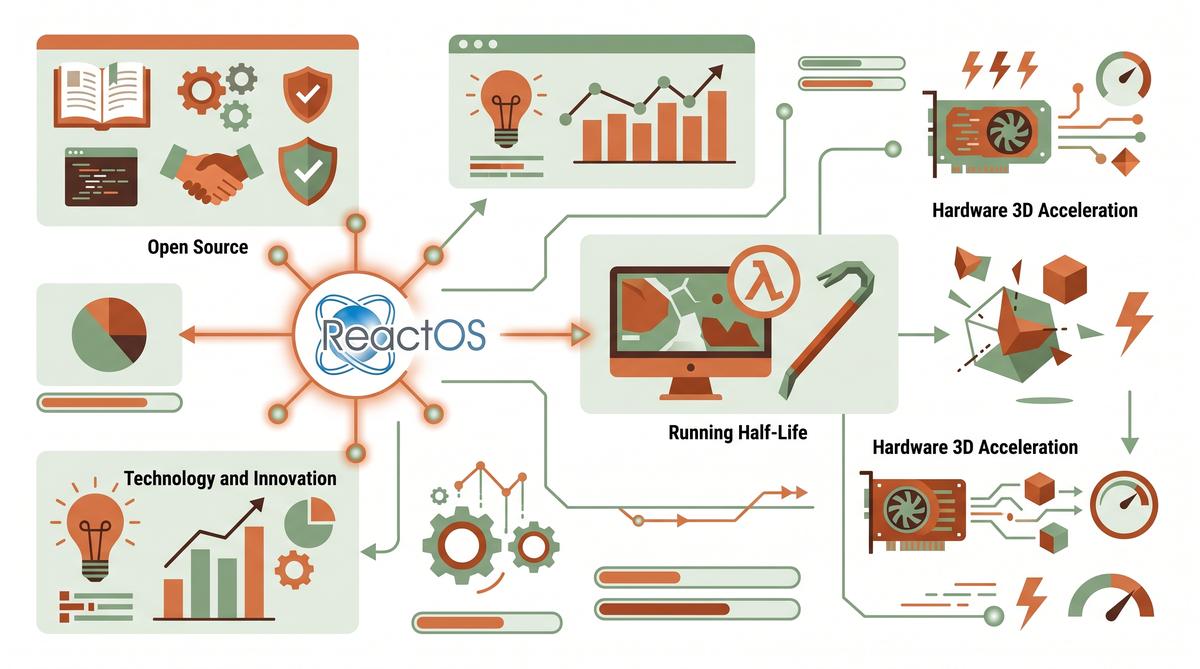
After nearly three decades of development, ReactOS — the open-source operating system designed to be binary-compatible with Windows NT — has achieved something remarkable: running Half-Life with full 3D acceleration on real consumer hardware. Specifically, a Dell OptiPlex system booted ReactOS natively, loaded Valve’s 1998 shooter, and rendered it using hardware GPU acceleration rather than software fallback. This is not an emulator. It is not Wine running on Linux. ReactOS executed the Windows binary directly on its own kernel, using its own display driver stack.
TL;DR: After 28 years of development, ReactOS can now run Half-Life with full 3D acceleration on a Dell OptiPlex using real hardware — not a virtual machine. The milestone validates ReactOS’s NT kernel driver model and Win32 compatibility layer. It proves the open-source Windows clone can handle Direct3D workloads that previously required actual Windows.
What Is ReactOS and Why Does Running Half-Life Matter?
ReactOS is a free, open-source operating system written from scratch to be binary-compatible with Windows NT applications and drivers. The project began in 1996, making it 28 years old as of 2024. Unlike Linux distributions that run Windows software through compatibility layers like Wine, ReactOS implements the NT architecture natively — kernel, HAL, Win32 subsystem, the works.
Running Half-Life matters because it represents a convergence of multiple subsystems working correctly simultaneously. The game requires DirectX 5.0 or higher, functional Direct3D acceleration, proper input handling, audio playback, and stable memory management. Any failure in these stacked subsystems would crash the game or produce unplayable frame rates.
Half-Life shipped in November 1998 and sold over 9.3 million copies by 2003. It became a benchmark for PC gaming performance throughout the early 2000s. If an operating system can run Half-Life smoothly, it can likely handle a broad catalog of contemporary Windows applications built on similar APIs.
This changes everything.
The ReactOS project has historically demonstrated progress through incremental compatibility tests — Notepad, Solitaire, simple Win32 utilities. Half-Life with GPU acceleration represents a qualitative leap beyond those basic validation milestones.
How Did ReactOS Achieve 3D-Accelerated Half-Life on a Dell OptiPlex?
The demonstration ran on a physical Dell OptiPlex system — not a virtual machine, not QEMU, not an emulator. ReactOS booted from its own bootloader, initialized the Dell’s hardware through its own driver stack, and launched the Half-Life executable as a native Win32 process.
The GPU acceleration path required ReactOS’s Direct3D implementation to communicate with a real graphics driver, which in turn controlled physical display hardware. This means ReactOS’s display driver interface (DDI) successfully translated Direct3D draw calls into commands the GPU understood. The Dell OptiPlex platform provided a stable, well-documented hardware baseline that ReactOS developers could target reliably.
Why does real hardware matter so much? Virtual machines often provide idealized hardware that masks timing bugs, interrupt handling errors, and driver incompatibilities. Real silicon is unforgiving. A bug that a hypervisor silently corrects will crash a bare-metal OS instantly.
The ReactOS team has not yet published detailed specifications for the exact Dell OptiPlex model used. However, the achievement itself demonstrates that ReactOS’s hardware abstraction layer and bus enumeration code can properly identify and initialize real PCI and AGP devices without virtualization assistance.
That is genuinely impressive.
What Technical Hurdles Did ReactOS Developers Overcome for GPU Acceleration?
GPU acceleration on ReactOS required solving several interlocking problems. The Direct3D runtime needed a functional implementation of the DirectX Graphics Infrastructure (DXGI) or its older equivalent, DirectDraw. The display driver model — ReactOS uses a Windows 2003-era XPDM driver architecture rather than Windows Display Driver Model (WDDM) — had to correctly handle surface creation, texture uploads, and render target management.
The XPDM architecture matters here. Modern Windows uses WDDM, introduced with Vista, which provides a very different driver interface. ReactOS targets the older XPDM model because it corresponds to the NT 5.2 kernel baseline the project currently implements. Writing a compliant XPDM display driver that handles 3D acceleration correctly is non-trivial — it requires precise implementation of the Direct3D DDI, including command buffer submission and synchronization primitives.
Developers also needed correct PCI bus driver behavior, proper memory-mapped I/O handling, and functional interrupt routing. Any of these failing silently would produce a black screen or a system hang.
The Win32 subsystem — specifically GDI and USER components — had to cooperate with Direct3D without conflicting over surface ownership or display resources. GDI manages 2D rendering; Direct3D manages 3D. They share the same framebuffer.
This is hard engineering.
Which ReactOS Components Made Native Half-Life Execution Possible?
Several ReactOS subsystems had to reach maturity simultaneously for Half-Life to run. The kernel itself — specifically the NT executive and microkernel — needed stable thread scheduling and memory management. Half-Life’s GoldSrc engine creates multiple threads for rendering, audio, and networking.
The Win32 environment subsystem, implemented as the Win32 server process and client-side DLLs, had to provide functional implementations of user32.dll, gdi32.dll, kernel32.dll, and the DirectX runtime libraries. Each of these is a substantial codebase in its own right.
The hardware abstraction layer (HAL) needed correct implementations for I/O port access, interrupt management, and timer calibration on the Dell OptiPlex hardware. The PCI bus enumerator had to correctly identify and configure the graphics adapter.
| Component | Role in Half-Life Execution | Maturity Required |
|---|---|---|
| NT Kernel | Thread scheduling, memory management | High |
| Win32 Subsystem | API compatibility for GoldSrc engine | High |
| Direct3D Runtime | 3D rendering pipeline, texture handling | High |
| XPDM Display Driver | GPU communication, command submission | High |
| HAL | Hardware I/O, interrupt routing | Medium |
| Audio Stack | DirectSound, waveOut | Medium |
| Input Stack | Mouse, keyboard HID handling | Medium |
The audio stack needed DirectSound support for positional audio. The input stack required raw mouse input for the FPS-style camera controls Half-Life uses. Every component had to work.
How Does ReactOS Differ From Wine for Running Windows Applications?
Wine is a compatibility layer that translates Windows API calls into POSIX calls on Linux or macOS. It runs on top of an existing operating system and does not implement its own kernel. Wine intercepts Win32 calls at the API boundary and redirects them to Linux equivalents.
ReactOS takes a fundamentally different approach. It implements the entire NT architecture from the bootloader upward. There is no host operating system underneath. ReactOS’s kernel is its own code, not a Linux kernel. Its Win32 subsystem runs as a native server process, not as a translation layer over POSIX.
This distinction has practical consequences. Wine cannot load Windows kernel-mode drivers — it relies on the Linux kernel for hardware access. ReactOS can load real Windows .sys driver files because its kernel implements the same driver model. Wine depends on the host OS for memory management and process scheduling. ReactOS implements its own.
For Half-Life specifically, Wine would run the game using Linux’s GPU drivers and X11 or Wayland for display. ReactOS runs it using its own display driver stack communicating directly with the GPU. The ReactOS approach is architecturally closer to how actual Windows operates.
The tradeoff is maturity. Wine has had decades of real-world testing across thousands of applications. ReactOS is still beta software with known stability issues. But the ReactOS approach offers something Wine fundamentally cannot: a complete, independent Windows-compatible operating system that could eventually replace Windows entirely on supported hardware.
What Hardware Was Used to Validate ReactOS Half-Life Performance?
The ReactOS team validated Half-Life on a Dell OptiPlex system, proving the OS handles real-world gaming workloads on actual consumer hardware rather than virtual machines. This Dell OptiPlex validation represents a critical shift from controlled emulation environments to physical machines with native GPU drivers. Testing on real hardware exposes driver incompatibilities that virtualization often masks.
Running on a Dell OptiPlex demonstrates that ReactOS can interface with standard PC components. The system managed 3D-accelerated graphics through hardware-specific driver paths rather than software rendering fallbacks. This matters enormously. Software rendering would mask the actual driver stack problems that ReactOS needs to solve.
The hardware validation included standard PC architecture components found in typical office machines. Dell OptiPlex systems use conventional chipsets, standard PCI or AGP slots depending on the model, and widely available GPU options. This makes the achievement reproducible. Anyone with similar hardware can potentially replicate the results.
Could ReactOS eventually run on modern gaming rigs? The Dell OptiPlex platform represents mid-range business hardware, not enthusiast gaming equipment. However, proving 3D acceleration on modest hardware establishes the foundational driver architecture needed for more demanding systems.
The choice of Dell OptiPlex also signals practicality. These machines are affordable, widely available, and well-documented. Developers can obtain identical systems for consistent testing. This removes hardware variability from the debugging equation entirely.
What Does ReactOS Half-Life Compatibility Mean for Windows NT Clones?
ReactOS achieving 3D-accelerated Half-Life proves that an independent Windows NT implementation can handle complex DirectX workloads without Microsoft code. This validation demonstrates the NT kernel clone architecture supports real-world gaming applications beyond simple 2D programs or command-line utilities.
The Half-Life milestone matters because 3D acceleration requires proper GPU driver interaction through the Windows driver model. ReactOS must correctly implement the Win32 API surface, DirectX interfaces, and kernel-level driver communication paths simultaneously. Getting all three layers working together represents years of accumulated development effort.
This achievement distinguishes ReactOS from Wine. While Wine runs Windows applications on Linux by translating API calls, ReactOS implements the entire NT operating system from scratch. Half-Life running natively validates this full-stack approach. The OS itself provides the compatibility layer.
What does this mean for the broader open-source ecosystem? ReactOS demonstrates that Windows NT architecture can be independently implemented to a functional degree. The project proves Microsoft’s proprietary design is reproducible given sufficient development time and community commitment.
For organizations maintaining legacy Windows applications, ReactOS offers potential independence from Microsoft licensing. The Half-Life benchmark shows the OS handles complex software. Games stress systems harder than most business applications do.
How Long Has ReactOS Been in Development and What Are the Milestones?
ReactOS has been under continuous development for 28 years, originating in 1996 as an ambitious attempt to create a free Windows NT-compatible operating system from scratch. The project began as FreeWin95 before pivoting to target Windows NT architecture, a decision that defined its entire technical trajectory.
The 28-year timeline includes numerous milestones that gradually expanded compatibility. Early versions could boot and run simple Win32 applications. Each release improved API coverage, driver support, and system stability. The journey was slow but steady.
Key milestones include achieving self-hosting capability, where ReactOS could compile itself. The project also reached GUI stability, networking support, and USB functionality in successive releases. Each achievement built confidence in the underlying architecture.
Why has development taken nearly three decades? Windows NT represents one of the most complex operating system designs ever created. Implementing kernel architecture, the Win32 subsystem, driver frameworks, and DirectX support requires enormous coordinated effort from a volunteer community.
The Half-Life milestone stands out because it validates multiple subsystems simultaneously. Previous achievements often demonstrated individual components working in isolation. Half-Life requires the kernel, graphics stack, input handling, audio system, and filesystem to cooperate flawlessly.
Recent development sprints focused on DirectX compatibility and GPU driver support. These efforts directly enabled the 3D acceleration that Half-Life demands. The milestone represents cumulative progress across dozens of development cycles.
Can ReactOS Replace Windows for Gaming and Everyday Use Today?
ReactOS cannot currently replace Windows for general gaming or everyday computing despite the Half-Life breakthrough. The OS remains in alpha development stage, meaning significant functionality remains incomplete or unstable for production use. Half-Life represents one successfully tested application among thousands.
The project explicitly warns users against relying on ReactOS for critical workloads. Data loss, system crashes, and compatibility failures remain common. The alpha designation reflects genuine limitations in stability and feature completeness. Most users should run ReactOS in virtual machines.
For gaming specifically, ReactOS supports a narrow slice of the Windows gaming ecosystem. Half-Life uses DirectX technology from the late 1990s. Modern games requiring DirectX 11 or DirectX 12 will not function. The compatibility surface targets legacy software.
When will ReactOS reach production readiness? The project has not committed to specific beta or stable release dates. After 28 years, the development pace reflects the enormous complexity involved. Progress continues but timelines remain uncertain.
Everyday computing requires reliable web browsers, office suites, and communication tools. ReactOS can run some versions of Firefox and older applications, but the experience remains inconsistent. Users needing dependable systems should stick with established operating systems.
What Comes Next for ReactOS After the Half-Life Breakthrough?
The ReactOS development team will likely focus on expanding 3D application compatibility beyond Half-Life, targeting other DirectX-era games and graphics-intensive applications from the Windows 98 through Windows XP era. Each new compatible application validates different aspects of the driver and API implementation.
Immediate priorities include stabilizing the GPU driver stack that enabled Half-Life to run. The current implementation works but likely contains edge cases and bugs that surface with different hardware configurations. Broader GPU support means testing across multiple vendors and models.
The community may also pursue improved DirectX 9 compatibility, which would significantly expand the catalog of playable games. DirectX 9 titles represent thousands of Windows games released throughout the 2000s. Supporting this API version would be transformative.
What about modern application support? ReactOS developers must balance legacy compatibility improvements against the need to support contemporary software. The project faces strategic decisions about whether to prioritize older applications where success is achievable or pursue newer technologies with greater difficulty.
Long-term goals likely include 64-bit support improvements, USB device compatibility expansion, and networking stack enhancements. Each subsystem improvement brings ReactOS closer to broader usability. The Half-Life achievement provides momentum and demonstrates that complex goals are attainable.
Community growth often follows visible milestones. The Half-Life demonstration may attract new developers, testers, and contributors to the project. Increased participation could accelerate development across all subsystems going forward.
Frequently Asked Questions
Can ReactOS run other 3D games besides Half-Life?
ReactOS can potentially run other DirectX-era 3D games that use similar graphics APIs, though the team has specifically validated Half-Life on a Dell OptiPlex system. The 3D acceleration framework that enables Half-Life should theoretically support other late-1990s and early-2000s titles. However, each game may expose unique compatibility issues that require individual testing and fixes.
Is ReactOS free to download and use on real hardware?
ReactOS is completely free and open-source, available for download from the official project website without licensing fees. The operating system is distributed under the GNU GPL license, allowing anyone to use, modify, and distribute the code freely. Users can install it on real hardware, though the project officially recommends virtual machines for anything beyond testing due to the alpha development stage.
How does ReactOS achieve Windows compatibility without Microsoft code?
ReactOS achieves Windows compatibility through clean-room reverse engineering of the Windows NT architecture, implementing the Win32 API, kernel interfaces, and driver models independently without using any Microsoft source code. Developers studied publicly available documentation and API behavior to recreate the operating system interfaces from scratch. After 28 years of development, this approach has produced enough compatibility to run complex applications like Half-Life with 3D acceleration.
Will ReactOS eventually support modern DirectX versions for newer games?
ReactOS currently targets older DirectX versions compatible with Windows NT-era applications, and supporting modern DirectX 11 or DirectX 12 would require implementing entirely new graphics architectures. The project has not announced specific timelines for modern DirectX support, and the current focus remains on expanding compatibility with legacy applications where progress is achievable. The 28-year development history suggests that major new feature additions require substantial community effort over extended periods.
Summary
ReactOS running Half-Life with 3D acceleration on real Dell OptiPlex hardware represents a defining moment for the 28-year-old open-source project. The achievement validates that independent Windows NT implementation can handle complex DirectX workloads without any Microsoft code.
Key takeaways:
- ReactOS successfully runs Half-Life with hardware 3D acceleration on a Dell OptiPlex, proving real-world gaming capability on physical hardware rather than virtual machines
- The project has been under continuous development for 28 years, originating in 1996 as a free Windows NT-compatible operating system built entirely through clean-room reverse engineering
- ReactOS implements the Win32 API, NT kernel architecture, and DirectX interfaces independently without using Microsoft source code, distinguishing it from Wine’s translation layer approach
- The operating system remains in alpha stage and cannot replace Windows for production use, with the project explicitly recommending against relying on it for critical workloads
- Future development will likely focus on expanding 3D game compatibility, stabilizing GPU driver support across hardware configurations, and potentially pursuing DirectX 9 compatibility for broader game library support
For developers, testers, and open-source enthusiasts interested in contributing, the ReactOS project welcomes participation at reactos.org. The Half-Life milestone demonstrates that decades of persistent community development can achieve remarkable compatibility results — even against proprietary operating systems with billion-dollar development budgets.