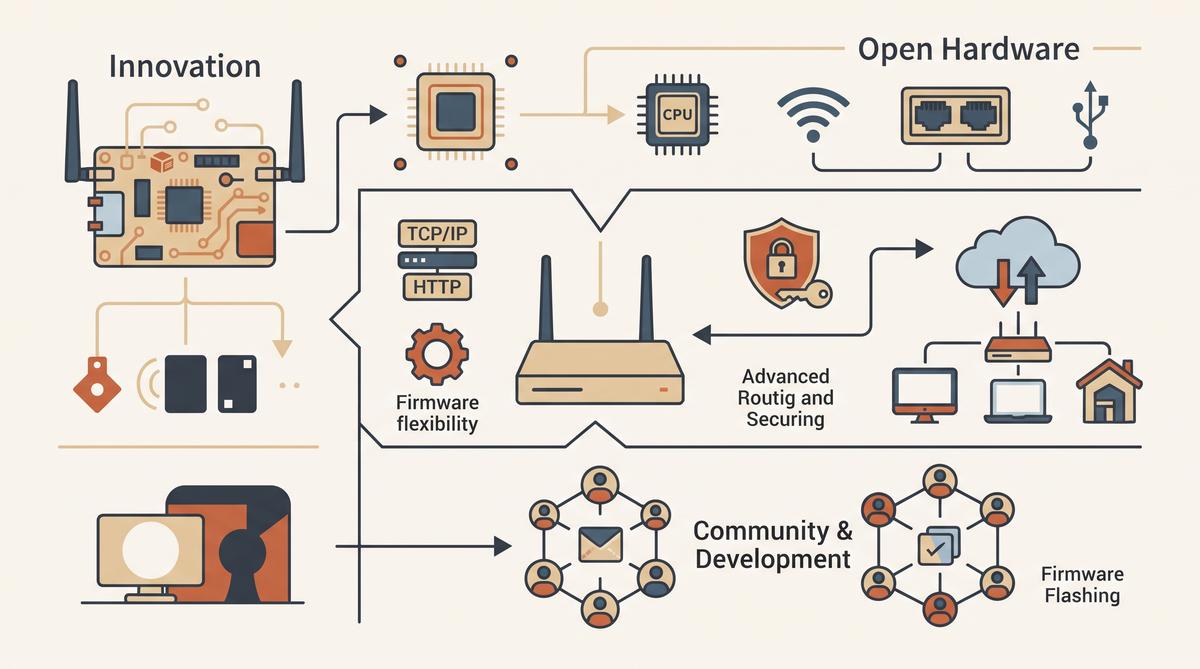
OpenWrt developers closed critical vulnerabilities in version 25.12.5, patching remote-exploitable flaws in the DHCP service odhcpd and multiple privilege escalation bugs in the LuCI web interface (heise online, 2025). Against this backdrop of active security maintenance, the OpenWrt One emerges as the first router designed from silicon up for open-source firmware. It ships with full schematics and no vendor-imposed restrictions.
TL;DR: The OpenWrt One is the first router designed specifically for open-source firmware, offering full hardware schematics and eliminating vendor lock-in. OpenWrt 25.12.5 patches critical vulnerabilities in the odhcpd DHCP service and multiple LuCI privilege escalations (heise online, 2025). This combination of open hardware and actively maintained firmware sets a new standard for network security and user control.
What Is the OpenWrt One and Why Does It Matter?
The OpenWrt One represents the first router hardware built in direct collaboration with the OpenWrt project, featuring a MediaTek MT7981B SoC running at 1.3 GHz alongside 1 GB of DDR4 RAM (1023 Jack, 2025). Unlike typical consumer routers, every hardware schematic and design document is published under open licenses. Anyone can inspect, modify, or reproduce the board design.
This matters because router vendors routinely abandon firmware updates within two to four years of a product launch. The OpenWrt One eliminates that dependency entirely. The hardware documentation allows independent developers to write, audit, and maintain firmware indefinitely. No proprietary driver blobs lock users into a specific software branch.
The device ships with OpenWrt pre-installed. Users do not need to flash custom firmware or risk bricking their hardware during installation. The router functions immediately out of the box with full OpenWrt support. Why is this significant? Because the OpenWrt project maintains the firmware actively, releasing security patches like version 25.12.5 that address critical DHCP and LuCI vulnerabilities (heise online, 2025).
Open hardware also means repairability. Technicians can trace circuits using published schematics. Independent shops can diagnose faults without relying on manufacturer service manuals. The board layout, bill of materials, and mechanical drawings are all publicly accessible documents.
How Does the OpenWrt One Compare to Consumer Routers?
Consumer routers from major brands like TP-Link, Netgear, and Asus typically ship with closed-source firmware that receives updates for only two to four years. The OpenWrt One breaks this model entirely. It runs OpenWrt out of the box, with the full weight of the open-source community behind ongoing maintenance.
Most consumer routers lock down their bootloaders. The OpenWrt One provides open bootloader access. Users can install any compatible firmware build without fighting cryptographic signature checks or locked boot chains. This is fundamental freedom.
The security difference is measurable. OpenWrt 25.12.5 patched remote-exploitable vulnerabilities in odhcpd and multiple privilege escalation flaws in the LuCI administrative interface (heise online, 2025). Consumer routers with similar DHCP implementations from proprietary vendors may never receive equivalent patches. The OpenWrt One guarantees long-term patch availability through community governance.
| Feature | OpenWrt One | Typical Consumer Router |
|---|---|---|
| Firmware | OpenWrt (pre-installed) | Proprietary vendor firmware |
| Schematics | Fully published | Closed source |
| Update lifespan | Community-maintained (indefinite) | 2-4 years typical |
| Bootloader | Unlocked | Often locked |
| Security patches | 25.12.5 patches odhcpd and LuCI (heise online, 2025) | Vendor-dependent |
Performance hardware in the OpenWrt One matches mid-range consumer offerings. The MediaTek MT7981B handles gigabit routing and basic VPN workloads without bottlenecking typical home internet connections.
What Hardware Powers the OpenWrt One?
The OpenWrt One is built around the MediaTek MT7981B (Filogic 820) system-on-chip, running a dual-core ARM Cortex-A53 processor at 1.3 GHz (1023 Jack, 2025). This silicon provides modern Wi-Fi 6 connectivity with 2x2 MIMO support on both 2.4 GHz and 5 GHz bands. The SoC includes hardware acceleration for NAT routing.
Memory configuration includes 1 GB of DDR4 RAM and 128 MB of NAND flash storage. The generous RAM allocation allows running additional OpenWrt packages simultaneously. Users can install ad-blocking software, VPN clients, intrusion detection systems, and traffic analysis tools without memory constraints.
Physical connectivity includes one 2.5 Gbps Ethernet port and three gigabit Ethernet ports. The 2.5 Gbps WAN port handles modern multi-gigabit internet connections. A USB 3.0 port enables external storage or 4G/5G modem connectivity for failover scenarios.
Power consumption is modest. The device draws approximately 8 watts under typical load. Passive cooling eliminates fan noise entirely. This makes the router suitable for deployment in living spaces or quiet office environments.
The IEEE 802.3at Power over Ethernet support allows flexible placement. A single Ethernet cable provides both data and power. Mounting the router on ceilings or walls becomes trivial. No nearby power outlet is required.
Why Does Open-Source Router Firmware Matter for Security?
Open-source firmware matters because security vulnerabilities get found and patched faster. OpenWrt 25.12.5 demonstrates this directly: the update closes critical holes in the odhcpd DHCP service that were remotely exploitable, plus multiple privilege escalation bugs in the LuCI web interface (heise online, 2025). Independent researchers can audit every line of code.
Proprietary router firmware operates as a black box. Users cannot verify what data the router collects, what backdoors exist, or whether vulnerabilities remain unpatched. The OpenWrt One eliminates this opacity completely. Every component is auditable.
The OpenWrt project maintains a public vulnerability disclosure process. Security advisories document exactly what flaws exist, how they are exploited, and which versions contain the fixes. This transparency allows network administrators to make informed risk decisions.
Key security advantages of open-source router firmware include:
- Public code auditability: Any researcher can review the LuCI interface code for privilege escalation flaws, leading to faster discovery and patching (heise online, 2025)
- Rapid patch deployment: OpenWrt 25.12.5 shipped fixes for odhcpd and LuCI vulnerabilities promptly after discovery (heise online, 2025)
- No hidden telemetry: The firmware contains no undisclosed data collection mechanisms that compromise user privacy
- Community vulnerability reporting: Multiple independent security researchers continuously test the firmware for weaknesses
- Cryptographic package verification: All installed packages are signed and verified to prevent supply chain attacks
- Configurable firewall rules: Full nftables support allows granular control over network traffic filtering
- Isolated guest networks: Built-in support for VLAN segmentation separates guest traffic from private networks
- Long-term maintenance: The OpenWrt community supports hardware far longer than typical vendor lifecycles
The OpenWrt One hardware amplifies these advantages. Open schematics mean security researchers can analyze the hardware layer for vulnerabilities. Proprietary routers often contain undocumented hardware features or debug interfaces that could serve as attack vectors.
What Critical Vulnerabilities Did OpenWrt 25.12.5 Fix?
OpenWrt version 25.12.5 addresses several critical security vulnerabilities that were partially exploitable remotely, directly affecting central network services. The update patches a critical flaw in the DHCP service daemon known as odhcpd, alongside multiple privilege escalation vulnerabilities found in the LuCI web interface. These flaws could allow attackers to gain root access to affected routers. The risk is severe.
The DHCP vulnerability in odhcpd represents a particularly dangerous threat because the service handles IP address assignment for every device on the local network. Attackers could potentially exploit this weakness from a remote location without requiring authentication credentials. This means any exposed router running an older firmware version remains vulnerable to external attacks. Network administrators should treat this patch as urgent.
Beyond the DHCP daemon issues, the LuCI web interface vulnerabilities involve multiple privilege escalation paths that could grant unauthorized administrative access. LuCI serves as the primary configuration interface for OpenWrt installations worldwide, making these privilege escalations especially concerning for daily operations. When combined, these security gaps create multiple attack surfaces that threaten router integrity. The 25.12.5 release systematically closes these entry points.
Security researchers emphasize that despite the routine version number increment, this update demands immediate deployment across all supported devices. The vulnerabilities patched in this release affect fundamental networking components that handle critical infrastructure tasks within home and enterprise environments alike. Delaying installation leaves networks exposed to potential compromise through well-documented attack vectors. Prompt updating eliminates these known risks entirely.
How Does the OpenWrt One Handle Updates and Long-Term Support?
The OpenWrt One receives direct firmware support from the official OpenWrt project, ensuring continuous security patches like the critical 25.12.5 update that fixed remotely exploitable DHCP vulnerabilities. Because the hardware specifications are fully documented and open, the OpenWrt community can maintain the device without relying on a single vendor for binary blobs or proprietary drivers. This guarantees longevity.
Traditional consumer routers typically stop receiving updates within two to three years of release, leaving millions of devices permanently exposed to known security flaws. The OpenWrt One breaks this cycle by existing as a fully documented platform where the community itself can write and maintain drivers. Even if the original manufacturer discontinues involvement, the open-source community can continue supporting the hardware independently. This fundamentally shifts the support model.
The device ships with a recent OpenWrt release pre-installed and configured for seamless over-the-air updates through the LuCI web interface. Users receive notifications when new security patches become available, and installation requires just a few clicks. There are no forced reboots or bloatware installations commonly found in proprietary router firmware. Updates respect user control completely.
For long-term viability, the MediaTek MT7981B chipset used in the OpenWrt One has already accumulated mature upstream support in the Linux kernel. This means kernel updates flow naturally to the device without requiring special patches or community reverse-engineering efforts. The open-hardware approach ensures the router remains functional and secure for years beyond typical industry support windows.
Who Should Buy the OpenWrt One?
The OpenWrt One targets networking enthusiasts, privacy advocates, and security-conscious users who want complete control over their home network infrastructure. Priced at approximately $89, the device appeals to individuals frustrated by the opaque firmware and limited update lifecycles of mainstream consumer routers from traditional manufacturers. It fills a specific niche.
Small business operators and homelab enthusiasts represent another core audience for this device. The ability to run custom packages, configure VLANs through LuCI, and implement advanced firewall rules makes the OpenWrt One suitable for environments where network segmentation and traffic control matter deeply. Developers who need a reliable platform for testing networking concepts also benefit from the fully documented hardware architecture. The router serves as a learning tool.
Privacy advocates appreciate the OpenWrt One because the open-source firmware contains no telemetry, no vendor data collection, and no hidden cloud connectivity features that phone home with usage statistics. Every component running on the device can be audited, modified, or removed by the user. For households concerned about surveillance capitalism embedded in consumer networking equipment, this router offers genuine transparency. Nothing operates in the shadows.
However, casual users who simply want plug-and-play simplicity may find the OpenWrt ecosystem initially intimidating despite the accessible LuCI interface. The device shines brightest for those willing to explore advanced networking concepts and take responsibility for their own infrastructure security. Users comfortable with technical configuration will find tremendous value here.
What Are the Limitations of the OpenWrt One?
The OpenWrt One ships without built-in Wi-Fi capability, requiring users to add a wireless card separately or rely on a dedicated access point for wireless connectivity. This design decision keeps the base hardware cost low and avoids the rapid obsolescence of integrated wireless chips. However, it adds complexity for users wanting an all-in-one solution.
The MediaTek MT7981B SoC with 1 GB of DDR4 RAM provides competent performance for typical home routing tasks but falls short of enterprise-grade throughput for demanding scenarios like multi-gigabit VPN tunnels. Users with internet connections exceeding one gigabit per second or those running intensive network services may encounter bottlenecks during heavy workloads. The hardware targets realistic home environments.
Advanced features like hardware-accelerated cryptography are limited compared to higher-end commercial routers equipped with dedicated security processors. While the OpenWrt One handles standard encryption protocols adequately for residential use, power users running site-to-site VPNs at high speeds might notice performance constraints. The device prioritizes open documentation over raw computational power. This tradeoff defines the platform.
Additionally, the OpenWrt ecosystem lacks the polished mobile applications and cloud management portals that accompany premium consumer routers from brands like ASUS or Netgear. Configuration happens primarily through the LuCI web interface, which assumes a degree of technical literacy. Beginners may face a learning curve when setting up features beyond basic internet connectivity. The interface rewards patience.
The 32 MB SPI-NAND flash storage, while larger than many legacy routers, still constrains how many additional packages users can install simultaneously. Running resource-heavy services like intrusion detection systems or ad-blocking proxies alongside standard routing functions requires careful storage management. Users must prioritize their installed software.
How Does OpenWrt One Fit Into the Broader Open-Hardware Movement?
The OpenWrt One represents a significant milestone in the open-hardware movement, demonstrating that networking equipment can be fully documented, community-supported, and commercially viable simultaneously. Developed through collaboration between the OpenWrt project and Banana Pi, the router proves that transparent hardware design works in real-world products. It challenges industry norms directly.
The broader open-hardware movement has historically focused on single-board computers like the Raspberry Pi and Arduino microcontrollers, leaving networking equipment largely in proprietary territory. The OpenWrt One bridges this gap by applying open-hardware principles to a device category that handles critical infrastructure. Every schematic, bill of materials, and design document is publicly available for community review and modification. Transparency extends to every component.
This approach matters because routers sit at the boundary between private networks and the public internet, making them prime targets for surveillance and compromise. Proprietary firmware running on undocumented hardware creates trust issues that open hardware directly addresses. By making every hardware specification verifiable, the OpenWrt One enables independent security audits and community-driven improvements that closed systems cannot match. Trust becomes verifiable.
The device also inspires similar initiatives across the networking industry, encouraging other manufacturers to consider more transparent approaches to hardware design. As consumers become increasingly aware of privacy and security implications in connected devices, demand for verifiable open hardware will likely grow. The OpenWrt One positions itself as an early example of what community-driven networking hardware can achieve. It sets a concrete precedent.
Frequently Asked Questions
Is the OpenWrt One difficult to set up for beginners?
The OpenWrt One ships with OpenWrt firmware pre-installed, so basic setup requires only connecting cables and configuring your internet connection through the LuCI web interface. However, the LuCI interface had multiple privilege escalation vulnerabilities patched in version 25.12.5, highlighting why understanding the update process matters. Beginners comfortable with basic router configuration should manage fine, though advanced features demand more networking knowledge.
Can I install other firmware like DD-WRT on the OpenWrt One?
The OpenWrt One was designed specifically for OpenWrt firmware, and its open-hardware documentation primarily supports the OpenWrt ecosystem. Because the LuCI web interface and odhcpd DHCP service receive active security patches like the critical fixes in version 25.12.5, staying within the OpenWrt ecosystem ensures the most stable and secure experience. Alternative firmware compatibility depends entirely on community development efforts for this specific hardware platform.
Does the OpenWrt One support Wi-Fi 7?
The OpenWrt One does not include integrated Wi-Fi capability at all, as it ships without wireless networking hardware to keep costs down and avoid rapid chip obsolescence. Users must add wireless functionality through a separate PCIe Wi-Fi card or connect a dedicated access point. The MediaTek MT7981B SoC focuses on wired routing performance rather than wireless standards.
How often does OpenWrt receive security updates?
OpenWrt receives security updates as vulnerabilities are discovered and patched, with the recent 25.12.5 release addressing critical flaws in the odhcpd DHCP service and multiple LuCI privilege escalation issues. These particular vulnerabilities were partially exploitable remotely, making the update urgent despite its routine version number appearance. The OpenWrt project does not follow a fixed release schedule but pushes patches whenever significant security issues require attention.
Summary
- Security-first design: OpenWrt 25.12.5 patches critical remotely exploitable vulnerabilities in odhcpd and LuCI, demonstrating the project’s commitment to rapid security response across central network components.
- Open hardware advantage: Full documentation of every component enables community-driven long-term support that outlasts typical vendor support windows for consumer networking equipment.
- Target audience: The OpenWrt One serves networking enthusiasts, privacy advocates, and security-conscious users willing to embrace configuration complexity for complete transparency and control.
- Intentional tradeoffs: No built-in Wi-Fi and modest hardware specifications reflect deliberate design choices prioritizing open documentation over feature density.
- Broader impact: The device proves open-hardware networking products can reach commercial viability, challenging the proprietary firmware model dominant in the router industry.
If this deep dive into the OpenWrt One sparked your interest, consider supporting open-hardware initiatives or exploring the OpenWrt ecosystem for your own network. The future of trustworthy networking starts with transparent design choices.