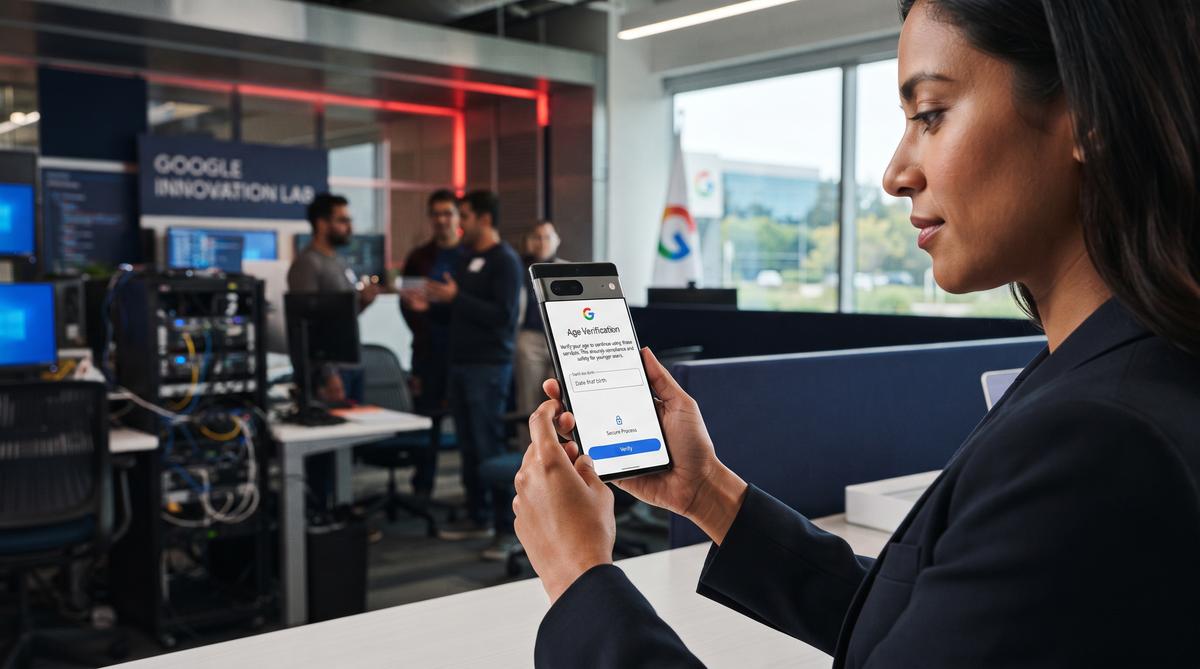
Google announced on July 29, 2026 that its Play Age Signal API will reach Android users worldwide by the end of 2026. The system lets apps request a user’s age range without collecting government IDs or requiring selfie verification. Brazil already runs the technology in production, with Australia and Canada joining in August 2026.
TL;DR: Google will expand its Play Age Signal API to Android users worldwide by the end of 2026, letting apps request age ranges without requiring ID uploads or selfies. The API relies on user-provided data and Family Link signals. Rollouts begin in August 2026.
What Is Google’s Play Age Signal API and How Does It Work?
The Play Age Signal API is a developer-facing interface that provides age estimation data to Android applications without requiring identity documents. Google launched the API in beta last year, allowing developers to request an age range rather than a specific birth date. The system returns a categorical signal — not a verified identity — so apps can adjust content accordingly. No ID required.
According to Dataconomy’s July 30, 2026 report, the API draws from multiple Google account signals to estimate a user’s age bracket. Developers receive a response indicating whether a user falls into ranges like “under 18,” “18 to 24,” or “25 and older.” The exact granularity depends on available data. Apps cannot access the user’s birthday through this interface.
The Indian Express confirmed on July 30, 2026 that the API does not require selfie verification or government-issued identification. Instead, Google synthesizes age signals from account information already present in its ecosystem. This approach reduces friction for users who would otherwise abandon apps demanding document uploads.
For developers, integration involves calling the Play Services API and handling the returned age signal. Google handles all data processing on its servers. Third-party apps never see the raw inputs — only the final age-range result.
When Will the Global Rollout Reach Android Users?
Google’s global rollout of the Play Age Signal API begins in August 2026 and completes by the end of that year. TechCrunch reported on July 29, 2026 that Brazil currently runs the system in production. Australia and Canada will join the rollout in August 2026 as the next phase of expansion.
The phased approach lets Google validate the API across different regulatory environments before scaling globally. Equitypandit noted on July 30, 2026 that the expansion targets all Android markets where Google Play operates. Developers in supported regions can begin integrating the API through Google Play Services.
PurePC.pl reported on July 30, 2026 that the global launch timeline aligns with increasing regulatory pressure from governments demanding age verification on digital platforms. The European Union’s Digital Services Act and similar legislation in the United Kingdom have accelerated demand for privacy-preserving age estimation tools.
Google has not published a specific country-by-country rollout calendar beyond the August 2026 expansion. However, the company confirmed that all supported Play Store markets will receive the API by December 31, 2026. Developers should monitor the Google Play Console for availability in their regions.
Why Is Google Replacing Traditional Age Verification Methods?
Google is replacing traditional age verification methods because document-based checks create privacy risks and user friction. Instalki.pl reported on July 30, 2026 that Google designed the API specifically so app developers would not need to build their own age-check mechanisms — many of which require scanning government IDs or performing facial recognition.
Traditional methods force users to photograph driver’s licenses or passports. This creates centralized databases of sensitive documents across dozens of app providers. Each database becomes a target for breaches. The Play Age Signal API eliminates that risk by keeping all age-related data within Google’s infrastructure.
Telix.pl noted on July 30, 2026 that Google’s approach shifts verification responsibility from individual developers to the platform itself. Apps receive only the minimum data needed — an age range — without ever handling identity documents. This reduces compliance burden under GDPR, CCPA, and children’s privacy regulations like COPPA.
The API also addresses abandonment rates. Users frequently abandon apps that demand ID uploads during onboarding. By providing instant age signals through Play Services, Google removes a significant conversion barrier for developers.
How Does Family Link Feed Age Data to Third-Party Apps?
Family Link contributes age data to the Play Age Signal API by sharing verified parent-provided information about child accounts. TechBriefly reported on July 30, 2026 that parents who manage their children’s devices through Family Link can consent to sharing age ranges with participating apps. This data flows through Google’s API rather than direct app-to-parent communication.
When a parent sets up a child’s Google Account through Family Link, they provide the child’s birth date. Google uses this verified information as a high-confidence signal within the Age Signal API. Third-party apps requesting an age range for that child’s device receive the Family Link data without ever seeing the birth date itself.
Mezha.net confirmed on July 29, 2026 that the API does not collect or transmit birthdays to developers. Instead, Google processes the Family Link data internally and returns only an age category. Parents retain control through their Family Link settings and can review which apps receive age signals.
For accounts not managed by Family Link, Google relies on account-creation data and usage patterns to estimate age ranges. These signals carry lower confidence than Family Link data but still provide useful categorization for content filtering purposes.
What Does This Mean for Android App Developers?
Android app developers gain access to a standardized age-estimation tool without building custom verification systems. The Play Age Signal API, which launched in beta last year according to The Indian Express, transmits age-related data through a simple API call. Developers receive an age range rather than a precise birthdate. This reduces compliance overhead significantly.
Before this API, developers had to implement their own age-gating mechanisms. Some required selfie uploads, others demanded government ID scans. Each method introduced friction and privacy concerns. Google’s solution eliminates that burden entirely.
The API integrates with Family Link, allowing parents to share age ranges directly. When a child’s device has Family Link configured, the age signal flows automatically. Apps can then adjust content, disable certain features, or restrict purchases based on the received age bracket. No additional user interaction is required.
Developers access the age signal through Play Services SDKs. The API returns one of several age ranges, letting apps apply appropriate content policies. According to Instalki.pl, app creators no longer need to maintain separate age-verification infrastructure — Google handles the estimation centrally.
For developers operating across multiple regions, the API simplifies regulatory compliance. Different countries enforce varying age requirements for digital content. A unified API means developers implement once and deploy everywhere.
How Does Google’s Approach Compare to Apple’s Age Verification?
Apple relies on the birthdate entered during Apple ID creation, which remains static unless manually changed. Google’s approach differs by combining multiple signals to estimate age dynamically. The Play Age Signal API does not require an ID or selfie verification, as The Indian Express reported — a notable departure from stricter methods.
Apple’s model gives developers the declared age from the user’s account. There is no independent estimation or cross-referencing. Parents can set up child accounts through Family Sharing, but third-party developers receive limited age data directly.
Google’s system pulls from several sources. According to Dataconomy, Family Link contributes parental declarations. Payment histories, account activity patterns, and previously provided information all feed into the estimation. This multi-signal approach aims for higher accuracy without invasive checks.
PurePC.pl notes that Google’s solution avoids mandatory document uploads entirely. Apple has not introduced a comparable API for third-party developers. iOS apps still implement custom age gates when needed. Google’s centralized model shifts responsibility from individual apps to the platform itself.
Neither company requires biometric verification by default. However, Google’s framework allows escalation to ID-based checks when the initial estimation falls below confidence thresholds. Apple lacks this graduated approach.
What Are the Privacy Implications of Centralized Age Checks?
Centralizing age verification through Google concentrates sensitive data within one ecosystem. The Play Age Signal API transmits age ranges — not exact birthdates — to third-party developers. This limits data exposure while still enabling age-appropriate content filtering.
Developers never see the underlying signals Google uses to estimate age. They receive a categorical response: an age range like “under 13” or “18-24.” This design prevents apps from collecting more information than necessary. According to TechBriefly, the privacy-focused architecture ensures apps get only what they need.
However, centralization creates a single point of failure. If Google’s age-estimation system produces errors, those errors propagate across every app using the API. A misclassified minor could access age-inappropriate content across dozens of applications simultaneously.
Google states that no government ID or selfie is required for the standard estimation flow. The system relies on account history, payment records, and Family Link declarations. Users concerned about data collection cannot opt out entirely — the age signal operates at the platform level.
Equitypandit reports that the API helps developers identify younger users more effectively. The trade-off: Google accumulates even more behavioral signals to refine its estimation model, potentially expanding its already vast user profiling infrastructure.
Which Countries Are Testing the Age Signal API First?
Brazil began initial testing of the Play Age Signal API before the global announcement. According to Mezha.net, Australia and Canada join the rollout in August 2026. Google plans to complete the worldwide expansion by the end of 2026.
Brazil served as the primary test market. The country has been actively regulating app stores and age verification through its national data protection authority. Google’s choice of Brazil reflects regulatory pressure as much as technical readiness.
Australia and Canada represent the next wave. Both countries have debated online safety legislation requiring platforms to verify user ages. By launching the API in these markets first, Google positions itself ahead of incoming regulations.
The global rollout follows a phased approach. Google has not published a detailed country-by-country schedule. However, the company confirmed that all regions will have access by year-end 2026.
According to Telix.pl, the API reaches developers globally through Play Console integration. Developers in supported regions can begin implementing the age signal immediately upon rollout in their country.
What Happens When Google Cannot Estimate a User’s Age?
When Google’s signals produce low-confidence age estimates, the system prompts the user for additional information. This graduated approach starts with the least invasive method. Users may be asked to confirm their age range through a simple in-app dialog.
If the initial estimate remains uncertain, Google can escalate to selfie-based age estimation. This method uses machine learning to analyze facial features and estimate age. It does not involve identity verification — the image is processed and discarded.
As a final step, users may submit a government-issued ID. According to The Indian Express, the standard API flow does not require ID upload. However, certain apps or regulatory environments may mandate stricter verification.
Google has not disclosed the exact confidence thresholds that trigger each escalation level. The company states that most users will receive accurate estimates without any additional steps. Accounts with long histories, payment records, and Family Link connections produce the most reliable signals.
New accounts with minimal activity present the biggest challenge. Users who recently created Google accounts may face more frequent verification prompts. Over time, as the account accumulates history, the estimation improves.
Frequently Asked Questions
Does the Play Age Signal API require users to upload a government ID?
No. According to The Indian Express, the Play Age Signal API launched in beta last year and does not require an ID or selfie verification for its standard operation. Google estimates age using account signals such as payment history, Family Link declarations, and account activity patterns. Government ID upload only occurs as an escalation step when confidence in the estimate remains too low.
Can app developers see the exact birthdate of Android users?
No. The API returns age ranges rather than precise birthdates. Developers receive categorical data such as “under 13,” “13-15,” or “18+” — enough to apply age-appropriate content policies without exposing unnecessary personal information. This design aligns with data minimization principles, ensuring apps collect only what they need.
Will all Android apps be forced to use the Age Signal API?
No. The API is voluntary for developers. However, apps that target younger audiences or contain age-restricted content will face increasing regulatory pressure to implement age verification. According to Instalki.pl, Google’s centralized approach lets developers skip building custom verification systems — but adoption remains their choice.
How accurate is Google’s age estimation without ID verification?
Google has not published specific accuracy figures for the Play Age Signal API. The system combines multiple account signals — payment history, Family Link data, and activity patterns — to generate estimates. Accounts with longer histories and richer data produce higher-confidence results. New accounts with minimal activity may trigger additional verification steps to improve accuracy.
Summary
Google’s Play Age Signal API represents a shift toward centralized, privacy-conscious age verification on Android. Here are the key takeaways:
- Global rollout by end of 2026: Brazil tested first, with Australia and Canada following in August. All regions gain access by year-end.
- No ID required by default: The API estimates age from account signals, payment history, and Family Link declarations — not government documents.
- Developers receive age ranges, not birthdates: This limits data exposure while enabling apps to filter content appropriately.
- Graduated escalation: When confidence is low, Google can prompt for selfie-based estimation or ID upload as a last resort.
- Voluntary for developers: Apps choose whether to integrate the API, though regulatory pressure may drive adoption among age-sensitive platforms.
For developers, the API eliminates the need to build custom age-verification infrastructure. For users, it reduces the number of apps demanding personal documents. For Google, it consolidates another layer of platform control — one that regulators will watch closely.