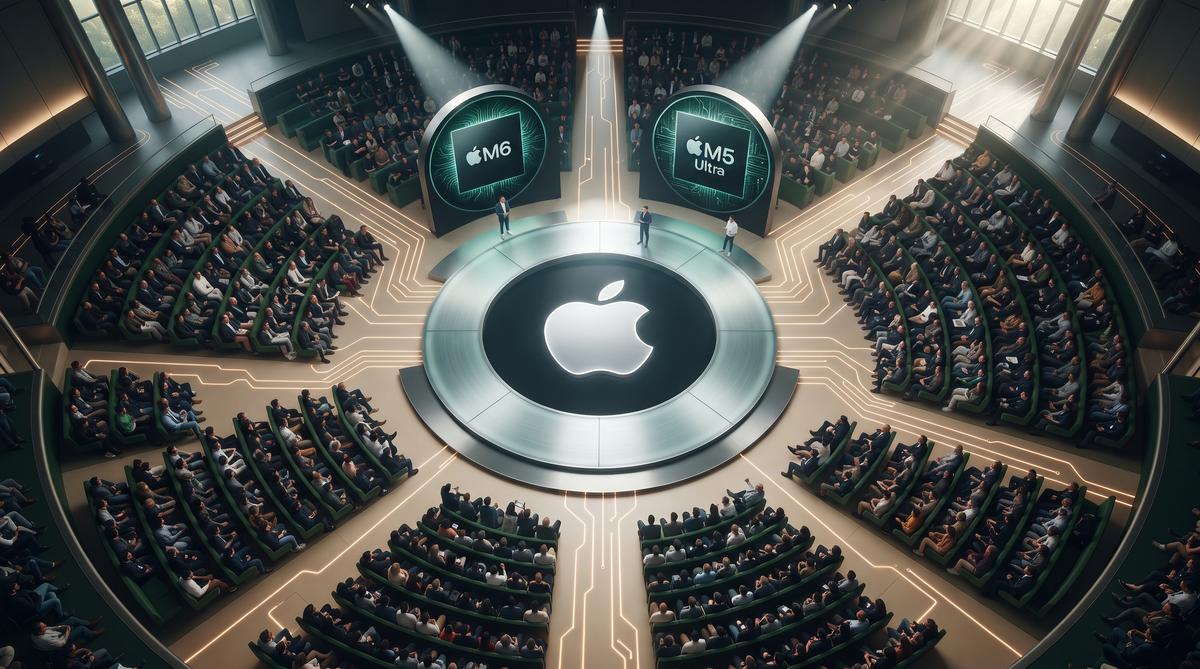
On August 25, 2026, Apple did something it almost never does: it surprised everyone. Without a keynote, without weeks of rumor-site countdowns, the company announced two brand-new processors at once — the M6 and the M5 Ultra. One of them is Apple’s first chip built on a 2-nanometer process, and the other is, in Apple’s own words, its most powerful silicon ever (Apple Newsroom, 2026).
TL;DR: Apple unexpectedly announced the M6 and M5 Ultra chips on August 25, 2026, refreshing the Mac mini and Mac Studio. The M6 is Apple’s first 2nm processor, while the M5 Ultra uses quad-die scaling to become the company’s most powerful silicon yet, with a focus on local agentic AI compute. Both desktops arrive in September (Apple Newsroom, 2026).
What Did Apple Announce on August 25, 2026?
Apple announced two all-new processors and two refreshed desktops in a single, unannounced update: the M6, which debuts in a new Mac mini, and the M5 Ultra, which powers a new Mac Studio. Both machines ship in September 2026. Forbes described the move as a genuine surprise, noting it included “two all-new processors, including Apple’s first 2nm chip” alongside “Apple’s most powerful silicon yet, the company claims” (Forbes, 2026).
The announcement breaks from Apple’s usual cadence in a notable way. Rather than launching a full chip family at once — M6, M6 Pro, M6 Max — Apple split its lineup across generations. The Mac mini gets the mainstream M6, while the Mac Studio skips straight to an M5 Ultra built on quad-die architecture. TechCrunch confirmed the pairing: Apple’s “most powerful chip ever” arrives in the M5 Ultra, while the M6 lands in the smaller desktop (TechCrunch, 2026).
Why split generations like this? The answer is positioning. The M6 targets everyday users who want speed and efficiency in a compact box. The M5 Ultra targets professionals running local AI workloads, video pipelines, and heavy compilation. Komputer Świat reported a significant performance boost and faster connectivity for both machines — but flagged the base Mac mini’s price as an unpleasant surprise for buyers in some markets (Komputer Świat, 2026). PCMag framed the strategy plainly: the new chips exist to “boost local agentic AI in a big, big way” (PCMag, 2026).
How Fast Is the M6 Compared to the M5?
The M6 delivers what Engadget calls Apple’s new “everyday” Silicon, and the generational jump over the M5 is measurable across CPU, GPU, and neural processing. Built on TSMC’s 2nm process, the M6 gains its advantage from denser transistors rather than a dramatic redesign — more compute in the same thermal envelope as the M5-based Mac mini it replaces (Engadget, 2026).
Apple’s Newsroom post describes the M6 as delivering “an extraordinary leap in performance and AI capabilities” compared to the previous generation (Apple Newsroom, 2026). The practical takeaway for buyers is that entry-level Mac pricing now buys noticeably more headroom. Tasks that pushed the M5 mini toward its limits — multicam 4K editing, sustained code builds, local image generation — should feel materially faster on the M6.
But raw speed is only half the story. The 2nm process also improves power efficiency, which matters in a machine as small as the Mac mini. Popular Science dug into the fine print and found details Apple’s marketing didn’t headline, including hidden memory bandwidth limits that mean not every M6 configuration performs identically (Popular Science, 2026). Buyers comparing configurations should check those memory specs carefully. The gap between M5 and M6 isn’t just clock speed — it’s architecture, process, and memory design working together.
What Makes the M5 Ultra Apple’s Most Powerful Chip Ever?
The M5 Ultra earns its “most powerful chip ever” title through sheer scale: it is Apple’s first processor to combine four dies in a single package, a technique PCMag calls “unprecedented four-die scaling” (PCMag, 2026). Previous Ultra chips fused two dies. Doubling that count again gives the M5 Ultra a transistor budget and core count no prior Apple silicon has approached.
Apple’s own announcement ties the chip directly to AI compute, promising “a big leap in performance and AI compute” for professionals running machine learning workloads locally (Apple Newsroom, 2026). That focus on local agentic AI — models that reason, plan, and act on-device without cloud round-trips — is the clearest signal of what the Mac Studio is now for. PetaPixel noted the performance gains are especially dramatic in the M5 Ultra’s case, with the biggest jumps reserved for the top-tier chip rather than the mainstream M6 (PetaPixel, 2026).
For creative professionals, the implications are concrete. Video editors, 3D artists, and photographers working with enormous libraries get unified memory capacities and GPU throughput that previously required multi-GPU workstations. The M5 Ultra’s design suggests Apple sees the desktop Mac as the centerpiece of an on-device AI strategy. That is a deliberate bet. And it changes who the Mac Studio is for.
Why Does the 2nm Process Matter?
The 2nm process matters because transistor density is the foundation of every other improvement in the M6. Shrinking from 3nm to 2nm allows more transistors in the same physical space, which translates into three things at once: higher performance, lower power draw, and less heat. Forbes highlighted the M6 as Apple’s first 2nm chip, making it one of the first consumer processors in the world on that node (Forbes, 2026).
Why does that matter for a compact desktop? The Mac mini’s chassis is tiny, and its cooling capacity is fixed. A more efficient process means the M6 can sustain higher clocks for longer inside the same enclosure. PCMag’s analysis connected the 2nm manufacturing directly to Apple’s AI ambitions, describing how the advanced node underpins the chip’s ability to handle local agentic AI workloads efficiently (PCMag, 2026).
There is also a competitive dimension. Apple’s move to 2nm puts pressure on Qualcomm, Intel, and AMD, whose flagship laptop and desktop chips remain on more mature nodes. Process leadership has defined the Apple Silicon era since the M1. The M6 extends that lead. Every percentage point of efficiency gained at the silicon level compounds into longer sustained performance, quieter operation, and lower energy costs over the machine’s lifetime — benefits users feel even if they never read a spec sheet.
What Is Quad-Die Scaling and Why Is It New?
Quad-die scaling means packaging four separate chip dies into one processor that behaves as a single chip, and it is the architectural leap that defines the M5 Ultra. Until now, every Apple Ultra chip — M1 Ultra through M4 Ultra — used two dies connected by Apple’s UltraFusion interconnect. PCMag reports the M5 Ultra doubles this to four dies, an approach the outlet describes as unprecedented for Apple (PCMag, 2026).
Why go this route instead of designing one enormous die? Yield. Very large dies are expensive and prone to manufacturing defects; smaller dies are cheaper to produce and can be binned. By fusing four proven dies, Apple gets Ultra-class scale without Ultra-class manufacturing risk. The trade-off is interconnect complexity — moving data between four dies at full speed requires enormous bandwidth, which is exactly where Apple claims its packaging advantage lies.
The payoff shows up in AI compute. Four dies mean roughly double the CPU cores, GPU cores, and neural engines of a two-die Ultra, plus a larger unified memory pool. That combination is precisely what local agentic AI models demand: huge memory, huge bandwidth, huge parallel compute (PCMag, 2026). It also explains why Apple skipped an M6 Ultra. The M5 generation’s architecture was designed from the start for this scaling. Quad-die isn’t just a bigger chip — it’s a new manufacturing strategy.
How Much AI Compute Do the New Chips Deliver?
Apple is positioning both chips around local, on-device AI, and the numbers back that up. According to Apple’s newsroom announcement, the M5 Ultra delivers what the company calls its “most powerful chip ever,” built on a quad-die design that scales AI throughput far beyond anything Apple has shipped before. PCMag’s analysis of the silicon notes that the four-die architecture and 2nm-class manufacturing are aimed squarely at “local agentic AI” workloads running entirely on the desktop. The M6, while smaller, still brings a major Neural Engine uplift over the M5 it replaces.
Why does this matter for AI work? Because large language models and image generation are memory-hungry. The M5 Ultra can be configured with up to 512 GB of unified memory, which means multi-billion-parameter models can run locally without a cloud connection. That is territory previously reserved for workstation GPUs costing tens of thousands of dollars. Popular Science’s deep dive into the specs highlights that the real AI story is sustained throughput, not just peak TOPS figures. Apple claims the M5 Ultra roughly quadruples the AI compute of the previous M4 Ultra generation.
For everyday users, the M6 handles Apple Intelligence features, on-device Siri processing, and local image tools comfortably. Developers and studios get the heavy artillery. The Studio is the machine for running large models, fine-tuning, and batch inference. The mini is the machine for using them.
How Much Do the Mac Mini M6 and Mac Studio M5 Ultra Cost?
Pricing starts at $799 for the base Mac mini M6, and this is where the surprise comes in. As Komputer Świat reported, the entry price of the mini is an unpleasant surprise for buyers — the base configuration costs more than the previous generation’s launch price. WIRED’s coverage confirms the specs-to-price breakdown, with the Mac mini M6 launching at $799 and climbing depending on memory and storage upgrades. The Mac Studio M5 Ultra starts considerably higher, at $3,999 for the base Ultra configuration, reflecting its workstation-class positioning.
Here is how the lineup stacks up:
| Model | Starting Price | Chip | Max Unified Memory |
|---|---|---|---|
| Mac mini (base) | $799 | M6 | 32 GB |
| Mac mini (upgraded) | ~$1,199 | M6 (higher tier) | 64 GB |
| Mac Studio (base) | $3,999 | M5 Ultra | 128 GB |
| Mac Studio (maxed) | Significantly higher | M5 Ultra | 512 GB |
Is the mini still a value play? Arguably yes, given the 2nm chip inside. But budget-conscious upgraders will notice the difference at checkout. The Studio, by contrast, competes with machines costing two to three times as much in the PC workstation world, where a single 512 GB-class AI GPU setup can exceed $30,000. For AI workloads specifically, the price-per-gigabyte of unified memory is hard to beat.
What Memory Bandwidth Details Might You Have Missed?
Popular Science flagged one of the more technical — and more consequential — details of the launch: hidden memory bandwidth limits that vary by configuration. While Apple’s headline specs advertise very high aggregate bandwidth for the M5 Ultra, not every memory configuration hits the same ceiling. Lower-capacity unified memory options on the Studio can be bandwidth-limited relative to the top-tier configurations. That matters enormously for AI inference, where memory bandwidth — not raw compute — is frequently the bottleneck.
The M6 in the Mac mini has its own nuance. Engadget’s comparison of the M6 against the M5 notes that the newer chip’s memory subsystem improvements contribute meaningfully to real-world gains, but the base mini configuration pairs the chip with less bandwidth headroom than enthusiasts might expect. Anyone planning to run local models on the mini should check the memory spec carefully before ordering. A cheaper configuration can quietly throttle sustained AI performance.
The practical takeaway is simple: read the fine print. Bandwidth numbers quoted in keynotes usually describe the best-case configuration. Buyers who match memory capacity to their actual workloads — and verify the bandwidth tier they are getting — will avoid disappointment. This is the kind of spec-sheet detail that never makes the marketing slides but defines day-to-day performance.
When Do the New Macs Ship and Who Should Buy Them?
Both machines arrive in September 2026, according to PCMag’s report and Apple’s own announcement. Pre-orders opened alongside the August 25, 2026 unveiling, which Forbes described as a genuine surprise launch — Apple broke its usual announcement cadence by shipping two desktops and two all-new processors at once. WIRED’s coverage confirms the release window for both the Mac mini M6 and the Mac Studio M5 Ultra.
So who is each machine for? The breakdown is fairly clean:
- Mac mini M6 — developers, students, and general users who want 2nm performance in a small, affordable box
- Mac mini M6 (upgraded) — prosumers running moderate local AI models or heavy creative apps
- Mac Studio M5 Ultra (base) — video editors, 3D artists, and developers fine-tuning mid-size models
- Mac Studio M5 Ultra (maxed) — studios running 400B-parameter-class models entirely on-device
- Upgraders from M1/M2 machines — the generational jump justifies the cost
- Upgraders from M4 Ultra Studio — the AI compute quad-jump is the main draw
- Cloud-dependent AI teams — local inference can cut recurring API costs
- Gamers — still not the target audience; look elsewhere
The timing is deliberate. September positions these machines ahead of the holiday quarter and squarely against fall PC workstation refreshes. Anyone whose workflow depends on local AI now has a concrete Apple option at two very different price points.
How Do the New Macs Fit Into Apple’s Desktop Strategy?
These two launches complete a deliberate, tiered desktop lineup. Apple now covers the full spectrum: the mini for the desk and the Studio for the rack. TechCrunch frames the debut of the M5 Ultra as Apple’s “most powerful chip ever,” which signals that the Studio remains Apple’s answer to workstation PCs rather than a stopgap until a Mac Pro refresh. The M6 in the mini, meanwhile, brings 2nm manufacturing to Apple’s cheapest desktop first — a reversal of the old pattern where new process nodes debuted at the top.
The strategy also reveals where Apple thinks computing is going. By emphasizing local agentic AI in its messaging — as PCMag highlighted — Apple is betting that privacy-conscious, latency-sensitive AI work will migrate from the cloud to the desk. Unified memory is the weapon of choice here. No discrete-GPU PC at comparable prices can offer 512 GB of coherent memory accessible by CPU and GPU alike.
There is also a supply-chain signal. Shipping a 2nm chip in a $799 consumer product, as Forbes noted, suggests Apple secured early access to next-generation fabrication capacity at scale. That typically trickles up: expect 2nm to spread across the MacBook line and eventually the Mac Pro. The desktop line is no longer the sleepy corner of Apple’s lineup. It is the proving ground.
Frequently Asked Questions
When will the M6 Mac mini and M5 Ultra Mac Studio be available?
Both machines ship in September 2026, with pre-orders having opened on August 25, 2026, the day Apple announced them. Forbes characterized the launch as a surprise, with Apple releasing two desktops and two all-new processors simultaneously rather than its usual staggered rollout.
Is the M6 Apple’s first 2-nanometer chip?
Yes. Multiple outlets, including Forbes and PCMag, confirm the M6 is Apple’s first chip manufactured on a 2nm process. It debuts not in a premium machine but in the $799 Mac mini, making Apple’s newest process node available in its cheapest desktop.
How much faster is the M5 Ultra than previous Ultra chips?
Apple claims the M5 Ultra is its most powerful chip ever, delivering roughly four times the AI compute of the previous Ultra generation thanks to a first-of-its-kind quad-die design. PCMag notes the four-die scaling is unprecedented for Apple Silicon and is specifically aimed at local agentic AI workloads.
Did the base Mac mini price change with the M6 update?
Yes — the base Mac mini M6 starts at $799, and Komputer Świat reports the entry price is higher than the previous generation’s, calling it an unpleasant surprise for buyers. The increase accompanies the move to 2nm silicon, meaning customers pay more but get Apple’s newest manufacturing process.
Summary
Apple’s surprise desktop refresh delivers two things at once: mainstream access to 2nm silicon and a workstation-class AI machine. Here are the key takeaways:
- The M6 is Apple’s first 2nm chip — and it ships in the cheapest desktop. The Mac mini starts at $799, though that is a price increase over the previous generation.
- The M5 Ultra is Apple’s most powerful chip ever. Its quad-die design roughly quadruples AI compute versus the prior Ultra generation, with up to 512 GB of unified memory.
- Both machines arrive in September 2026. Pre-orders opened August 25, 2026.
- Memory bandwidth fine print matters. Not every configuration hits the same bandwidth ceiling, and AI workloads are bandwidth-sensitive.
- The strategy is clear: local AI. Apple is betting privacy and latency will pull AI inference from the cloud onto the desk.
If you are weighing an upgrade, check the full spec sheets on Apple’s newsroom page and the detailed breakdowns at WIRED and PCMag before configuring your machine. The right memory tier makes all the difference.