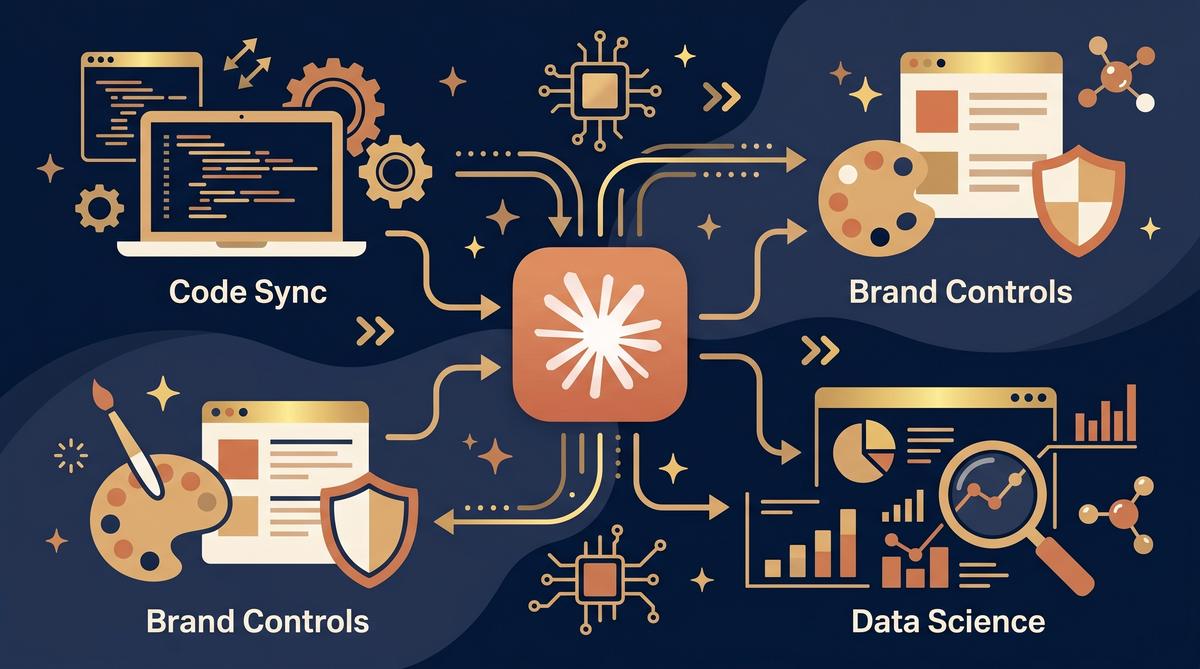
Anthropic shipped a major overhaul of Claude Design on June 2, 2026, adding bidirectional code sync, brand-compliance controls, and reduced token consumption. The update positions the AI tool as a production-ready platform for design-to-code workflows. Anthropic wants Claude Design to become the starting point for branded assets and code-ready interfaces.
TL;DR: Anthropic overhauled Claude Design with bidirectional Claude Code integration, brand-compliance controls, and reduced token consumption. The update adds design system imports, canvas editing, and enterprise exports to Canva, Adobe, Vercel, and Replit, positioning Claude Design as a production-ready design-to-code platform.
What Is Claude Design and What Changed in This Update?
Claude Design is an AI-powered design tool that lets users create designs, interactive prototypes, and presentations through natural-language conversations with Claude. Anthropic overhauled the platform with brand-compliance controls, Claude Code integration, lower token usage, and new enterprise app exports. According to VentureBeat, the update transforms Claude Design into a serious platform for design-to-code workflows rather than just a prototyping toy.
The core concept remains conversational. Users describe what they want, and Claude generates visual designs, interactive prototypes, or presentation decks. The overhaul adds substantial new capabilities. According to TechRepublic, the update includes design system imports, Claude Code syncing, canvas editing, and expanded export options for enterprise teams.
Anthropic heard user feedback loud and clear. Fast Company reports that the new version handles design systems better, offers finer-tuned editing controls, and operates more efficiently with tokens. The tool now connects directly to popular workplace applications.
Users can export work to Canva, Adobe, Vercel, Replit, and PDF formats. This transforms Claude Design from an isolated creative sandbox into a connected hub. IT Brief notes that users can now tie design work directly to coding tools and workplace platforms. The expansion widens Claude Design’s reach across teams and entire projects.
How Does the New Code Sync Between Claude Design and Claude Code Work?
The flagship feature of this update is bidirectional integration between Claude Design and Claude Code. According to Technobezz, the update establishes a direct pipeline that enables a governed enterprise workflow with direct handoff to Claude Code. This means designs created in Claude Design can flow directly into production code without manual translation.
The integration works as a round-trip process. A user creates a design or prototype in Claude Design, then sends it to Claude Code for implementation. According to VentureBeat, the code round-trip capability represents a core piece of the overhaul. Changes made in Claude Code can sync back to Claude Design.
This bidirectional sync addresses a persistent pain point. The New Stack reports that Anthropic built this feature specifically to fix the handoff problem between design and engineering teams. Designers and engineers have historically struggled with translating visual mockups into functional code.
Here is how the workflow operates in practice:
- A designer creates an interface in Claude Design using natural language
- The design includes brand colors, typography, and layout specifications
- Claude Design exports the design directly to Claude Code
- Claude Code generates the corresponding frontend code
- Engineers refine the code in Claude Code as needed
- Those code changes sync back to the Claude Design canvas
- The updated design reflects the engineering modifications
- Teams iterate without switching between disconnected tools
The Claude Help Center documentation confirms that Claude Design lets users create designs, interactive prototypes, and presentations by conversing with Claude. The new code sync layer adds a technical dimension to this creative process.
| Feature | Previous Version | Updated Version |
|---|---|---|
| Code Integration | One-way export | Bidirectional sync |
| Design Handoff | Manual translation | Direct pipeline |
| Iteration Cycle | Separate tools | Round-trip workflow |
| Export Targets | Limited options | Canva, Adobe, Vercel, Replit |
This table illustrates the gap between the old and new versions.
What Brand Compliance Controls Did Anthropic Add?
Anthropic added brand-compliance controls and design system imports to Claude Design. According to TechRepublic, these features let enterprise teams enforce visual consistency across all AI-generated designs. The controls ensure that Claude adheres to established brand guidelines when creating new assets.
Design system imports allow teams to upload their existing brand standards directly into Claude Design. The system then uses those standards as constraints. According to Fast Company, the new version works significantly better with established design systems, giving design leads tighter control over output.
This matters for large organizations. Brand consistency has long been a challenge with generative AI tools. A marketing team could ask an AI to create a presentation, but the output might use wrong colors or fonts. The brand-compliance controls aim to solve this problem at the platform level.
Anthropic wants Claude Design to serve as the starting point for branded assets. According to Digg’s coverage, the tool now sends compliant work into external applications like Canva and Adobe. This governance layer makes the platform viable for enterprise adoption.
The New Stack highlights a tension, though. Designers acknowledge the brand controls are powerful, but some note that token costs still slow down their overall workflow. The controls add processing overhead to each generation request.
How Much Did Token Usage Drop in the New Version?
Anthropic reduced token consumption in Claude Design to address what VentureBeat called a token-burning problem. The previous version consumed tokens at a rate that made iterative design expensive. The new version operates more efficiently, lowering the cost barrier for teams.
Fast Company reports that the updated Claude Design is notably more efficient with tokens. This efficiency improvement matters because token costs directly affect how teams use the tool. High token consumption limited experimentation and rapid iteration in the earlier release.
The New Stack provides important context here. Designers praised the efficiency gains but noted that token costs still represent a workflow bottleneck. The reduction helps, but the overall expense of AI-driven design iteration remains a concern for some enterprise teams.
Technobezz confirms that the overhaul cuts token costs as part of a broader strategy. Anthropic paired the efficiency improvements with the new brand controls and code sync features. The goal is enabling governed enterprise use at a more sustainable price point.
Lower token consumption changes how teams approach the tool. Designers can iterate more freely without watching their token budget drain. The efficiency fix removes a layer of friction from the creative process. However, the cost is not zero. Teams evaluating Claude Design should still factor token expenses into their budget planning.
Which Export and Integration Options Are Available?
Claude Design now exports directly to Canva, Adobe, Vercel, Replit, and PDF formats, according to Digg’s coverage of the update. This positions the tool as a starting point for branded assets rather than a closed-loop system. Users generate prototypes, then push them into external platforms for refinement or deployment. The integration with Vercel and Replit targets developers who want to move from interface concept to deployed application without manual handoffs. Adobe and Canva exports serve designers who need to continue work in established creative suites.
The export pipeline addresses a specific frustration with earlier versions. Users previously had to screenshot or manually recreate Claude-generated designs in other tools. Now, the round-trip workflow lets assets flow outward and return for further iteration. According to VentureBeat, Anthropic added enterprise app exports specifically to position Claude Design as a serious platform for design-to-development workflows rather than a novelty.
IT Brief reported that users can now tie design work to coding and workplace tools, widening Claude Design’s reach across teams. The connectors span both creative and technical destinations.
Can Claude Design Import Existing Design Systems?
Yes. TechRepublic confirms the update includes design system imports, allowing teams to bring established component libraries, color palettes, and typography rules into Claude Design. This solves a major gap — previous versions generated designs from scratch, ignoring existing brand guidelines.
Fast Company reported that the new version handles design systems more effectively, giving what the publication described as “vibe coders and their design overlords” finer control over output consistency. Import functionality means a company’s existing design tokens, spacing rules, and component patterns can govern what Claude produces. The New Stack noted that this feature directly addresses complaints from enterprise teams who found earlier output disconnected from their established visual standards.
Designers no longer need to re-specify brand rules in every prompt. The imported system persists across sessions.
How Does the Canvas Editing Feature Work?
The canvas editing feature gives users direct manipulation controls over generated designs, moving beyond pure conversational iteration. TechRepublic lists canvas editing among the core additions in the overhaul. Users can click, drag, and adjust elements visually rather than describing every change in text.
Fast Company highlighted finer-tuned editing controls as a key improvement. The canvas interface bridges the gap between AI-generated output and traditional design tool expectations. Designers can select specific components, adjust positioning, modify properties, and see changes apply in real time. According to the Claude Help Center guide, Claude Design supports creating designs, interactive prototypes, and presentations through conversation — the canvas layer adds tactile control on top of that conversational foundation.
This dual approach matters. Conversational generation handles rapid ideation, while canvas editing handles precision adjustments that are cumbersome to describe verbally.
Is Claude Design Ready for Enterprise Design-to-Development Pipelines?
Anthropic is positioning Claude Design for exactly that use case, though adoption signals remain mixed. VentureBeat reports the overhaul adds enterprise app exports, Claude Code syncing, and brand-compliance controls — all aimed at governed enterprise deployment. The direct pipeline to Claude Code, covered by Technobezz, enables what Anthropic describes as a governed handoff from design to development.
However, The New Stack found disagreement between designers and engineers on whether the handoff actually works. A designer and an engineer interviewed by the publication reached different conclusions about the update’s effectiveness. Designers reported that token costs still slow the workflow, creating friction in iterative cycles. Engineers were more optimistic about the code synchronization features.
The enterprise readiness depends on workflow scale. For prototyping and initial concept work, the pipeline functions well. For high-volume iterative design cycles, token economics create resistance.
What Did Designers and Engineers Say About the Update?
Reactions split along role lines. The New Stack interviewed both a designer and an engineer about the overhaul, and their assessments diverged. Designers acknowledged the improvements in design system handling and brand controls but flagged token costs as a persistent workflow bottleneck. The efficiency improvements Anthropic shipped — which Fast Company reported as a fix for the tool’s token-burning problem — did not fully resolve cost concerns during intensive iteration.
Engineers responded more positively to the Claude Code integration. The bidirectional sync between design and code reduces manual translation work. Technobezz characterized the direct handoff as enabling governed enterprise use, which aligns with developer priorities around automation and pipeline integration.
VentureBeat’s reporting framed the update as Anthropic’s push to position Claude Design as a serious platform rather than an experimental tool. The mixed feedback suggests Anthropic closed functional gaps but has not yet resolved economic ones.
Frequently Asked Questions
Does Claude Design replace traditional design tools like Figma or Adobe XD?
No. Anthropic explicitly designed Claude Design as a starting point that exports to tools like Canva and Adobe, according to Digg. The platform generates initial concepts, prototypes, and branded assets, then pushes them into established design suites for further work. Fast Company described the tool as giving “vibe coders and their design overlords” more control — not replacing either group’s existing toolkit.
How does the Claude Code integration actually function?
The integration creates a bidirectional sync between Claude Design and Claude Code, as confirmed by The New Stack and VentureBeat. Designs generated in Claude Design can pass directly to Claude Code as functional code, and code changes can flow back to update the design. Technobezz reported this as a direct pipeline enabling governed enterprise use with clean handoff between design and development phases.
What export formats does Claude Design support after the update?
According to Digg’s coverage, Claude Design exports to Canva, Adobe, Vercel, Replit, and PDF. TechRepublic additionally confirmed enterprise app exports as part of the overhaul. IT Brief reported that users can now tie design work to coding and workplace tools, expanding the connector set across both creative and technical destinations.
Is the updated Claude Design available to all users?
The Claude Help Center documents the updated Claude Design as available for users to create designs, interactive prototypes, and presentations through conversation with Claude. VentureBeat and TechRepublic reported the overhaul as shipped, positioning the tool for enterprise teams. Specific tier availability — whether all features require a paid Claude plan — was not detailed in the coverage reviewed.
How significant is the token cost reduction in the new Claude Design version?
Fast Company reported that Anthropic addressed the tool’s token-burning problem, and Technobezz confirmed lower token usage as part of the overhaul. However, The New Stack found that designers still consider token costs a workflow bottleneck despite the reductions. The efficiency gains are real but have not fully eliminated cost friction during intensive iterative design cycles.
Summary
Key takeaways from the Claude Design overhaul:
- Export pipeline now spans creative and technical destinations: Canva, Adobe, Vercel, Replit, and PDF exports position Claude Design as a project starting point rather than a closed system.
- Design system imports close a critical brand-compliance gap: Teams can bring existing component libraries, color palettes, and typography rules into Claude Design sessions.
- Canvas editing adds tactile precision: Users can visually manipulate elements instead of describing every adjustment conversationally.
- Claude Code integration enables bidirectional design-to-development sync: The direct pipeline reduces manual translation between design output and functional code.
- Token cost reductions are real but incomplete: Anthropic fixed the token-burning problem, yet designers report cost friction persists during intensive iteration.
The update signals Anthropic’s intent to compete in the enterprise design-to-development space. Whether it succeeds depends on how quickly token economics align with professional workflow demands. For now, Claude Design serves as a capable prototyping front-end with growing integration depth.
Read the official documentation at the Claude Help Center, and check coverage from VentureBeat and The New Stack for additional detail.