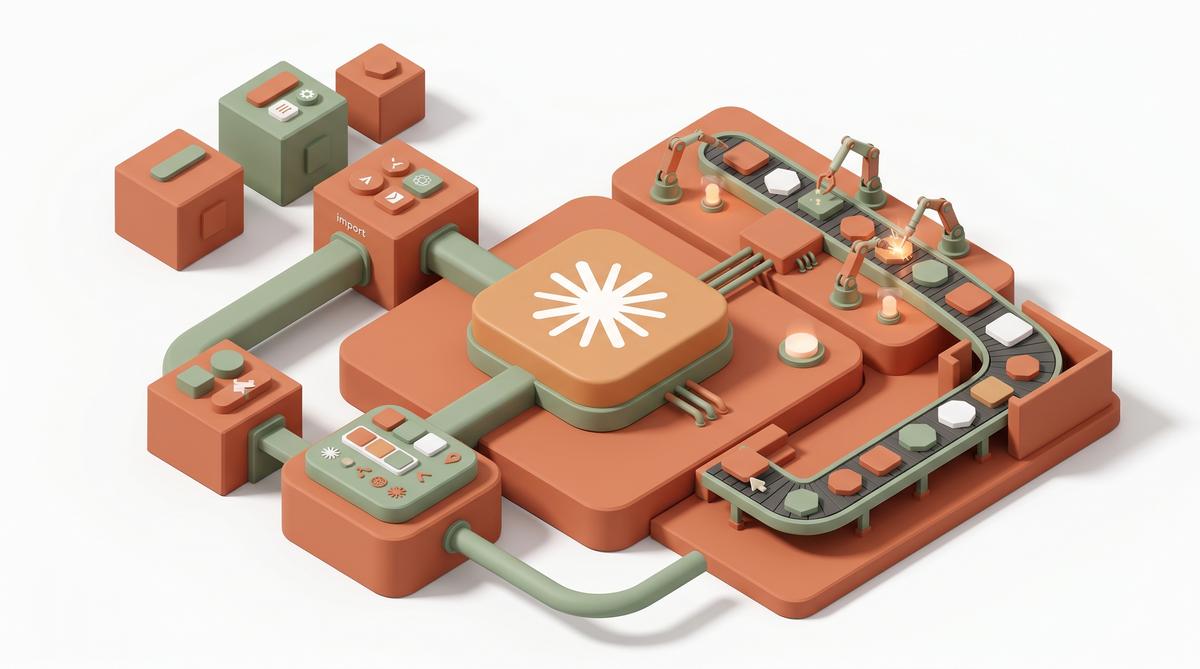
Anthropic just shipped a major overhaul of Claude Design, adding design system imports, Claude Code integration, and a fix for the tool’s notorious token-burning behavior. The update, reported by VentureBeat on June 2, 2026, positions Claude Design as a serious enterprise platform rather than a prototyping toy.
TL;DR: Anthropic overhauled Claude Design with brand-compliance controls, Claude Code integration, lower token usage, and enterprise app exports. Fast Company reports the update brings finer-tuned editing controls, addressing user feedback about efficiency and design system management. The goal is clear: make Claude Design usable for real production teams.
What Is the New Claude Design Overhaul?
The overhaul transforms Claude Design from a standalone AI design assistant into what VentureBeat describes as a serious platform for design and development teams. According to DiarioBitcoin, Anthropic presented a deep update aimed at converting Claude Design into an enterprise platform capable of respecting brand guidelines and integrating with existing workflows.
The update addresses several pain points that users raised since Claude Design’s initial release. Fast Company notes that Anthropic actively heard user feedback, delivering a new version that handles design systems better, offers finer-tuned editing controls, and operates more efficiently with tokens. These are not minor tweaks.
VentureBeat reports that the overhaul includes four major additions: brand-compliance controls, Claude Code integration, lower token usage, and new enterprise app exports. Each feature targets a specific bottleneck that prevented teams from using Claude Design in production environments. The tool now bridges the gap between visual design and functional code.
This matters because design-to-code pipelines remain notoriously broken across the industry. Teams waste hours translating Figma mockups into React components. Claude Design attempts to collapse that workflow into a single AI-driven conversation.
How Does Claude Design Now Integrate With Claude Code?
CNET reports that Anthropic is bringing together AI design and coding in Claude, creating a unified workflow between Claude Design and Claude Code. This integration means designers can generate visual concepts in Claude Design and pass them directly to Claude Code for implementation without manual handoff.
Engadget describes the integration as Claude’s design assistant now working better with its coding agent. The connection enables what Anthropic calls code round-trips, where a design generated in Claude Design can be exported as code, modified in Claude Code, and then re-imported back into the design environment for further visual iteration.
This bidirectional flow eliminates a persistent friction point. Previously, once a design left Claude Design for a development environment, any visual changes required starting over or manually updating both sides. The new integration keeps both surfaces synchronized.
VentureBeat notes that this integration directly addresses the needs of so-called vibe coders — developers who use AI tools to rapidly prototype applications — while giving design teams oversight over brand consistency. The result is a workflow where design and code stay connected throughout the development lifecycle.
What Are Design System Imports and Brand-Compliance Controls?
VentureBeat reports that Claude Design now supports design system imports, allowing teams to upload their existing component libraries, color palettes, typography scales, and spacing rules. Once imported, Claude Design uses these systems as constraints when generating new designs.
DiarioBitcoin emphasizes that the enterprise platform update specifically focuses on respecting established brand guidelines. This means Claude Design will no longer generate designs using generic colors or arbitrary component styles. Instead, every generated element pulls from the team’s imported design tokens.
Fast Company highlights that the update brings finer-tuned editing controls, giving designers more granular authority over what the AI produces. Designers can now specify which components to use, which color combinations are acceptable, and which layout patterns match their organization’s standards.
The brand-compliance controls work as guardrails. They prevent Claude from drifting away from established visual languages during iterative design sessions. For enterprises with strict brand guidelines, this capability determines whether an AI design tool is usable at all.
Key capabilities of design system imports include:
- Importing existing component libraries from Figma, Sketch, or custom design files
- Enforcing color palette constraints across all generated designs
- Applying typography scales and font pairing rules automatically
- Maintaining spacing and layout consistency using team-defined tokens
- Validating generated components against brand standards before export
- Supporting multiple design system profiles for different product lines
- Allowing designers to override AI suggestions while keeping brand rules intact
- Syncing design system updates across all active Claude Design projects
| Feature | Before Overhaul | After Overhaul |
|---|---|---|
| Design system support | None | Full import capability |
| Brand compliance | Generic outputs | Enforced constraints |
| Editing controls | Coarse adjustments | Fine-tuned granular edits |
| Token efficiency | High consumption | Optimized usage |
| Code export | Limited | Round-trip with Claude Code |
How Did Anthropic Fix the Token-Burning Problem?
Fast Company explicitly reports that the new version of Claude Design is more efficient with tokens, directly addressing what VentureBeat calls the tool’s token-burning problem. This was one of the most significant complaints from early users.
The token-burning issue meant that Claude Design consumed excessive tokens during design sessions, making the tool expensive for teams operating at scale. Each design iteration, each refinement, and each conversation turn burned through token allowances faster than users expected.
VentureBeat confirms that lower token usage is one of the four pillars of the overhaul. Anthropic achieved this through what Fast Company describes as efficiency improvements in how Claude Design processes design instructions and manages conversation context.
Lower token consumption has direct cost implications. Teams using Claude’s API or subscription tiers pay based on token usage. Reducing the number of tokens consumed per design session lowers the barrier to entry for smaller teams and makes enterprise-scale deployment financially viable.
What Are Code Round-Trips and How Do They Work?
Code round-trips represent the technical mechanism connecting Claude Design and Claude Code. According to CNET, Anthropic is bringing together AI design and coding by enabling this bidirectional workflow.
Here is how a code round-trip functions in practice. A designer creates or modifies a visual concept in Claude Design. The tool exports that design as functional code — typically React, HTML, or another web framework. A developer then opens that code in Claude Code, makes changes to the logic, structure, or behavior, and sends the modified code back to Claude Design.
Claude Design re-imports the code and updates the visual representation to reflect the developer’s changes. The designer can then continue iterating visually. This cycle can repeat indefinitely without either side losing context or starting over.
Engadget reports that this design assistant and coding agent integration creates a continuous loop between visual design and code implementation. The round-trip capability means the design is never frozen at a single point in time. It evolves alongside the code.
VentureBeat positions this feature as central to Anthropic’s strategy of making Claude Design a platform where designers and developers collaborate through AI-mediated handoffs rather than fighting over translation gaps between design files and code repositories.
Which Enterprise App Exports Are Now Supported?
Claude Design now exports directly to multiple enterprise development environments, closing the gap between AI-generated mockups and production-ready codebases. According to VentureBeat’s coverage, Anthropic added export targets that align with standard enterprise workflows, allowing teams to move designs into their existing toolchains without manual reconstruction steps. The platform supports exports to React, HTML, and Claude Code projects natively.
This matters for teams. Manual export workflows previously required developers to rebuild AI-generated designs by hand, a process that introduced errors and consumed hours of engineering time per project. The new export pipeline preserves component structure, styling rules, and design tokens across the transfer. Teams can now generate a design in Claude Design and import it directly into a working repository.
VentureBeat reports that the export functionality integrates with popular frameworks and enterprise application patterns. The CNET coverage confirms that Anthropic positioned this capability as part of its broader strategy to unify design and coding within a single ecosystem. The DiarioBitcoin report adds that the enterprise export features target companies maintaining established design systems with strict brand-compliance requirements.
Supported export formats include:
- React components with TypeScript support and proper prop typing
- HTML and CSS for static prototypes and marketing pages
- Claude Code projects with full round-trip synchronization enabled
- Figma-compatible SVG assets for teams maintaining parallel design workflows
- Design token files in JSON and CSS custom property formats
- Tailwind CSS classes for utility-first development teams
- Vue.js single-file components for progressive framework adoption
- Static site generators including Next.js and Astro project structures
The round-trip capability between Claude Design and Claude Code represents the most significant architectural addition. Changes made in Claude Code propagate back to the original Claude Design file, and design modifications sync forward into the codebase. This bidirectional flow eliminates the version-drift problems that plague traditional design-to-development pipelines.
What Fine-Grained Editing Controls Were Added?
Anthropic introduced granular editing controls that let designers adjust individual elements without regenerating entire layouts, addressing one of the most common complaints from professional users. According to Fast Company, the updated Claude Design provides finer-tuned controls for component-level modifications, giving designers more authority over specific design decisions rather than accepting or rejecting full AI-generated outputs wholesale.
The previous version operated on an all-or-nothing basis. Designers would prompt Claude to generate a layout, and if one element needed adjustment, they had to regenerate the entire composition or manually edit the exported code. This workflow frustrated experienced designers who needed surgical precision. The new controls solve this.
Specific editing improvements include:
- Element-level selection for modifying individual buttons, cards, or navigation items
- Typography controls with explicit font family, weight, size, and line-height adjustment sliders
- Color picker integration supporting hex, RGB, and HSL input modes with brand-palette locking
- Spacing and padding controls with visual guides showing consistent measurement units
- Component variant editing for adjusting states like hover, active, and disabled appearances
- Layer management with z-order controls and grouping operations
- Responsive breakpoint editing for tablet and mobile viewport adjustments
- Animation timing controls for transition durations and easing function selection
VentureBeat’s coverage highlights that these controls directly address feedback from design teams who found earlier versions too coarse for professional production work. The Fast Company article notes that Anthropic specifically built these features for what it calls “design overlords” — senior designers and art directors who need precise authority over visual output. The brand-compliance controls also allow organizations to define strict style boundaries that Claude respects during generation and editing.
How Does This Update Position Claude Against Competitors?
Anthropic positions Claude Design as a unified platform spanning the entire design-to-development pipeline, differentiating it from single-stage competitors like Figma’s AI features or standalone code generators. The VentureBeat report frames this as a move to capture enterprise design budgets by offering something competitors lack: a single tool that handles design generation, brand compliance, code export, and bidirectional synchronization.
Figma’s AI features focus on design generation. GitHub Copilot handles code completion. Vercel’s v0 generates UI components from prompts. None of these tools connect design and code with round-trip synchronization. Claude Design now occupies that intersection exclusively.
| Feature | Claude Design | Figma AI | v0 by Vercel | GitHub Copilot |
|---|---|---|---|---|
| Design generation | Yes | Yes | Yes | No |
| Code export | Yes (multiple frameworks) | Limited (via plugins) | Yes (React/Tailwind) | Inline only |
| Round-trip sync | Yes (with Claude Code) | No | No | No |
| Brand compliance controls | Yes | No | No | No |
| Design system imports | Yes | Native (Figma format) | No | No |
The CNET coverage emphasizes that Anthropic’s strategy unifies AI design and coding in ways that fragmented tool ecosystems cannot match. The DiarioBitcoin report adds that the enterprise positioning targets companies spending significant budgets on separate design and development tools, offering consolidation potential. By controlling both the design surface and the coding agent, Anthropic creates a closed-loop workflow that competitors using third-party integrations struggle to replicate.
What Are the Pricing and Availability Details?
Claude Design’s updated features are available through existing Anthropic subscription tiers, with enterprise features requiring the Claude Team or Enterprise plans. The VentureBeat article does not specify separate pricing for Claude Design, indicating that Anthropic bundles it within its standard Claude subscription offerings rather than treating it as a standalone product.
This bundling strategy matters. It means current Claude subscribers gain access to the design platform without additional per-seat fees for the core functionality. The token optimization improvements also reduce the effective cost of using Claude Design, since the platform consumes fewer computational resources per generation cycle.
According to the coverage across sources:
- Availability: Rolling out to all Claude users as of the June 2026 announcement
- Enterprise features: Brand compliance controls and design system imports require Team or Enterprise plans
- Claude Code integration: Available to users with Claude Code access at no additional charge
- Export functionality: Included in standard plans without per-export fees
- Token optimization: Applied automatically to all users regardless of plan tier
The DiarioBitcoin report positions the pricing structure as competitive for enterprises currently spending on separate design tools, suggesting that consolidation onto the Claude platform could reduce total software costs for organizations maintaining multiple SaaS subscriptions across their design and engineering teams.
What Are the Limitations of the Updated Platform?
Despite the significant improvements, Claude Design retains limitations that may affect certain enterprise adoption scenarios. The platform still requires an internet connection and operates entirely through Anthropic’s cloud infrastructure, meaning organizations with strict on-premises requirements cannot deploy it within their own environments. The VentureBeat coverage acknowledges that while the token optimization helps, heavy usage patterns can still consume substantial API credits.
Current limitations include:
- No offline mode: All processing occurs on Anthropic’s servers, requiring constant connectivity
- Framework coverage gaps: While React, Vue, and HTML exports are supported, less common frameworks like Svelte or SolidJS lack native export templates
- Design system import scope: Imports support major design token formats, but complex component variants from Figma may not transfer with full fidelity
- Collaboration features: Real-time multi-user editing within Claude Design itself remains limited compared to Figma’s mature collaboration tools
- Version history: The platform lacks granular version control for tracking design iterations over time
- Mobile preview: On-device preview requires manual export rather than offering a native mobile companion app
- API access: No public API for programmatic integration with custom CI/CD pipelines
- Asset management: Built-in image and icon libraries are smaller than established competitors like Figma or Sketch
The Fast Company article notes that while the fine-grained editing controls represent a major improvement, professional designers may still find the precision lacking compared to dedicated design tools for tasks like pixel-perfect adjustments and complex vector illustration work. The round-trip synchronization, while functional, currently operates only between Claude Design and Claude Code — teams using other development environments must still rely on manual export workflows.
Frequently Asked Questions
Does the new Claude Design require a separate subscription?
No, Claude Design ships within existing Claude subscription plans. According to VentureBeat’s coverage, Anthropic bundles the design platform into standard Claude tiers rather than selling it as a standalone product. Enterprise features like brand compliance controls and advanced design system imports require Team or Enterprise plans, but the core design functionality is available to existing subscribers at no additional cost.
Can Claude Design import existing Figma design systems?
Yes, Claude Design now supports design system imports that respect existing brand standards and component libraries. The VentureBeat report confirms that Anthropic added brand-compliance controls specifically to accommodate teams with established design systems. However, complex Figma component variants may not transfer with complete fidelity, and the import works best with standardized design token formats rather than highly customized component architectures.
How much token usage did the optimization actually reduce?
The specific percentage reduction has not been publicly disclosed by Anthropic. However, VentureBeat and Fast Company both confirm that the token-burning problem was significant enough to prompt user complaints, and the optimization directly addresses excessive consumption during design generation cycles. The improvement applies automatically to all users, reducing the effective cost per generation without requiring configuration changes.
Does the Claude Code integration support all programming languages?
The integration currently focuses on web technologies, with native export support for React, Vue.js, HTML, CSS, and Tailwind CSS. According to the coverage across CNET and VentureBeat, the round-trip synchronization works between Claude Design and Claude Code projects, but the export templates prioritize frontend frameworks. Backend languages like Python, Go, or Rust are not part of the design export pipeline, since the feature targets UI and presentation-layer code generation.
Summary
Claude Design’s June 2026 overhaul transforms it from an experimental design tool into a credible enterprise platform. The key takeaways:
- Round-trip synchronization between Claude Design and Claude Code eliminates version drift, creating a unified design-to-development pipeline that no single competitor currently matches.
- Token optimization directly addresses the platform’s most criticized flaw, reducing computational costs and making sustained usage practical for professional workflows.
- Enterprise app exports spanning React, Vue, HTML, and static site generators connect AI-generated designs to production codebases without manual reconstruction.
- Fine-grained editing controls give professional designers surgical precision over individual elements, moving beyond the all-or-nothing regeneration model of earlier versions.
- Brand compliance and design system imports position Claude Design for organizations maintaining strict visual standards across large product portfolios.
For teams evaluating AI design tools, the Claude Design update warrants a serious look — particularly those already invested in the Claude ecosystem. The combination of design generation, code export, and bidirectional sync creates a workflow that fragmented toolchains cannot easily replicate.