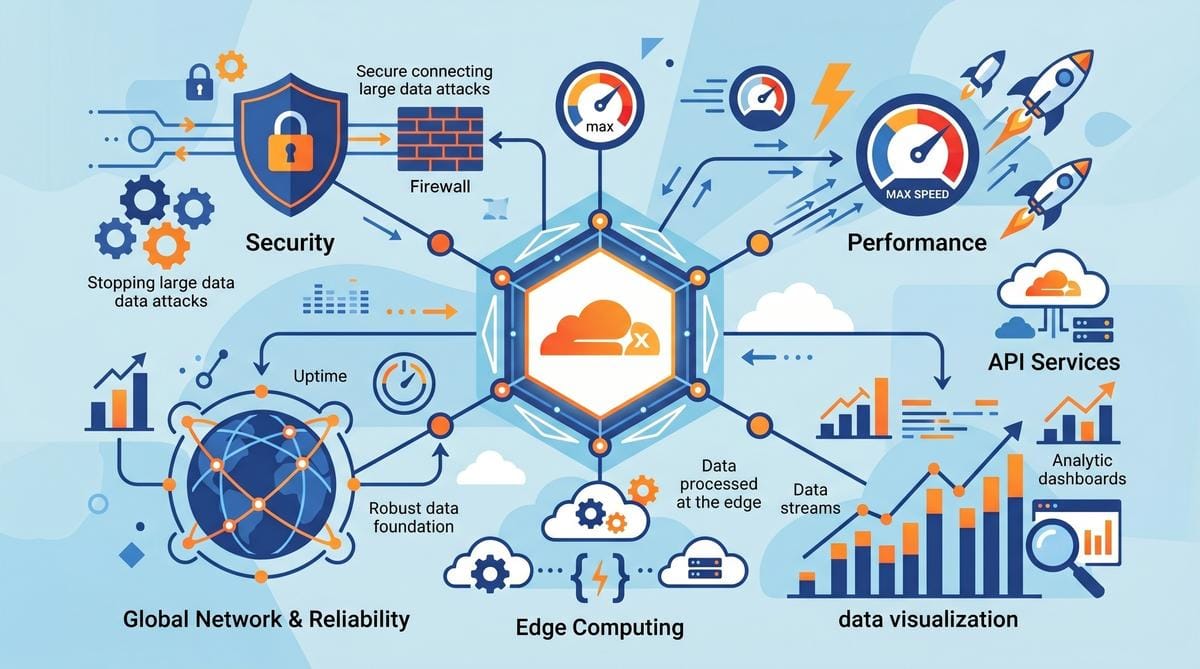
Cloudflare reported a 600% increase in AI traffic over the past year. Now the company is entering the feature flags space with Flagship — a tool designed specifically for AI-generated code and controlling autonomous agent behavior in production environments.
TL;DR: Cloudflare Flagship is a new feature flag service built into the Workers infrastructure, optimized for code created by artificial intelligence. The tool allows dynamic control of application behavior without redeployment. Cloudflare reports a 600% surge in AI traffic, which contextualizes the need for such solutions.
What Is Cloudflare Flagship and How Does It Work in the Workers Ecosystem?
Cloudflare Flagship is a native feature flag service integrated directly with the Cloudflare Workers platform. The tool was announced in May 2026 as part of a broader AI agent infrastructure offering that includes Agent Memory, Shared Dictionaries, and an LLM compression technique called Unweight. Flagship evaluates conditional decisions in real time, allowing features to be toggled on and off without redeploying code. The solution is available globally through Cloudflare’s network, minimizing latency.
Additionally, integration with Workers means there’s no need to configure external services. A flag is simply a configuration object checked on the fly. If an AI agent needs to change its behavior — for example, switching to a different language model — you just change the flag value in the dashboard. The code remains untouched.
Flagship acts as an intermediary layer between a function call and its execution. For instance, when an AI agent calls an API, Flagship checks the flag state and decides whether to use endpoint A or B.
Why Are Feature Flags Important for AI-Generated Code?
Code produced by language models has a specific lifecycle. Changes are introduced rapidly, often without the model fully understanding the business context. Feature flags give human operators a control point — they can disable a risky feature in seconds rather than waiting for a new version of code from the agent.
Cloudflare recorded a 600% year-over-year increase in AI traffic, meaning more and more applications are operating autonomously. In this environment, traditional deployment becomes a bottleneck. Flagship addresses this by separating decision logic from execution code. Configuration changes require no redeployment.
It’s worth examining how this abstraction layer performs in practice with Claude agents, whose collaboration with Cloudflare has been expanded. For more details, see the analysis at Cloudflare (NET) Valuation Check As Anthropic AI Agent Partnership Highlights Its Infrastructure Ambitions.
How Does Flagship Integrate with Anthropic’s Claude Agents?
Cloudflare expanded its partnership with Anthropic, creating Cloudflare Environments for Claude Managed Agents — a platform for securely running AI agent tasks at scale. Flagship serves as the feature versioning control mechanism within this ecosystem. Claude agents can dynamically switch between operating modes based on flags set by the operator.
For example, when an agent processes a user query, Flagship decides whether to use the Haiku or Sonnet model. The decision depends on a flag configured in the Cloudflare dashboard. This enables cost optimization — lighter queries are routed to the cheaper model. Moreover, switching doesn’t require restarting the agent.
This integration is part of Cloudflare’s broader AI strategy. The company restructured operations around AI tool adoption, which involved layoffs. For context on this, see Cloudflare Lays Off Approximately 20% of Employees.
What AI Infrastructure Components Accompany Flagship?
Flagship doesn’t operate in isolation. Cloudflare presented an entire toolkit for AI agents, which includes:
Agent Memory — a mechanism for persisting agent state between sessions
Shared Dictionaries — shared dictionaries for coordination between agents
Redirects for AI Training — redirect rules for model-training bots
Unweight — an LLM response compression technique that reduces payload size
Flagship — feature flags optimized for AI-generated code
Agent Readiness Score — assessment of a website’s readiness for AI agent traffic
These components form a cohesive ecosystem. For instance, Agent Memory stores context, while Flagship decides which version of logic processes it. Shared Dictionaries allow agents to share data, while Unweight optimizes transfer. For a detailed overview, see All You Need To Know About Cloudflare’s Agent Readiness Score.
| Component | Function | Application |
|---|---|---|
| Flagship | Feature flags | Feature version control |
| Agent Memory | State persistence | Agent session continuity |
| Unweight | LLM compression | Transfer cost reduction |
| Shared Dictionaries | Data sharing | Agent coordination |
The key takeaway is that Flagship acts as a safety switch. If an AI agent starts behaving unpredictably, the operator can immediately disable the problematic feature. This is especially important in the context of autonomously generated code, where traditional debugging can be difficult.
Cloudflare positions these tools as the foundation of next-generation AI agent infrastructure. The company is targeting 2029 for full post-quantum security, as described in Cloudflare Targets 2029 for Full Post-Quantum Security. Security and AI infrastructure strategies are being developed in parallel.
The Anthropic partnership further strengthens Cloudflare’s position in this space. According to Simply Wall St, Cloudflare shares rose 6.4% following Q1 earnings announcements and the Anthropic collaboration news.
How Does Flagship Support Security and Stability in AI Deployments?
Cloudflare laid off 1,100 employees — approximately 20% of its workforce — restructuring operations around AI tool adoption (The Times of India, 2026). Flagship fits into this strategy as a safety mechanism, allowing immediate disabling of problematic agent features without code redeployment. In an environment where AI agents operate autonomously, feature flags serve as a physical control point.
Code generated by language models is characterized by unpredictable behavior in production. Traditional debugging can be difficult because agents make decisions dynamically. An operator can disable a risky feature in seconds.
Additionally, the tool enables gradual rollout of new agent behaviors. Instead of launching a feature globally, the operator enables it for a small percentage of traffic. If something goes wrong, disabling the flag takes an instant.
This provides a clear advantage in risk management.
What Flagship Use Cases Does the Documentation Show?
Cloudflare’s documentation outlines several specific Flagship applications in the context of AI agents. The tool evaluates conditional decisions in real time, enabling dynamic control of application behavior without code changes. Below are the main scenarios described in the company’s materials.
LLM model switching — an AI agent can dynamically choose between Claude Haiku and Sonnet based on a flag
Feature access control — the operator decides which agent capabilities are active
Gradual rollout — a new feature is activated for an increasing percentage of traffic
Safety kill switch — immediate blocking of problematic agent behavior
A/B testing — comparing two versions of an agent’s decision logic
Cost optimization — switching to a cheaper model for simple queries
Region management — different agent behavior depending on user location
API version control — switching between endpoints without code changes
All these scenarios rely on a single mechanism — checking the flag value before executing an action. For a detailed description of Cloudflare’s AI infrastructure components, see All You Need To Know About Cloudflare’s Agent Readiness Score.
| Scenario | Flag | Effect |
|---|---|---|
| Model switching | model_version | Haiku or Sonnet |
| Gradual rollout | rollout_percentage | 1-100% of traffic |
| Safety kill switch | feature_enabled | true/false |
| Cost optimization | cost_mode | budget/premium |
How Does Flagship Affect Operational Costs of AI Agents?
Cloudflare reported a 33.5% year-over-year revenue increase in Q1 2026 (Börse Express, 2026). At the same time, the company integrated Anthropic’s Claude system, increasing the need for cost control mechanisms. Flagship allows operators to dynamically switch agents between differently priced models, directly impacting inference spending.
The key mechanism is flag-based routing. When an AI agent receives a simple query, Flagship routes it to a cheaper model — for example, Claude Haiku. For complex tasks, the system switches to the more expensive Sonnet. The decision is made on the fly, without programmer involvement.
Flagship thus acts as a cost optimization layer. Instead of constantly using the most expensive model, the system adapts the choice to actual needs. At the scale of thousands of queries per day, the difference becomes significant.
This has a direct impact on the budget.
What Are Flagship’s Limitations and What to Watch Out For?
Flagship is available exclusively within the Cloudflare Workers ecosystem, meaning it cannot be used with other computing platforms. For teams not using Workers, Flagship is not an option.
Here are the main limitations based on the documentation:
No support outside Workers — the tool does not run on other platforms
New product — May 2026 is the launch date, so solution maturity is limited
Ecosystem dependency — full capabilities require Agent Memory and Shared Dictionaries
Restructuring context — Cloudflare laid off 20% of its workforce, raising questions about product team stability
On the other hand, it’s worth considering whether committing to the Cloudflare ecosystem is justified from a business perspective. As described in Switching from Cloudflare to Bunny.net, migrating between infrastructure providers can be costly. Choosing Flagship entails a long-term platform commitment.
That said, for teams already using Workers, integration is seamless. For more on Cloudflare’s security strategy, see Cloudflare Targets 2029 for Full Post-Quantum Security.
How Does Flagship Position Itself Against the Competition?
Cloudflare positions Flagship as a tool designed specifically for AI-generated code, distinguishing it from general feature flag solutions like LaunchDarkly or Split.io. Integration with Agent Memory and Shared Dictionaries creates a cohesive ecosystem unavailable from competitors. Cloudflare shares rose 6.4% following Q1 earnings announcements and the Anthropic collaboration news (Simply Wall St, 2026).
The feature flag market is mature, but Flagship brings a new perspective — automated management of AI agent behavior. Traditional tools were designed with human-written code in mind.
Furthermore, integration with Cloudflare’s global infrastructure means low-latency flag evaluation. For AI applications where response time matters, this is a significant advantage. For detailed information on Cloudflare’s valuation and positioning, see Cloudflare (NET) Valuation Check As Anthropic AI Agent Partnership Highlights Its Infrastructure Ambitions.
The market is beginning to notice the difference.
Frequently Asked Questions
Does Flagship work outside the Cloudflare Workers ecosystem?
No. Flagship is a native Cloudflare service announced in May 2026 and is not available on other computing platforms (Search Engine Journal, 2026). If your infrastructure relies on AWS Lambda or Google Cloud Functions, you’ll need to look for alternatives.
How much does Flagship cost?
Cloudflare does not list a separate price for Flagship — the tool is part of the AI agent infrastructure package that includes Agent Memory, Shared Dictionaries, and Unweight (Search Engine Journal, 2026). Costs depend on overall Workers platform usage.
How quickly does Flagship respond to configuration changes?
A flag change in the dashboard is visible immediately to AI agents without redeployment. Flagship evaluates conditional decisions in real time, enabling instant behavior switching without restarting sessions.
Is Flagship suitable for small projects without AI agents?
Flagship was designed specifically for AI-generated code and autonomous agents (Search Engine Journal, 2026). For traditional applications without an AI component, general feature flag tools like LaunchDarkly or Flagsmith would be a better fit.
Summary
Flagship is a safety tool — it allows immediate disabling of a problematic AI agent feature without code redeployment, which is critical in autonomous environments.
Workers ecosystem integration — the tool runs natively in Cloudflare’s infrastructure, guaranteeing low latency but also tying you to the platform.
Inference cost optimization — dynamic switching between LLM models reduces spending by routing simple queries to cheaper models.
Restructuring context — Cloudflare laid off 20% of its workforce while restructuring operations around AI, raising questions about long-term product support stability.
AI infrastructure package — Flagship works alongside Agent Memory, Shared Dictionaries, and Unweight, forming a cohesive ecosystem for next-generation AI agents.
If your organization uses Cloudflare Workers and is planning AI agent deployments, Flagship is a solution worth considering as part of your risk management strategy. For more on Cloudflare’s infrastructure, see the analysis at Cloudflare Targets 2029 for Full Post-Quantum Security and How Cloudflare Responded to the “Copy Fail” Vulnerability in Linux.