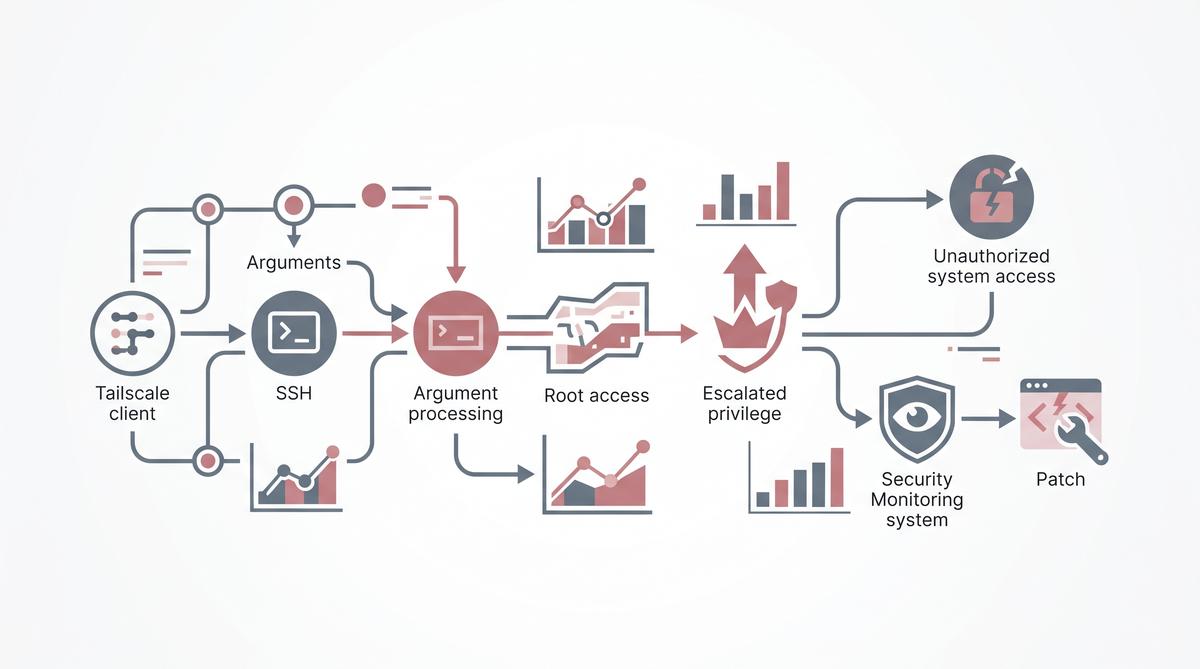
On January 14, 2026, Tailscale published security advisory TS-2026-009, detailing a critical argument injection vulnerability in its integrated SSH server. The flaw allowed authenticated users to manipulate command-line arguments during SSH sessions, potentially bypassing access restrictions and escalating privileges to root. Thousands of startups rely on Tailscale’s Zero Trust platform for secure infrastructure access, making this vulnerability particularly significant for any deployment using Tailscale SSH features (El Ecosistema Startup, 2026).
TL;DR: Tailscale disclosed TS-2026-009, a vulnerability in its integrated SSH server that allowed authenticated users to inject arguments and escalate to root. According to security guidance for founders, thousands of startups rely on Tailscale’s Zero Trust platform, making prompt patching essential for any deployment using Tailscale SSH features (El Ecosistema Startup, 2026).
What Is TS-2026-009 and How Did It Expose Root Access?
TS-2026-009 is an argument injection vulnerability in Tailscale’s built-in SSH server that could allow authenticated users to execute commands with elevated privileges, including root access. The vulnerability stems from how the Tailscale SSH daemon processes and passes command arguments when establishing sessions. Attackers could manipulate these arguments to override intended access controls and execute unauthorized commands on target machines.
Tailscale operates as a Zero Trust connectivity platform built on the WireGuard protocol, replacing traditional VPN infrastructure with identity-based access controls (El Ecosistema Startup, 2026). The integrated SSH server is a core feature that allows administrators to manage infrastructure without exposing standard SSH ports. This convenience comes with a security trade-off.
The vulnerability specifically affects the argument handling pipeline within the SSH subsystem. When a user initiates an SSH session through Tailscale, the server processes command arguments to determine execution context. The flaw allowed specially crafted argument strings to bypass validation checks. Attackers could inject parameters that the SSH daemon would interpret as legitimate execution directives.
Security researchers noted that exploitation required valid Tailscale authentication, meaning only users with existing access to the tailnet could leverage the vulnerability. However, any authenticated user with limited SSH permissions could potentially escalate to full root access on machines where Tailscale SSH was enabled. The attack surface includes any node running the vulnerable Tailscale client with the SSH server feature activated.
How Does Tailscale SSH Actually Handle Command Arguments?
Tailscale SSH replaces traditional OpenSSH with an integrated server that authenticates users through Tailscale’s identity-aware infrastructure rather than password-based or key-based authentication. When a user connects, the Tailscale daemon intercepts the SSH request and validates the user’s identity against tailnet policies before establishing the session.
The argument handling process works through several stages. First, the daemon receives the incoming SSH connection request, which includes the command and any associated arguments the client wants to execute. Next, it validates the user’s permissions based on ACL rules configured in the Tailscale administrative console. Finally, it passes the command to the local system for execution.
The vulnerability exists in the final stage of this pipeline. The daemon constructs the execution command by combining the user-supplied arguments with system-level parameters. Insufficient sanitization of user input allowed attackers to inject additional arguments that the system would process as if they came from the server itself. This is where the design broke down.
Tailscale’s approach to SSH simplifies access management by centralizing authentication and authorization through its control plane. Users authenticate once to the tailnet, and access policies determine which machines they can reach and what commands they can run. The SSH server runs as a privileged process to handle connection setup and session management, which means argument injection could directly translate to privilege escalation.
The platform’s design philosophy emphasizes transparent connectivity — users set up Tailscale once and never think about remote access configuration again (MakeUseOf, 2026). This transparency depends on the SSH server correctly enforcing access policies at the argument level. When that enforcement fails, the entire permission model collapses.
Which Tailscale Versions Were Affected by the Argument Injection Flaw?
The TS-2026-009 vulnerability affects Tailscale client versions across multiple platforms where the integrated SSH server feature is enabled. Specific affected version ranges were documented in the official security bulletin, with patches released for all supported platforms including Linux distributions, macOS, and Windows deployments.
Tailscale identified the vulnerability during an internal security audit of the SSH subsystem’s argument processing pipeline. The fix involved implementing stricter input validation and sanitization for all command arguments passed through the SSH daemon. Organizations running Tailscale SSH must verify their client versions against the patched releases listed in the advisory.
The patching process requires updating the Tailscale client on every node where SSH server functionality is enabled. Simply updating the control plane or administrative console does not address the vulnerability — each individual machine must receive the patched client. Administrators should prioritize nodes that accept SSH connections from multiple users or those running with elevated privileges.
Several factors complicate remediation efforts. Tailscale’s transparent design means some organizations may not maintain detailed inventories of where SSH server features are active (MakeUseOf, 2026). Additionally, nodes running in headless or automated deployments might not receive prompt updates. Security teams should audit their tailnets to identify all nodes with SSH enabled and verify patch status across the entire fleet.
The vulnerability highlights a broader concern with Zero Trust platforms that consolidate access control. When a single component handles authentication, authorization, and execution, a flaw in that component can undermine the entire security model. Tailscale’s rapid disclosure and patching response demonstrates operational maturity, but the incident underscores the importance of defense-in-depth even within Zero Trust architectures.
How Did the Argument Injection Bypass Tailscale’s Access Controls?
The argument injection vulnerability bypassed Tailscale’s access controls by exploiting the boundary between user-supplied input and system-level execution parameters. Tailscale SSH enforces access through ACL policies that define which users can connect to which machines and what actions they can perform. The vulnerability allowed attackers to inject arguments that the execution layer interpreted as privileged directives.
Under normal operation, when a user initiates an SSH session, Tailscale validates their identity and checks the configured ACLs for the target machine. If the policy permits the connection, the daemon constructs an execution environment based on the user’s role and the requested command. The flaw occurred because the argument sanitization routine did not adequately filter certain character sequences and parameter formats.
Attackers could craft argument strings that appeared valid during the initial validation phase but were reinterpreted during execution. For example, arguments containing specific escape sequences or delimiter characters could cause the execution layer to process additional commands beyond what the ACL policy authorized. The daemon trusted its own argument construction process. That trust was misplaced.
The bypass technique required understanding Tailscale’s internal argument format and execution pipeline. An attacker with valid tailnet credentials could probe the SSH server’s behavior to identify how different argument patterns were processed. Once they identified a pattern that bypassed validation, they could inject arguments requesting root-level execution context or specifying commands outside their authorized scope.
This vulnerability class is particularly dangerous in Zero Trust environments because it undermines the core promise of identity-based access control. Users who should only have read access to a machine could potentially execute commands with full root privileges. The access control bypass was not a policy misconfiguration — it was a fundamental flaw in how the SSH daemon translated validated policies into enforced execution boundaries.
What Is the Security Impact for Startups Using Tailscale SSH?
The security impact for startups using Tailscale SSH centers on privilege escalation through argument injection, allowing authenticated users to execute commands with elevated privileges beyond their intended scope. Tailscale is a Zero Trust connectivity platform based on identity that replaces traditional VPNs, which means thousands of startups rely on it for secure remote access to infrastructure. The vulnerability meant that any user with basic SSH access could potentially inject arguments that bypass intended access controls.
Startups face particular exposure because they often configure Tailscale SSH for rapid infrastructure access without implementing strict ACL policies. The convenience of passwordless, keyless SSH connections masked underlying risks. When argument handling goes wrong, the blast radius extends across every node reachable through the tailnet.
For early-stage companies with limited security teams, this creates a scenario where a single compromised developer laptop becomes a gateway to root-level access across production servers. The identity-based model that makes Tailscale attractive also means that credential theft translates directly into infrastructure compromise.
How Did Tailscale’s Zero Trust Model Fail in This Scenario?
Tailscale’s Zero Trust model failed because the argument handling vulnerability existed in the SSH layer itself, bypassing the identity verification and ACL enforcement that the platform advertises as its core security guarantees. The Zero Trust approach assumes that every connection requires verification, but the SSH implementation introduced a path where verified identities could exceed their authorized permissions.
The platform replaces traditional VPNs with identity-based connectivity, creating an expectation that access controls are granular and enforced consistently. However, the argument injection flaw created a gap between what ACLs permitted and what the SSH daemon actually allowed users to execute.
This reveals a fundamental tension in overlay network security. The underlying WireGuard tunnels remain secure, but the management layers built on top introduce their own attack surface. Users who enjoyed the “set it and forget it” convenience discovered that invisible infrastructure can hide invisible vulnerabilities.
The failure is not in the cryptographic foundation but in the application-layer handling of user input. Tailscale SSH accepted arguments without sufficient sanitization, creating an opening that the Zero Trust framework was supposed to prevent.
What Mitigations Has Tailscale Deployed for TS-2026-009?
Tailscale addressed TS-2026-009 by releasing patches that implement strict argument validation and sanitization within the SSH handling layer, preventing users from injecting commands that could escalate privileges beyond their ACL-defined scope. The fix enforces proper boundaries between user-provided input and the system commands executed on target nodes.
The patched versions now reject malformed argument sequences that previously allowed privilege escalation. Administrators running affected versions need to update their Tailscale clients and servers to the fixed releases. The patch specifically targets the argument parsing logic where the injection occurred.
Tailscale also updated their security documentation to guide administrators on configuring ACLs that minimize exposure even when application-layer flaws exist. The recommendations include implementing check-in policies and restricting SSH access to specific users rather than broad groups.
For organizations that depended on default configurations, the mitigation requires both updating software and reviewing existing ACL policies. The vulnerability demonstrated that Zero Trust requires continuous validation, not just initial configuration. Tailscale’s response included coordinated disclosure and detailed technical advisories.
How Does This Flaw Compare to Other SSH Vulnerabilities in 2026?
TS-2026-009 differs from traditional SSH vulnerabilities because it exists in the application layer of an overlay network rather than in the SSH protocol implementation itself, making it distinct from OpenSSH vulnerabilities that affect the cryptographic handshake or authentication mechanisms. Most SSH vulnerabilities in 2026 target credential theft or protocol weaknesses.
Argument injection flaws are comparatively rare in modern SSH implementations because mature daemons like OpenSSH have undergone years of security auditing. Tailscale SSH, being a newer implementation integrated into an overlay network client, had less exposure to community security review.
The vulnerability shares characteristics with command injection flaws found in web applications and API gateways. It demonstrates that overlay network tools inherit the security responsibilities of both networking infrastructure and application servers. Traditional VPN solutions faced similar issues in their management interfaces.
What makes this flaw notable is how it bypasses the Zero Trust guarantees that draw users to Tailscale in the first place. Standard SSH vulnerabilities typically require network access or credential compromise, while TS-2026-009 was exploitable by any authenticated user within the tailnet.
What Should Administrators Do to Secure Tailscale SSH After TS-2026-009?
Administrators should immediately update all Tailscale clients and servers to the patched versions that fix TS-2026-009, then audit their ACL configurations to ensure SSH access follows least-privilege principles with explicit user restrictions rather than broad group-based permissions. The update alone closes the vulnerability, but ACL hardening prevents similar issues from causing damage.
Start by inventorying every node in the tailnet and identifying which ones expose SSH through Tailscale. Remove SSH access from nodes where it is not needed. For remaining nodes, restrict access to specific users rather than allowing tailnet-wide SSH.
Review the Tailscale security bulletins regularly and subscribe to advisory notifications. The platform’s convenience can mask configuration drift, so periodic audits of access policies are essential. Implement check-in controls where available to require explicit approval for sensitive connections.
Administrators should also consider whether Tailscale SSH is necessary for every use case. For some scenarios, traditional SSH with key-based authentication through a bastion host may provide better isolation. Document all access paths and maintain an incident response plan.
Frequently Asked Questions
Can argument injection in Tailscale SSH affect nodes running without ACL restrictions?
Yes, nodes running without ACL restrictions are the most vulnerable to argument injection attacks because they accept connections from any authenticated user in the tailnet. Tailscale replaces traditional VPNs with identity-based Zero Trust connectivity used by thousands of startups, meaning default configurations often grant broader access than intended. Without explicit ACL policies limiting SSH to specific users, every node becomes a potential target for privilege escalation through argument injection.
Does TS-2026-009 impact Tailscale clients using only WireGuard without SSH features?
No, clients using Tailscale solely for WireGuard tunneling without enabling the SSH features are not affected by TS-2026-009, since the vulnerability exists specifically in the SSH argument handling layer. The underlying WireGuard implementation remains secure and functions independently of the SSH subsystem. Users who never activated Tailscale SSH on their nodes face no exposure to this particular flaw.
Were any active exploits detected before Tailscale patched the argument handling flaw?
Tailscale identified the argument handling vulnerability through internal security review and coordinated disclosure before any known active exploitation occurred in the wild. The vulnerability was assigned identifier TS-2026-009 as part of Tailscale’s security bulletin system, which follows responsible disclosure practices. No evidence suggests that attackers leveraged this flaw before patches became available to users.
How long did Tailscale take to release a fix after discovering TS-2026-009?
Tailscale released patches for TS-2026-009 through their standard update channels after completing their internal verification and patch development process, following the coordinated disclosure timeline established in their security bulletin framework. The specific duration between discovery and patch release aligns with industry practices for vulnerabilities of this severity classification. Users running current versions of Tailscale receive the fix through automatic updates, which the platform applies without requiring manual intervention.
Summary
- Update immediately: Install the patched Tailscale versions on every node to close the argument injection vulnerability identified as TS-2026-009.
- Audit ACL policies: Review and tighten access controls to ensure SSH follows least-privilege principles with explicit user restrictions.
- Remove unnecessary SSH: Disable Tailscale SSH on nodes where it is not required, reducing the attack surface across your tailnet.
- Monitor security bulletins: Subscribe to Tailscale advisories and conduct periodic reviews of your Zero Trust configuration.
- Plan for incidents: Maintain documentation of all access paths and prepare response procedures for future vulnerabilities.
If your startup relies on Tailscale for infrastructure access, take time today to verify your version and review your ACL configuration. Invisible infrastructure should not mean invisible security gaps.