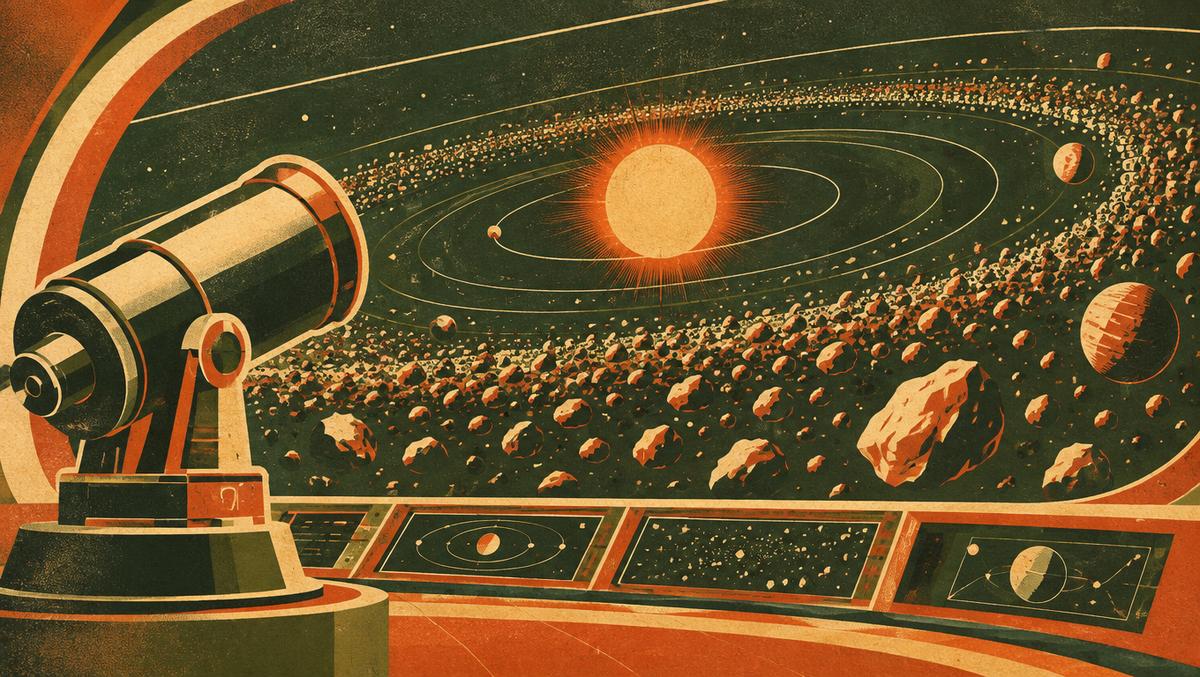
527,080 bodies. That is how many objects a new Show HN project called Space Now lets anyone explore in real time, right in a browser. The visualization covers 526,000 asteroids alongside more than 35,000 tracked satellites and spacecraft, turning a laptop screen into a live map of the solar system.
TL;DR: Space Now, a Show HN project, renders the solar system in real time, letting anyone explore 527,080 bodies including 526,000 asteroids, plus more than 35,000 tracked satellites and spacecraft. The visualization doubles as an educational gateway into asteroid composition and the solar system’s 4.6-billion-year history.
What Is Space Now and What Does It Actually Show?
Space Now is an interactive, real-time visualization of the solar system. According to the project’s Show HN listing, users can explore 527,080 solar system bodies at any given moment. The map is not a static illustration — it represents the current positions of objects as they move through space.
The scope is unusual for a browser-based tool. Most solar system visualizations show the eight planets and a handful of moons. Space Now goes much further, pulling in the vast asteroid population and everything currently tracked in orbit around Earth.
That combination makes the project serve two audiences at once. Space enthusiasts can zoom out and watch planets drift along their orbits. Anyone curious about Earth orbit can switch focus and see the swarm of satellites and spacecraft circling overhead right now.
The project also works as an educational entry point. Sources covering it highlight that the visualization opens the door to questions about what asteroids are made of and where they came from. That is where the science gets genuinely interesting.
How Many Objects Can You Explore in Real Time?
The headline numbers tell most of the story. The project displays 527,080 solar system bodies in total, according to its listing. Of those, roughly 526,000 are asteroids — meaning asteroids make up the overwhelming majority of everything on the map.
Here is the breakdown of what the visualization includes:
- 527,080 solar system bodies available for real-time exploration
- Approximately 526,000 asteroids, the dominant category in the dataset
- More than 35,000 tracked satellites orbiting Earth
- Spacecraft alongside those satellites in the live tracking view
- The planets and their orbits as the familiar backbone of the map
For comparison, if a person spent one second examining each asteroid in the visualization, it would take roughly six days of nonstop clicking to get through them all. The scale of the catalog is difficult to grasp until you see it rendered on screen.
Why does this matter? Because the density of objects is itself the lesson. The solar system is not an empty stage with a few planets. It is cluttered, with hundreds of thousands of rocky remnants scattered between and around the worlds we know.
How Does Real-Time Tracking of Satellites and Spacecraft Work?
Beyond the natural bodies of the solar system, Space Now tracks the artificial ones. The project includes more than 35,000 satellites and spacecraft, and the listing emphasizes that all tracked satellites are covered — not a curated sample.
Real-time tracking means the visualization reflects where these objects are now, not where they were when the dataset was compiled. Satellites in low Earth orbit move fast, so a live view looks very different from a static catalog. Thousands of dots drift and reposition continuously.
The inclusion of spacecraft matters too. It means the map is not limited to hardware that stays in orbit permanently. Missions in progress appear alongside the satellite population, giving a fuller picture of human activity in space.
What does 35,000 tracked satellites look like visually? Imagine a shimmering shell around Earth, densest near the altitudes where communications and observation constellations operate. The visualization makes an otherwise invisible infrastructure suddenly visible.
Anyone who has wondered how crowded Earth orbit has become gets a direct answer. The count is right there: more than 35,000 objects, tracked and rendered in real time.
Why Are There So Many Asteroids in the Solar System?
The answer lies in how the solar system formed. As coverage of asteroid research explains, approximately 4.6 billion years ago the solar system formed from a huge disk of gas and dust orbiting the sun. Not all of that material got incorporated into planets.
The asteroids visible today are described as some of the most complete artifacts of that formation process. They are the leftovers — material that never coalesced into a planet or was scattered out of the way during the solar system’s early, chaotic history.
A common analogy captures this well. Asteroids have been described as the screws, sawdust, and scraps left behind after a house is built, drifting through space long after the construction crew went home. The house is the solar system. The scraps are the 526,000 asteroids Space Now renders.
That leftover character is precisely why so many of them exist. Planet formation was an imperfect process, and rocky debris accumulated in regions — most famously the belt between Mars and Jupiter — where a planet never formed.
So when you scroll through half a million asteroids in the visualization, you are essentially browsing a debris field from the solar system’s construction phase. Each dot represents material older than any rock on Earth’s surface.
What Are Asteroids Made Of?
Asteroids are not uniform rocks. Researchers classify them into distinct types based on composition, and sources on the topic group them into three broad categories: carbonaceous (C-type), stony (S-type), and metallic (M-type). The Planetary Society maintains detailed educational material on exactly this question of asteroid composition.
The differences are more than academic. Each type preserves different information about conditions in the early solar system, which is why researchers describe asteroids as “time capsules” of the formation era.
- C-type (carbonaceous): carbon-rich bodies, dark in appearance, among the most ancient material in the solar system
- S-type (stony): silicate rock composition, common in the inner solar system
- M-type (metallic): metal-rich bodies, with 16 Psyche cited as a typical example in imagery from NASA
Recent research has added a twist to this tidy classification. Astronomers have discovered a hidden link between M-type and K-type asteroids, suggesting that these two different types may actually share the same origin story. The finding indicates that the boundary between categories is less clean than it once appeared.
This matters for anyone using Space Now. The 526,000 asteroids on the map are not interchangeable dots. They represent chemically distinct populations that tell different chapters of the same 4.6-billion-year story, and ongoing research continues to redraw the map of how they relate to one another.
Frequently Asked Questions
How many objects does Space Now include in total?
According to the project’s Show HN listing, Space Now allows exploration of 527,080 solar system bodies in real time. Approximately 526,000 of those are asteroids, with the remainder covering planets, satellites, and spacecraft.
How many satellites does the visualization track?
The project tracks more than 35,000 satellites and spacecraft, per the listing. The Show HN description emphasizes that all tracked satellites are included, rendered live alongside the natural bodies of the solar system.
What are the main asteroid types?
Sources classify asteroids into three main composition categories: carbonaceous (C-type), stony (S-type), and metallic (M-type). NASA imagery cites 16 Psyche as a typical M-type asteroid, and recent research suggests M-type and K-type asteroids may share a common origin.
How old is the solar system that Space Now depicts?
Research coverage states that the solar system formed approximately 4.6 billion years ago from a huge disk of gas and dust orbiting the sun. Today’s asteroids are described as some of the most complete artifacts of that formation process.
Summary
Space Now is a Show HN project that turns the solar system into a live, explorable map. The key takeaways:
- The visualization renders 527,080 solar system bodies in real time, including roughly 526,000 asteroids
- More than 35,000 tracked satellites and spacecraft appear alongside the natural objects
- The asteroid population exists because planet formation 4.6 billion years ago left vast amounts of material unclaimed
- Asteroids fall into C-type, S-type, and M-type composition classes, each preserving different clues about the early solar system
- New research linking M-type and K-type asteroids shows the science behind the map is still evolving
If the numbers spark your curiosity, open the visualization and start zooming. Half a million rocks are waiting, and each one has a story older than Earth itself.
What Do C, S, and M Asteroid Types Tell Us About Solar System History?
Asteroid classification into C (carbonaceous), S (stony), and M (metallic) types acts as a record of how the early solar system assembled itself. Sources describing these categories call them “time capsules” — objects whose composition preserves clues about the conditions under which they formed (kosmos.porady-tech.pl). Roughly 4.6 billion years ago, the solar system condensed from a huge disk of gas and dust orbiting the Sun, and today’s asteroids are described by researchers as some of the most complete artifacts of that formation (phys.org).
The three classes correspond to different materials.
- C-type: carbonaceous, rich in carbon compounds
- S-type: stony, silicate-based bodies
- M-type: metallic compositions
Because each class formed from different starting material, comparing them lets scientists reconstruct where and how bodies in the young solar system accumulated. When a visualization like Space Now plots hundreds of thousands of asteroids, it is effectively displaying a map of that ancient construction site. The type of an asteroid is not a trivial label. It is a hint about the object’s birthplace and history.
Why Did Astronomers Link M-Type and K-Type Asteroids?
Astronomers discovered a hidden link suggesting M-type and K-type asteroids may share the same origin story, revising the long-held view that they formed as entirely separate populations. Coverage of the finding, reported in August 2025, uses a vivid analogy: asteroids are the screws, sawdust, and scraps left behind after a house is built, drifting through space ever since (MSN/phys.org).
The traditional picture treated metallic M-types and K-types as distinct families with separate formation histories. The new research argues that this separation may be an artifact of classification rather than a real divide in origin. If confirmed, it means the population of metal-rich bodies in the asteroid belt is less cleanly partitioned than textbooks have suggested.
Why does this matter for a visualization project? Databases of asteroid properties feed directly into tools like Space Now. When researchers revise how asteroid types relate to each other, the classification layers shown in real-time solar system viewers become more accurate. A finding about taxonomy eventually shows up in what a curious browser user sees on screen.
Who Is a Tool Like This Useful For?
Space Now lets users explore 527,080 solar system bodies and more than 35,000 tracked satellites and spacecraft in real time (GeekNews coverage). That combination makes it useful for several distinct audiences, each of whom interacts with the data differently.
- Amateur astronomers planning observation sessions around asteroid positions
- Educators demonstrating orbital mechanics to students with live, not static, data
- Journalists and writers checking the actual position of objects during news events
- Satellite enthusiasts tracking spacecraft in orbit in real time
- Science communicators looking for accurate visuals of the solar system’s scale
- Developers and hobbyists studying how large orbital datasets render in a browser
- Curious users who simply want to see how crowded near-Earth space has become
The satellite layer deserves emphasis. More than 35,000 tracked objects orbit Earth alone, a number that surprises most first-time viewers. Seeing them plotted alongside 527,080 natural bodies reframes the scale of human activity in orbit. A classroom projection of this tool does more than any textbook diagram.
How Does It Compare to Other Solar System Visualizations?
Most familiar solar system viewers show the eight planets and a handful of moons, often with pre-rendered, time-adjusted animations rather than live positions. Space Now’s differentiator is scale and immediacy: 527,080 bodies rendered in real time, plus over 35,000 satellites and spacecraft (GeekNews coverage).
| Feature | Typical planet viewers | Space Now |
|---|---|---|
| Bodies shown | Planets and major moons | 527,080 solar system bodies |
| Satellites | Rarely included | 35,000+ tracked objects |
| Position data | Often static or simplified | Real-time |
| Focus | Education, visual appeal | Full-catalog exploration |
| Asteroid coverage | Minimal | 526,000 asteroids |
The comparison is not about which tool looks prettier. It is about whether a viewer represents the solar system as it actually is — dominated by small bodies — or as a simplified diagram of planets. Anyone who has browsed the asteroid catalog on The Planetary Society’s resources knows that composition and classification data exist separately from orbital viewers. A tool that merges live orbital tracking with hundreds of thousands of small bodies closes that gap.
Is the Solar System in Real Time the Future of Astronomy Outreach?
Real-time, browser-based visualizations represent a shift in how astronomy reaches the public. When 527,080 bodies and 35,000 tracked satellites can be explored from a web browser with no installation, the barrier between professional orbital catalogs and casual curiosity drops to nearly zero (GeekNews coverage of the project).
Outreach has historically relied on static images, planetarium shows, and simplified diagrams. Those formats still work, but they hide the true density of the solar system. A live view showing 526,000 asteroids at once communicates something a diagram cannot: the solar system is not an empty stage with eight actors. It is a crowded construction site, full of the leftover material researchers describe as “screws, sawdust, and scraps” from its formation (phys.org).
Projects like this also benefit from ongoing research. The August 2025 finding that M-type and K-type asteroids may share an origin story shows how classification knowledge keeps evolving — and live tools can integrate updated data faster than printed materials ever could. In my opinion, the strongest outreach tools of the coming years will be the ones that treat users as explorers of live data rather than audiences for finished pictures.
Frequently Asked Questions
How many objects does Space Now track?
Space Now lets users explore 527,080 bodies in the solar system in real time, alongside more than 35,000 tracked satellites and spacecraft (GeekNews coverage of the project). That makes it one of the most extensive browser-based solar system visualizations available.
What are the main asteroid types?
Asteroids are commonly classified into C (carbonaceous), S (stony/silicaceous), and M (metallic) types based on their composition. These categories act as “time capsules” that preserve clues about how the early solar system formed and evolved.
Why do scientists study asteroids?
Asteroids are considered leftover building materials from the solar system’s formation about 4.6 billion years ago, when it condensed from a huge disk of gas and dust. Studying them reveals what conditions were like during that era.
What did researchers recently discover about M and K-type asteroids?
Astronomers found a hidden link suggesting M-type and K-type asteroids may actually share the same origin story, revising the long-held view that they formed as entirely separate populations. The finding was reported in August 2025 coverage of the research.
Summary
- Space Now renders 527,080 solar system bodies and more than 35,000 tracked satellites in real time, directly in the browser.
- Asteroid types — C, S, and M — function as time capsules preserving information about the solar system’s formation 4.6 billion years ago.
- New research reported in August 2025 suggests M-type and K-type asteroids may share a common origin, revising earlier classification assumptions.
- Real-time visualizers with full small-body catalogs communicate the solar system’s true density better than static diagrams.
- If this kind of live exploration caught your attention, open the tool, zoom out to the asteroid belt, and see the leftover construction material of the solar system for yourself.