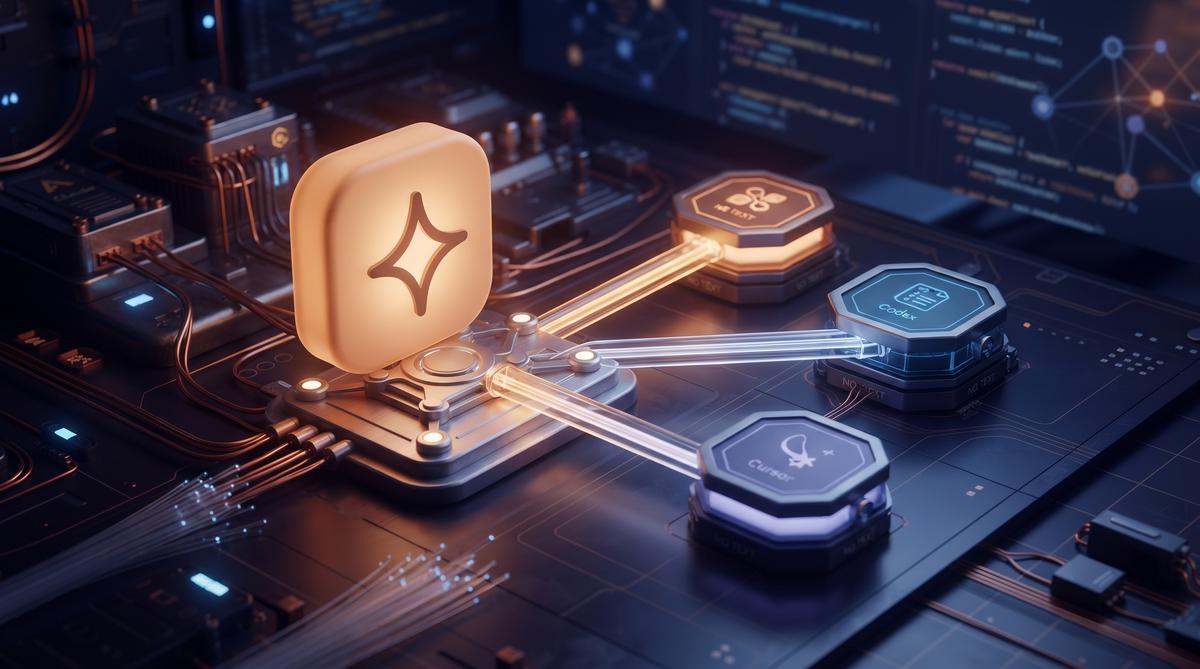
OpenAI’s Codex, Anthropic’s Claude Code, and Cursor now let developers route tasks to different models on the fly. A single workflow can call GLM-5.2 for a codebase audit, then switch to Claude Opus for a complex refactor. The cost difference is staggering.
TL;DR: Smart model routing lets developers dynamically switch between models like GLM-5.2 and Claude Opus inside agents such as Claude Code and Cursor. Tests show GLM-5.2 handled codebase audits, UI redesigns, and autonomous bug-hunting for just $3.36, challenging the dominance of pricier proprietary models.
What Is Smart Model Routing in Coding Agents?
Smart model routing is the practice of directing specific coding tasks to different AI models based on their complexity, context requirements, and cost. Rather than locking into a single provider, developers can configure agents to call GLM-5.2 for routine work and Claude Opus 4 for nuanced reasoning. This cuts spend dramatically.
The concept emerged as coding agents evolved beyond simple chat interfaces. Claude Code, originally tightly coupled to Anthropic’s models, now supports configurable routing through custom hooks and model overrides. Cursor similarly allows users to select different models for different phases of development. Codex brings its own approach to CLI-based workflows.
Routing matters because model pricing varies wildly. Claude Opus commands premium rates for complex reasoning, while open-weight alternatives like GLM-5.2 from Z.AI deliver comparable results for a fraction of the cost. The open-weight model from Z.AI was tested through codebase audits, UI redesigns, and a 45-minute autonomous bug-hunting task across both Cursor and Claude Code (Lenny’s Newsletter, 2026). The total bill came to $3.36.
That is not a typo. An entire session of autonomous coding, bug detection, and interface work cost less than a coffee. Developers are taking notice because the implications for team budgets and individual productivity are enormous.
The routing layer sits between the developer’s intent and the model’s execution. When a developer types a prompt, the agent evaluates which model should handle it. Simple completions go to cheaper models. Complex architectural decisions route to premium ones. This happens transparently.
How Does Model Routing Work Inside Claude Code?
Claude Code operates as a terminal-based agent that reads your codebase, executes commands, and modifies files directly. Model routing inside Claude Code works through configuration files and command-line flags that specify which model to use for a given session or task. Developers can override the default Claude model.
The mechanism relies on Anthropic’s API infrastructure but is not limited to Anthropic models. Developers have successfully configured Claude Code to route requests to GLM-5.2 by modifying the underlying API endpoints and authentication tokens. This requires some setup but enables significant cost savings without abandoning the Claude Code interface.
Claude Code has generated significant attention in the developer community since its release (Antyweb, 2026). The tool’s ability to navigate complex codebases, understand project structure, and make multi-file edits set it apart from earlier coding assistants. The growing interest stems from its terminal-native approach, which fits naturally into existing developer workflows.
Routing specifically involves these configuration points:
- API endpoint overrides — pointing Claude Code’s backend to a different model provider — Model name parameters — specifying which model variant to call
- Authentication tokens — configuring credentials for alternative providers like Z.AI
- Session-level routing — choosing models per terminal session rather than globally
- Task-based switching — manually switching models mid-session when task complexity changes
- Hook-based automation — using Claude Code’s hook system to trigger model switches programmatically
- MCP server integration — routing through Model Context Protocol servers that can proxy requests
- Cost monitoring — tracking token usage per model to optimize routing decisions
The practical workflow looks like this. A developer starts a Claude Code session pointed at GLM-5.2 for initial codebase exploration and audit work. Once the model identifies issues that require deeper reasoning, the developer switches to Claude Opus for the actual fix. This hybrid approach captures the strengths of both models.
Claude Code’s architecture supports this flexibility because it separates the agent logic from the model backend. The agent’s ability to read files, execute commands, and manage context operates independently of which model generates the responses. This separation is what makes routing viable.
What Differences Does Codex Bring to CLI Workflows?
Codex approaches model routing from a different angle than Claude Code. As a CLI-native tool developed by OpenAI, Codex integrates routing decisions directly into the command-line workflow, offering distinct surfaces for application interaction, hook configuration, and MCP support. The architecture prioritizes automation.
A detailed comparison of Codex and Claude Code as of June 2026 reveals significant differences in how each tool handles multi-model workflows (Iwoszapar, 2026). Codex structures its CLI around worktrees and automation pipelines, making it particularly suited for team environments where multiple developers interact with the same codebase simultaneously.
The routing model in Codex emphasizes explicit task boundaries. Rather than dynamically switching models mid-conversation, Codex encourages developers to define discrete tasks and assign appropriate models to each. This creates a more structured workflow but requires more upfront planning. The trade-off is predictability.
Codex’s CLI workflow differs from Claude Code’s in several key areas:
| Feature | Codex | Claude Code |
|---|---|---|
| CLI architecture | Worktree-centric, parallel sessions | Single-session, sequential |
| Hook system | Built-in automation triggers | Custom hooks via configuration |
| MCP support | Native integration | Supported via adapters |
| App surfaces | Terminal plus IDE extension | Terminal-focused |
| Team collaboration | Multi-developer worktree support | Individual sessions |
| Model switching | Task-bound, explicit | Session-bound, flexible |
| Automation depth | Deep pipeline integration | Moderate scripting support |
For developers already invested in OpenAI’s ecosystem, Codex offers natural integration with existing API keys and billing. The tool’s worktree approach means multiple models can run simultaneously on different branches, each handling a specific aspect of a project. One branch might run GLM-5.2 for documentation. Another runs Claude Opus for core logic.
The CLI workflow in Codex also handles long-running tasks differently. Where Claude Code sessions typically block the terminal during model inference, Codex can queue tasks and notify on completion. This asynchronous model fits better in CI/CD pipelines and automated development workflows.
How Does Cursor Handle Multi-Model Routing?
Cursor handles model routing through its IDE-integrated interface, giving developers a visual model picker that sits directly in the editor. Unlike terminal-based tools, Cursor exposes routing as a first-class UI feature. Developers select models from a dropdown before each prompt.
This visual approach lowers the barrier to entry. Developers do not need to edit configuration files or pass command-line flags. They simply choose the model that fits the current task. Cursor supports Claude models, GPT variants, and increasingly open-weight alternatives like GLM-5.2 through API configuration.
The tested workflow with GLM-5.2 in Cursor demonstrated the model’s capability across multiple task types (Lenny’s Newsletter, 2026). During a codebase audit, GLM-5.2 identified architectural issues and suggested refactoring paths. For UI redesigns, the model generated component modifications and styling updates. The 45-minute autonomous bug-hunting session produced actionable fixes.
Cursor’s routing system also includes context-aware suggestions. The IDE analyzes the current file, cursor position, and recent edits to recommend which model might perform best. This is subtle but useful. A developer working on a complex algorithm gets pointed toward Claude Opus. Routine documentation work suggests a cheaper model.
The cost advantage becomes clear in practice. Running GLM-5.2 for an extended session that included all three task types — codebase audit, UI redesign, and bug hunting — totaled $3.36 across both Cursor and Claude Code combined. That same workload on Claude Opus alone would cost significantly more.
Cursor’s multi-model routing extends beyond just picking a model per prompt. The IDE supports custom commands that can chain different models together. A developer might configure a command that uses GLM-5.2 to generate an initial draft, then automatically routes the output to Claude Opus for review and refinement. This pipeline approach maximizes both cost efficiency and quality.
Can Open-Weight Models Like GLM-5.2 Replace Proprietary Options?
Open-weight models are closing the gap faster than most developers expected. GLM-5.2, developed by Z.AI, recently completed codebase audits, UI redesigns, and a 45-minute autonomous bug-hunting session across Cursor and Claude Code for just $3.36, according to testing reported by Lenny’s Newsletter. That price point makes it roughly an order of magnitude cheaper per session than running equivalent workloads on Claude Opus. The performance delta is shrinking.
For routing strategies, this matters because the traditional assumption has been that only frontier proprietary models can handle complex agentic coding tasks. GLM-5.2 challenges that directly. Tests demonstrated the model sustaining context over extended autonomous sessions without catastrophic degradation. It held its own during multi-file refactoring and sequential bug discovery.
That said, replacement is context-dependent. Proprietary models still maintain advantages in niche reasoning benchmarks and ecosystem polish. However, when you route specific task categories — like initial codebase scanning or repetitive test generation — to an open-weight model, the cost savings compound rapidly across a development cycle. Teams running hundreds of agent sessions per week feel that difference in their monthly invoices.
The practical approach emerging in the community is hybrid. Route the heavy lifting to GLM-5.2 where it performs adequately, then escalate ambiguous or high-stakes decisions to Claude Opus. This preserves quality where it matters most.
What Role Do Hooks and MCP Play in Routing?
Hooks and the Model Context Protocol function as the nervous system for intelligent routing. Claude Code exposes a hook system that lets developers intercept agent actions at specific lifecycle points — before a tool executes, after a file edit, or when a session encounters an error. According to the comparison documented on Iwoszapar.com, these hooks can trigger model switches based on real-time signals from the agent’s own behavior. The agent effectively reroutes itself.
MCP complements this by standardizing how external context reaches the model regardless of which provider generated the response. A routing layer can query a vector database through MCP, assess the complexity of the retrieved context, and select the appropriate model before the prompt is even assembled. The protocol abstracts away provider differences.
Together, these two systems allow routing logic to live outside the model itself. A hook can detect that an agent has failed three consecutive file edits and automatically escalate to a more capable model. MCP ensures the escalated session inherits full context without manual re-entry. This is structural automation, not just prompt engineering.
Developers are building custom hooks that evaluate task difficulty heuristically — checking file size, dependency depth, or test coverage — before the first token is generated. The routing decision becomes deterministic and auditable rather than ad hoc.
How Do Worktrees and Automation Fit Into Routing Strategies?
Git worktrees have become an unexpected enabler of parallel multi-model routing. By isolating branches into separate working directories, developers can run multiple agent sessions simultaneously, each powered by a different model, without filesystem collisions. The Codex versus Claude Code comparison highlights worktrees as a core differentiator in how each tool handles concurrent automation workflows.
The strategy works as follows. A team spins up a worktree for a specific subtask — say, generating boilerplate API endpoints. That session routes to a fast, inexpensive model. Meanwhile, a second worktree handles architectural refactoring on a different branch, routed to a frontier model with stronger reasoning. Both sessions operate independently. Neither blocks the other.
Automation layers extend this further. Scripts can orchestrate worktree creation, model assignment, and result merging without human intervention. A CI pipeline could dispatch a low-cost model to write integration tests in one worktree while a premium model tackles the core logic in another. The merge happens when both sessions complete successfully.
This approach treats model selection as a scheduling problem rather than a manual decision. The infrastructure handles distribution.
Which Team Structures Benefit Most From Multi-Model Routing?
Small, autonomous squads with full-stack responsibilities gain the most from routing. These teams typically lack the budget to run every agent session through a frontier model, so intelligent escalation lets them reserve expensive capacity for genuinely difficult problems. A four-person team can function like a larger one.
Startups operating under tight token budgets are natural adopters. When monthly API costs directly impact runway, routing routine generation tasks to GLM-5.2 at a fraction of the cost preserves capital for the tasks where Claude Opus or GPT-4-class reasoning is non-negotiable. The math is straightforward.
Enterprise platform teams also benefit, though differently. They use routing to enforce compliance boundaries — keeping sensitive codebases on self-hosted open-weight models while allowing general-purpose queries to hit cloud APIs. The routing layer becomes a governance tool, not just a cost optimization.
Open-source maintainers represent another strong fit. Community contributors submit patches of varying quality and complexity. A routing system can triage incoming pull requests, sending simple formatting fixes to a lightweight model while flagging architectural changes for human review paired with a frontier model.
What Are the Cost Implications of Switching Models Mid-Session?
Switching models mid-session introduces both savings and hidden costs that teams must account for. The obvious saving is token pricing — GLM-5.2’s $3.36 for a 45-minute autonomous session, as reported by Lenny’s Newsletter, represents a fraction of what Claude Opus would consume for identical work. At scale, this delta is significant.
However, context transfer between models carries overhead. When a session escalates from one model to another, the conversation history and file context must be re-encoded into the new model’s prompt window. This means reprocessing tokens that were already billed on the previous model. Frequent switching can erode savings if not managed carefully.
The break-even point depends on task granularity. If a team routes entire task categories to specific models — all test generation to the cheaper option, all architecture decisions to the premium one — switching overhead is minimal because transitions happen at natural boundaries. Problems arise when routing logic flips between models within a single coherent task.
Teams should track a simple metric: cost per merged pull request. This captures both model efficiency and the overhead of any mid-session transitions.
Frequently Asked Questions
Can GLM-5.2 fully replace Claude Opus in production coding sessions?
Not entirely. GLM-5.2 completed a 45-minute autonomous bug-hunting session for $3.36, demonstrating strong capability in codebase audits and UI redesigns, according to Lenny’s Newsletter. However, Claude Opus still maintains advantages in complex multi-step reasoning and ecosystem integration within Claude Code’s native environment.
Does Codex support the same hook system as Claude Code?
No. According to the Codex versus Claude Code comparison on Iwoszapar.com, Claude Code exposes a granular hook system that intercepts agent actions at specific lifecycle points. Codex handles automation differently, relying more on its CLI workflow and worktree integration rather than developer-defined lifecycle hooks.
How does Cursor decide which model to route a task to?
Cursor’s model selection currently relies on manual configuration or explicit developer choice within the interface. However, community workflows using GLM-5.2 in Cursor, as documented by Lenny’s Newsletter, show developers building external routing scripts that select models based on task type before the session begins.
Is multi-model routing suitable for small development teams?
Yes, small teams are arguably the strongest beneficiaries. A four-person team running GLM-5.2 for routine generation tasks at $3.36 per extended session can preserve frontier model budgets for genuinely complex work. The cost differential makes routing a practical necessity rather than a luxury.
Summary
Multi-model routing inside Claude Code, Codex, and Cursor represents a structural shift in how development teams allocate AI resources. The key takeaways:
- GLM-5.2 costs $3.36 for a 45-minute autonomous session, making it viable for routine coding tasks that previously required frontier models.
- Claude Code’s hook system enables automatic model escalation based on real-time agent behavior, removing manual switching overhead.
- Git worktrees allow parallel sessions across different models, turning routing into a scheduling problem rather than a sequential bottleneck.
- Small teams and startups gain the most from routing because the cost differential directly extends their development capacity.
- Mid-session switching carries context re-encoding overhead — route at task boundaries, not mid-task, to preserve savings.
If your team is spending more than $500 monthly on AI coding sessions, implementing a routing strategy is the single highest-impact change available right now. Start by identifying which task categories consistently succeed on cheaper models, then build hooks or scripts to automate that split.