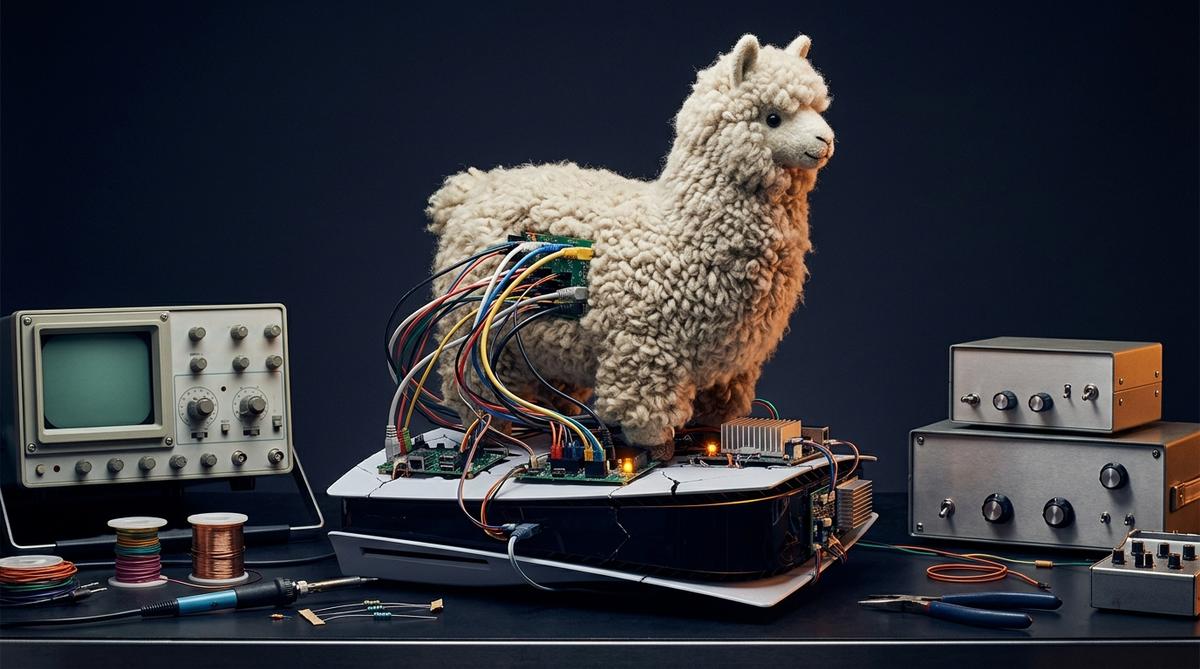
A PlayStation 5 running a large language model sounds like a stunt. It isn’t. A new homebrew project called PS5LM ports llama.cpp to Sony’s console and runs GGUF models directly on its GPU.
TL;DR: PS5LM is an open-source PS5 homebrew app that runs llama.cpp on the console’s GPU through Vulkan. It serves GGUF models over OpenAI- and Anthropic-style APIs, according to coverage from PromptZone and AI/TLDR, effectively turning a jailbroken PlayStation 5 into a local inference host for whatever model you load onto it.
What Exactly Is PS5LM?
PS5LM is an open-source homebrew application for the PlayStation 5. Its purpose is narrow and well-defined: run llama.cpp on the console and serve GGUF models from it. The PS5LM repository documents the project and its homebrew setup.
The project matters because the PS5 sits in an odd position. It’s a locked-down consumer device, but under the hood it carries capable compute hardware sitting idle most of the day. PS5LM treats that hardware as a target platform for llama.cpp rather than as an untouchable appliance.
Two details define the project. First, it runs inference on the console’s GPU through Vulkan, not on the CPU alone. Second, it doesn’t just generate text locally — it exposes the models through standard API interfaces. That second point turns the console from a toy into something other software can actually talk to.
How Does Llama.cpp Work on a PS5 GPU?
Llama.cpp is an inference engine built to run GGUF-quantized models on consumer hardware, and its Vulkan backend is what makes the PS5 port possible. Vulkan is a cross-platform graphics and compute API, and it gives llama.cpp a way to address GPU hardware without caring whether that GPU sits in a desktop card or a game console. AI/TLDR’s PS5LM listing describes the app’s Vulkan-based GPU path.
So the stack looks like this: GGUF model files on one end, llama.cpp’s Vulkan backend on the other, and the PS5’s GPU doing the matrix math in between. No cloud, no remote server, no streaming from a PC. The tokens come from the console itself.
Why Does the PS5 Need to Be Jailbroken First?
A stock PlayStation 5 cannot run PS5LM. The project README requires a jailbroken console on firmware 7.00 to 13.60 and lists kstuff-lite, etaHEN, and ShadowMountPlus as required payloads. That makes PS5LM a homebrew setup, not an app for a stock console.
Which GGUF Models Can You Run?
The GGUF format is the key constraint. GGUF is llama.cpp’s native model container — a single-file format that bundles model weights with quantization metadata so a range of models can run on modest hardware. PS5LM inherits that support directly, since llama.cpp is the engine underneath.
In practical terms, this means models from the GGUF ecosystem are candidates: quantized builds of small and mid-size open models, the kind of files commonly shared for local inference on laptops and mini PCs. You convert or download a model to GGUF, load it in PS5LM, and the console runs it.
If you have a specific model in mind, test the corresponding GGUF file and quantization on the console before relying on it. For background on how quantization and runtime settings affect local-model use, see our guide to the local LLM setup problem.
How Does the API Server Fit Into the Picture?
Here’s where PS5LM stops being a curiosity. AI/TLDR describes the app serving GGUF models over both OpenAI- and Anthropic-style APIs. Those two formats are the request shapes supported by many existing AI clients.
The consequence is straightforward. Any application that can point at an OpenAI-compatible endpoint — chat frontends, coding assistants, custom scripts, agent frameworks — can point at a PS5 instead. The console becomes a local inference host on your network, and the client software doesn’t care or need to know what hardware is answering.
This design choice mirrors what llama.cpp’s own server component does on other platforms, and it’s what separates PS5LM from a one-off demo. You’re not limited to typing prompts at the console. Anything that speaks those API dialects can route requests to the PS5 and get completions back from whatever GGUF model is loaded.
For homelab users, that’s the pitch in one sentence: your console moonlights as an inference endpoint.
What Makes a Game Console a Viable LLM Host?
A modern game console packs GPU hardware that, in principle, can execute the same workloads a desktop graphics card handles — and PS5LM demonstrates this by running llama.cpp directly on the PS5’s GPU through Vulkan. The project shows that the console’s graphics pipeline can be treated as a general-purpose compute target rather than something reserved exclusively for rendering game worlds.
The appeal is straightforward. Millions of PS5 units already sit in living rooms, each containing GPU silicon capable of executing inference workloads via a standard graphics API. According to the AI/TLDR tool listing, PS5LM is an open-source PS5 homebrew app that runs llama.cpp on the console’s GPU through Vulkan and serves GGUF models over OpenAI- and Anthropic-style APIs.
What does this mean in practice? It means a jailbroken console can behave like a small, self-contained inference box. GGUF — the model format associated with llama.cpp — is loaded, the GPU executes the computation, and the results are exposed through familiar API interfaces. The console stops being just a game machine and starts looking like an appliance for running local models.
That said, viability depends on software access. A stock PS5 cannot execute arbitrary homebrew code, so the hardware alone is not enough. The combination of a jailbroken console, the Vulkan-capable GPU, and llama.cpp’s portable architecture is what makes the setup workable at all.
How Do You Set It Up?
The starting point is a PS5 with homebrew access enabled. PS5LM ships as homebrew software, which stock consoles cannot execute — the jailbreak is a prerequisite, not an optional convenience. Once the console runs homebrew, PS5LM can be installed like any other homebrew application in that ecosystem.
From there, the app handles the heavy lifting internally. It embeds llama.cpp, the widely used inference engine for GGUF models, and drives the console’s GPU through the Vulkan graphics API. Users work with GGUF model files, the standard format consumed by llama.cpp-based tooling.
The service model is what makes the setup genuinely useful. Rather than offering only a local interactive interface, PS5LM serves GGUF models over two API styles:
- OpenAI-style API endpoints
- Anthropic-style API endpoints
- Compatibility with existing clients that already target those formats
- Access from other devices on the network, since the model is exposed as a service
- A single console acting as the host for the model rather than a desktop PC
Why does the dual-API approach matter? Because most existing AI tooling already speaks OpenAI- or Anthropic-style protocols. Coverage indicates this design lets users point software they already have at a PS5 instead of rewriting clients or learning a new interface. In my opinion, exposing a console as an API server is the most interesting part of the design — it turns an unusual hardware experiment into something other applications can actually consume.
The practical workflow, then, is: jailbroken console, install the homebrew app, load a GGUF model, connect a client to the exposed API.
What Are the Practical Limitations?
The most obvious limitation is the jailbreak requirement itself. PS5LM only runs on a console with homebrew access enabled, and stock firmware consoles cannot execute the software at all. That immediately restricts the audience to users willing to modify their consoles.
Hardware considerations follow. The project describes llama.cpp running on the PS5’s GPU through Vulkan. If you plan to use a particular model, test that model and quantization on the console before relying on it.
Other constraints worth listing:
- A jailbroken console is required; stock units cannot run the app
- Models must be in GGUF format, the format llama.cpp consumes
- Vulkan serves as the compute path, which shapes how the engine operates on the GPU
- The console functions as an inference server, so client devices need network access to it
- The project is homebrew software rather than an officially supported platform feature
Are these limitations disqualifying? Not for the target audience. For hobbyists already running homebrew on a PS5, the setup slots into an existing workflow. For everyone else, the jailbreak requirement is the single largest hurdle, and the GGUF-only model format narrows which models can be loaded compared to runtimes supporting many formats. Coverage of the project frames it as a homebrew app first, which shapes who can realistically use it.
Why Does Console Homebrew Matter for Local AI?
Console homebrew has traditionally meant emulators, media players, and small games. PS5LM points at something different: repurposing console hardware for AI workloads. The project shows llama.cpp — an engine designed for portability across many GPU vendors — running on a consumer games console’s GPU through Vulkan.
The broader lesson is about software portability. llama.cpp’s ability to target the PS5’s GPU via a standard graphics API suggests the underlying engine adapts to hardware far beyond desktop PCs. When an inference engine treats a console GPU as just another Vulkan device, the category of “devices that can run GGUF models” expands in ways that were previously theoretical.
Related reading: OpenCV 5’s LLM integration.
There is also an accessibility angle. Hardware that already exists in homes gains a second function. Instead of leaving a console idle, a homebrew ecosystem can convert it into a device serving models over OpenAI- and Anthropic-style APIs — protocols that an enormous amount of existing software already understands.
Does this signal a trend? The sources here describe PS5LM as an open-source homebrew project. What this project establishes is feasibility: with the required homebrew setup, llama.cpp can run on a PS5 through Vulkan. That is a concrete example of software portability across hardware categories.
Is This Something Everyday Users Should Try?
For most everyday users, the honest answer is no — at least not without accepting significant prerequisites. PS5LM requires a jailbroken console. The jailbreak step is not a toggle in a settings menu; it is a modification of the console’s software state that stock units do not support, and PS5LM only runs on consoles with homebrew access enabled.
Who should actually consider it?
- Homebrew enthusiasts who already run custom software on a jailbroken PS5
- Developers curious about running llama.cpp on non-standard Vulkan targets
- Tinkerers who want an API server exposed through OpenAI- or Anthropic-style endpoints without dedicating a desktop PC
- Anyone specifically interested in GGUF model workflows on unusual hardware
For these users, the project removes a real obstacle: the app packages llama.cpp for the console and handles the GPU integration through Vulkan, so users do not have to port the engine themselves.
Who should wait? Anyone uncomfortable with the firmware and payload prerequisites. The project README describes a homebrew app, not a stock-console feature. In my view, this is best understood as an enthusiast project.
Frequently Asked Questions
What is PS5LM?
PS5LM is an open-source PS5 homebrew app that runs llama.cpp on the console’s GPU through Vulkan. It serves GGUF models over both OpenAI- and Anthropic-style APIs.
Do I need a jailbroken PS5 to run GGUF models with it?
Yes. The jailbreak is required because PS5LM ships as homebrew software, which stock consoles cannot execute. The app only runs on a console with homebrew access enabled.
Which API formats does PS5LM expose?
The app serves GGUF models through APIs compatible with both the OpenAI and Anthropic styles. Existing clients that target those API formats can therefore point at a PS5.
What engine powers PS5LM under the hood?
PS5LM is built on llama.cpp, the widely used inference engine for GGUF models. It runs that engine on the PS5’s GPU via the Vulkan graphics API.
Summary
PS5LM turns a jailbroken PS5 into a host for GGUF model inference, and the project’s details are worth restating plainly:
- It runs llama.cpp on the PS5’s GPU through Vulkan, demonstrating that the engine works on console graphics hardware.
- It serves models over OpenAI- and Anthropic-style APIs, so existing clients can target a console instead of a desktop machine.
- A jailbreak is mandatory — the app is homebrew software that stock consoles cannot execute.
- Models must be in GGUF format, the standard consumed by llama.cpp-based tooling.
- The project is open source, and its main significance is proving feasibility rather than offering a polished consumer product.
For homebrew enthusiasts, PS5LM is a genuinely novel addition to the console’s software ecosystem. For everyone else, it is a sign of how portable local inference tooling has become. If you run homebrew on a PS5 and work with GGUF models, the project repository and PromptZone’s write-up are the right places to dig deeper.
For Polish: read the Polish version.