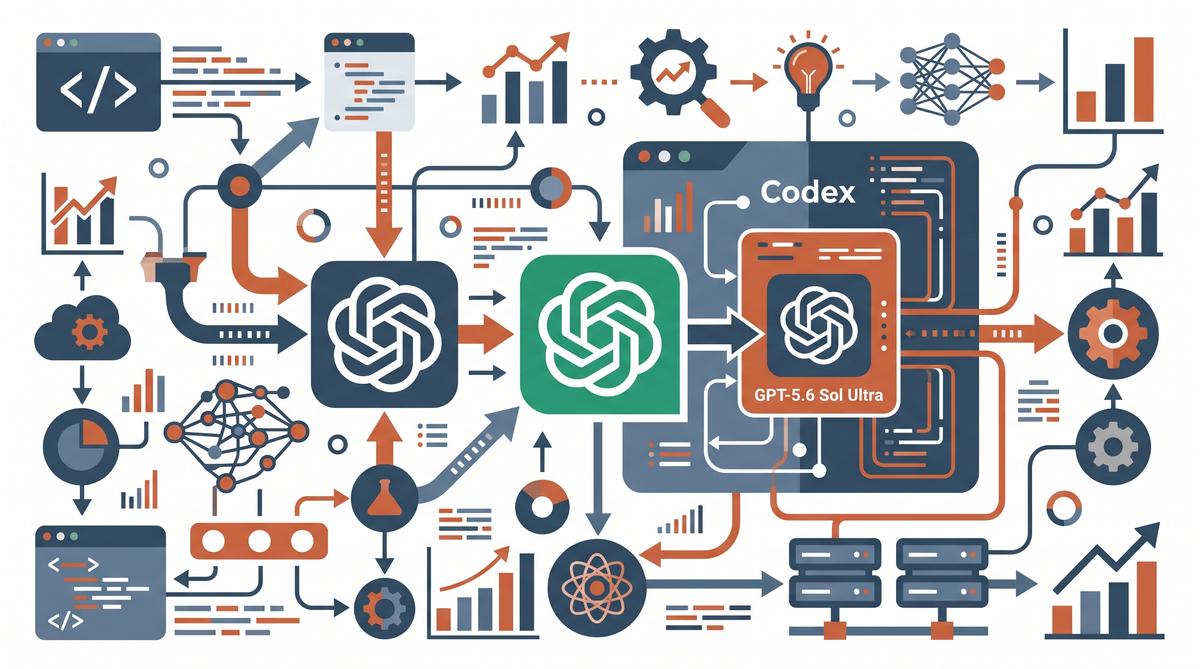
TL;DR: OpenAI engineering lead Thibault Sottiaux confirmed GPT-5.6 Sol Ultra is coming to Codex, reportedly timed to ambush Anthropic during their July 7 launch window. The model is part of a leaked trio appearing in the Codex app, with benchmark figures still unverified.
OpenAI engineering lead Thibault Sottiaux confirmed that GPT-5.6 Sol Ultra is heading to Codex, setting up a direct collision with Anthropic’s reported July 7 launch window. The confirmation came through a short post that quickly circulated across developer communities. The model is part of a leaked trio discovered inside the Codex app.
What Is GPT-5.6 Sol Ultra and Why Does It Matter for Codex?
GPT-5.6 Sol Ultra is the flagship-tier model in a newly leaked trio of OpenAI models appearing inside the Codex application, designed specifically for sustained coding workloads without the throttling that typically frustrates power users. The name itself — “Sol Ultra” — has generated significant discussion. Derya Unutmaz, MD, posted on X that the model “really deserves its name” and urged followers to “get ready for the power of the sun coming to Codex near you.”
For Codex users, the model matters because of how it interacts with quota systems. Conor Dart, an active developer on X, explained the appeal: he finds it “frustrating when platforms limit access to their best model after you’ve used around half of your quota.” With Codex, Dart expects to “keep using GPT 5.6 Sol Ultra throughout” his entire weekly limit. That detail alone could shift developer loyalty.
The model reportedly targets Terminal-Bench performance, though the exact figures circulating remain unverified. AI Weekly noted that the Terminal-Bench figure should be treated “as reported, not settled, until OpenAI publishes it” through official channels.
Who Confirmed the Model’s Arrival in Codex?
Thibault Sottiaux, OpenAI’s Codex engineering lead, is the person behind the confirmation. According to AI Weekly, “a short post from OpenAI’s Codex engineering lead is doing the rounds” after Sottiaux teased the model’s availability. The post from Sottiaux was succinct but unambiguous about Sol Ultra landing in Codex.
The confirmation was subsequently amplified by the community. A widely shared post from the X account Chubby stated plainly: “Confirmed by OpenAI Tibo: GPT-5.6 Sol Ultra will be in Codex. Tomorrow is going to be an insane day.” The nickname “Tibo” refers to Sottiaux directly, tying the confirmation back to his engineering authority at OpenAI.
Sottiaux’s role matters here. As the engineering lead for Codex, his statements carry product-level weight rather than coming from a marketing channel. When an engineering lead says a model is arriving, it typically means integration work is already underway or complete.
How Does GPT-5.6 Sol Ultra Fit Into the Reported Model Trio?
GPT-5.6 Sol Ultra is not arriving alone. According to reporting from BigGo Finance, OpenAI’s GPT-5.6 lineup forms a trio that was leaked inside the Codex app itself. The trio structure suggests tiered access, with Sol Ultra sitting at the top as the highest-capability variant for demanding coding tasks.
The leak appeared through the application’s internal configuration, meaning developers or users discovered references to the models by inspecting app data. BigGo Finance reported that the trio is “reportedly timed to ambush Anthropic during July 7 window,” suggesting OpenAI deliberately seeded multiple model variants to maximize competitive pressure.
The tiered approach mirrors how OpenAI has structured previous model families — offering users a choice between speed, cost, and maximum capability. With Codex specifically, the trio likely maps to different usage tiers within the platform’s weekly quota system.
Is OpenAI Timing This Release to Ambush Anthropic?
Yes, according to BigGo Finance reporting. The outlet stated directly that the GPT-5.6 trio in Codex is “reportedly timed to ambush Anthropic during July 7 window.” Anthropic is expected to make announcements around that date, and OpenAI appears positioned to steal attention by launching a flagship coding model in the same timeframe.
This is not a new playbook in the AI industry. Companies frequently time major model releases to overlap with competitor events. What makes this instance notable is the specificity — a confirmed model name, a confirmed platform, and a reported target date that aligns with a known competitor window.
The community reaction suggests the strategy is already generating buzz. The Chubby account on X declared that “tomorrow is going to be an insane day,” indicating that the timing is creating anticipation well beyond typical product updates. Developers like Conor Dart are already committing to Sol Ultra as their “go-to model” before it has even launched.
What Does Sol Ultra Mean for Developers’ Usage Quotas?
Developers using Codex can expect GPT-5.6 Sol Ultra to remain accessible throughout their entire weekly quota, unlike competing platforms that downgrade users to lesser models after approximately 50% usage. Conor Dart, a developer active in the AI coding community, highlighted this distinction on social media, noting that Codex maintains model access without the frustrating tier degradation common elsewhere. This approach directly addresses one of the most common complaints among professional developers relying on AI coding assistants.
The quota model matters significantly for teams running long coding sessions. Developers frequently report hitting limits mid-task, forcing them to either wait or switch to inferior models. With Codex, the promise of consistent Sol Ultra access means workflows remain uninterrupted. Weekly limits reset predictably, allowing teams to plan their usage around sprint schedules and project deadlines.
Pricing details for Sol Ultra within Codex remain unconfirmed by OpenAI as of the latest reports. However, the Codex platform historically bundled model access into subscription tiers rather than charging per-token. If that pattern holds, developers paying for Codex subscriptions would gain Sol Ultra access without additional per-query costs. This could represent substantial savings for high-volume users.
How Does Codex Differ From Standard ChatGPT Access?
Codex operates as a specialized coding environment within the OpenAI ecosystem, separate from the consumer-facing ChatGPT interface. While ChatGPT serves general-purpose conversations, Codex focuses specifically on software development tasks including code generation, debugging, and architectural planning. The platform integrates directly with development workflows, supporting repository connections and multi-file editing capabilities that standard ChatGPT lacks.
Thibault Sottiaux, OpenAI’s Codex engineering lead, confirmed Sol Ultra’s arrival through a brief social media post rather than a formal product announcement. This communication style aligns with how OpenAI has handled incremental Codex updates — teasers followed by gradual rollout rather than staged press events. The Codex team appears to favor direct developer engagement over marketing campaigns.
Feature parity between ChatGPT and Codex for the same underlying model is not guaranteed. Historically, models deployed in Codex receive system prompts and fine-tuning optimizations specifically calibrated for programming tasks. A developer using GPT-5.6 Sol Ultra through ChatGPT might experience different behavior compared to the same model running through Codex’s specialized pipeline.
What Performance Benchmarks Are Circulating Ahead of Launch?
A Terminal-Bench score for GPT-5.6 Sol Ultra has been circulating in developer communities following Sottiaux’s teaser post. AI Weekly reported the figure as circulating but explicitly noted it should be treated as reported rather than settled, pending official publication by OpenAI. The benchmark allegedly measures the model’s ability to complete terminal-based programming tasks autonomously.
Terminal-Bench evaluates AI models on real-world command-line operations including package management, file manipulation, build system configuration, and deployment scripts. The benchmark has gained traction among developers as a practical measure of coding agent capability beyond synthetic code generation tests. Scores from this benchmark typically correlate with how effectively a model can navigate complex development environments.
No official benchmark documentation has been published on OpenAI’s website or technical blog as of the reporting date. The circulating figures originate from social media discussions and community posts referencing Sottiaux’s comments. Without OpenAI’s formal technical report, the exact methodology, test conditions, and comparison baselines remain opaque. Developers should approach these numbers with appropriate skepticism.
The broader GPT-5.6 family reportedly includes three variants, according to leaked information from the Codex application reported by BigGo Finance. Sol Ultra represents the highest tier, with additional models filling mid-range and entry-level positions. The tiered approach mirrors strategies seen across the AI industry, where providers offer multiple capability levels at different price points.
What Are the Risks of Relying on Unverified Benchmark Figures?
Treating unverified benchmarks as definitive performance indicators carries significant risk for development teams making tooling decisions. AI Weekly explicitly cautioned that the Terminal-Bench figure should be considered reported, not confirmed, until OpenAI publishes official results. Decisions about platform migration, team workflow changes, or tool procurement based on preliminary numbers could prove costly if actual performance differs.
Benchmark gaming represents another concern in the AI industry. Models can be optimized to score well on specific tests without delivering proportional real-world improvements. Without transparency into how Terminal-Bench was administered for Sol Ultra, the development community cannot independently verify that testing conditions match their actual use cases. A model excelling at benchmark tasks might underperform on proprietary codebases or niche programming languages.
The competitive pressure between OpenAI and Anthropic adds another layer of complexity. With reports from BigGo Finance suggesting the Sol Ultra release is timed to coincide with Anthropic’s July 7 launch window, both companies face incentives to present their models favorably. Marketing-driven benchmark releases during competitive windows deserve heightened scrutiny compared to results published during neutral periods.
Development teams should establish their own evaluation criteria before committing to any platform. Running internal benchmarks against representative codebases provides more relevant signal than published scores on generic tests. Until OpenAI releases official Sol Ultra documentation, teams making immediate tooling decisions should factor in the uncertainty surrounding current performance claims.
How Might This Reshape the Competitive Coding Agent Landscape?
The coding agent market has intensified dramatically, with OpenAI, Anthropic, and Google all racing to capture developer mindshare. OpenAI’s decision to position Sol Ultra within Codex signals continued investment in purpose-built developer tools rather than relying solely on general-purpose models. This specialization trend could pressure competitors to build equally focused platforms.
Anthropic’s Claude has established strong adoption among developers, particularly for its coding capabilities and large context windows. If Sol Ultra delivers on circulating benchmark promises, Claude’s positioning as the preferred coding model faces direct challenge. The reported timing — coinciding with Anthropic’s July 7 launch window — suggests OpenAI intends to disrupt competitor momentum rather than release on a neutral schedule.
Smaller players in the coding agent space face increasing pressure. GitHub Copilot, Cursor, and independent coding tools must compete not only on model quality but also on integration depth, pricing, and developer experience. As OpenAI and Anthropic push capabilities further, the gap between first-party platforms and third-party tools may widen. Independent tools relying on API access to frontier models could find themselves competing directly with the platforms providing their underlying infrastructure.
Frequently Asked Questions
When will GPT-5.6 Sol Ultra be available in Codex?
Thibault Sottiaux, OpenAI’s Codex engineering lead, teased the imminent arrival of GPT-5.6 Sol Ultra through a social media post, with community posts from accounts like @kimmonismus suggesting availability could come as early as the following day. However, OpenAI has not published an official release date on its product blog or developer documentation as of the reporting period.
Will GPT-5.6 Sol Ultra have restrictive rate limits?
According to developer Conor Dart’s analysis shared on social media, Codex is expected to maintain Sol Ultra access throughout a user’s entire weekly quota without the mid-cycle downgrades that competing platforms impose after approximately 50% usage. This approach would differentiate Codex from services that restrict access to top-tier models once consumption thresholds are reached.
Is the Terminal-Bench score officially confirmed by OpenAI?
No. AI Weekly explicitly reported the Terminal-Bench figure as circulating but not settled, recommending that it be treated as a reported number rather than a confirmed result until OpenAI publishes official benchmark documentation. No technical report or methodology paper has appeared on OpenAI’s website validating the score.
How does the Anthropic launch window factor into this release?
BigGo Finance reported that the GPT-5.6 trio was leaked through the Codex application with timing described as deliberately positioned to ambush Anthropic during their July 7 launch window. This strategic scheduling suggests OpenAI aims to capture developer attention and media coverage during a period when Anthropic would otherwise dominate the AI news cycle.
Summary
Key takeaways from the GPT-5.6 Sol Ultra announcement:
- Codex retains full model access: Developers can use Sol Ultra throughout their entire weekly quota without mid-cycle downgrades to lesser models, addressing a persistent pain point in AI coding tools.
- Benchmarks remain unverified: The circulating Terminal-Bench score has not been officially published by OpenAI, and AI Weekly recommends treating it as reported rather than confirmed.
- Competitive timing is deliberate: BigGo Finance reports the release targets Anthropic’s July 7 launch window, signaling an aggressive market positioning strategy.
- Codex specialization continues: OpenAI is investing in purpose-built developer environments rather than relying on general-purpose ChatGPT for coding tasks.
- Verification is essential: Development teams should run internal benchmarks against their own codebases before making tooling decisions based on preliminary performance claims.
For ongoing coverage of AI coding tools and platform developments, follow the latest analysis at gikiewicz.com.