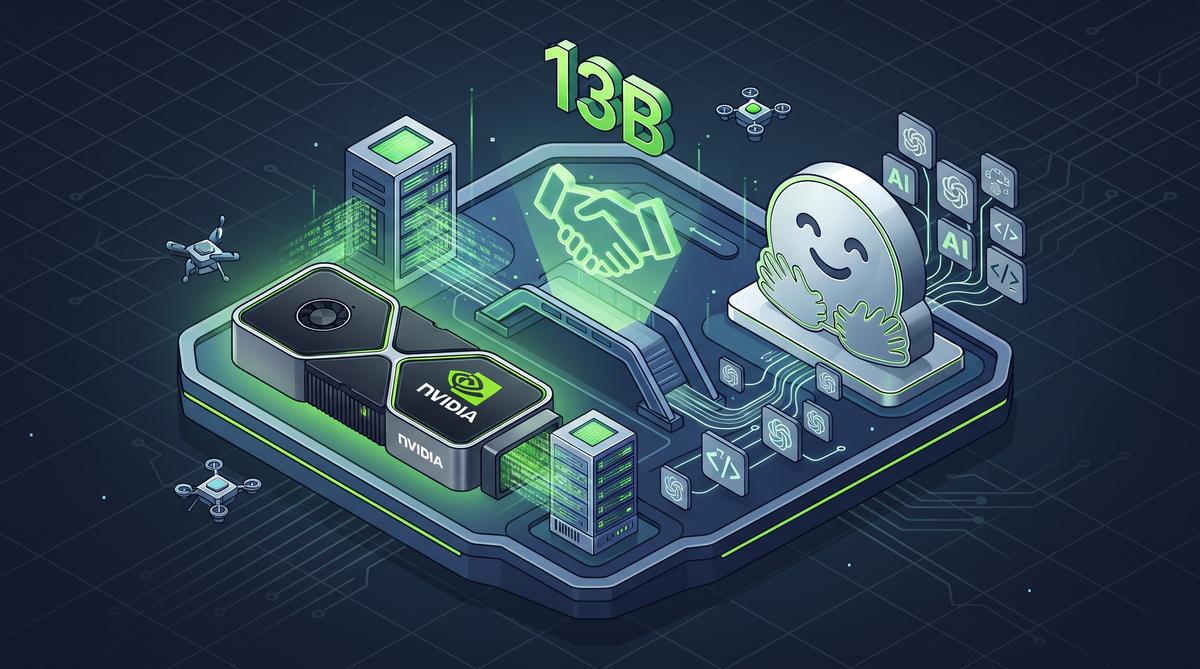
Nvidia has agreed to acquire Hugging Face for $12.9 billion, according to The Information, with CNBC, Bloomberg, and Forbes all confirming the report on August 27, 2026. That price would make the deal one of the largest AI acquisitions on record. And it hands the world’s dominant AI chipmaker control of the platform that hosts most of the industry’s open-source models.
TL;DR: Nvidia has agreed to acquire Hugging Face, the leading repository of open-source AI models, for $12.9 billion, according to The Information and confirmed by CNBC, Bloomberg, and Forbes. The deal would give the chip giant control of the hub hosting most of the industry’s open models and datasets.
What Has Nvidia Agreed to With Hugging Face?
Nvidia has agreed to buy Hugging Face for $12.9 billion, according to a person with knowledge of the agreement cited by The Information. The figure was subsequently reported by CNBC, Bloomberg, and Forbes, with Bloomberg noting the deal values the AI startup at roughly $13 billion. Business Insider reported the talks had exceeded $13 billion at one stage.
The agreement, if completed, would transform Nvidia from a chip supplier into the owner of the platform where much of the open-source AI world actually lives. Hugging Face is often described as a GitHub-like repository for AI models and datasets. Fortune framed the move as a way for Nvidia to cement its grip on the open-source AI ecosystem.
The timing matters. Bloomberg’s opinion piece observed that Nvidia is not only tightening its hold on artificial intelligence, it is also absorbing one of the companies fighting to keep the industry open and decentralized. That tension sits at the heart of the deal.
Why Does Nvidia Want a Model Hosting Platform?
Because hosting is where open models converge. Hugging Face has become the default home for open-source AI, a platform Moneywise described as starting as a chatbot for teenagers and ending up hosting the world’s open-source AI models. Whoever owns that hub shapes how millions of developers discover, download, and deploy models.
For Nvidia, the strategic logic runs along two lines. First, the company already sells the GPUs that train and run most open models, so owning the distribution layer above the silicon extends its reach across the full AI stack. Second, as Tom’s Hardware noted, the acquisition could strengthen Nvidia’s open-model strategy and shore up its position against rivals.
There is also a defensive angle. Open-weight models from competitors increasingly ship through Hugging Face, and controlling that channel gives Nvidia visibility and influence over an ecosystem it does not directly build. Bloomberg put it bluntly: the deal would make Nvidia the king of AI.
How Much Is the Deal Worth and Who Reported It?
The agreed price is $12.9 billion, first reported by The Information on August 27, 2026. CNBC echoed the figure, while Bloomberg and Forbes rounded it to roughly $13 billion. Business Insider reported that talks had valued the company at more than $13 billion during negotiations.
The reporting timeline unfolded quickly. Bloomberg first reported on August 27, 2026, that Nvidia was nearing an agreement to acquire Hugging Face. TechCrunch had already reported on August 26, 2026, that Nvidia was closing in on the acquisition. Fortune and TechRadar followed with confirmations of the advanced talks.
The valuation is striking for a company that began as a consumer chatbot app. It places Hugging Face among the most valuable AI infrastructure companies ever acquired, and it represents one of Nvidia’s largest deals as it expands its AI dealmaking, as Business Insider described it.
What Exactly Is Hugging Face and How Did It Start?
Hugging Face is best known as a GitHub-like repository of open-source AI models, as The Information described it. Researchers and companies use it to publish model weights, datasets, and demos, making it the central hub of the open-weight AI movement. Polish outlet MamStartup called it a key repository of open-source AI models and datasets.
The company’s origin is unusual. Moneywise reported that Hugging Face started as a chatbot aimed at teenagers, a consumer product with no obvious connection to enterprise AI infrastructure. The pivot toward model hosting turned that quirky startup into infrastructure the entire industry depends on.
That evolution explains the price tag. A platform that began as an emoji-covered chatbot now sits at the center of how open models are distributed worldwide. Nvidia is effectively buying the distribution layer of open-source AI itself.
How Does the Acquisition Fit Nvidia’s Open-Model Strategy?
The deal aligns with a broader Nvidia pattern of investing across the AI stack. Tom’s Hardware argued the acquisition could strengthen Nvidia’s open-model strategy and shore up the company’s position against rivals competing on both chips and models. Owning Hugging Face connects Nvidia’s hardware business directly to the open-source community.
Bloomberg’s analysis raised the irony embedded in the transaction. Nvidia is absorbing a company that has fought to keep AI open and decentralized, and the announcement came on the same day the chip giant made other significant moves. The question of whether the platform stays neutral under new ownership is now unavoidable.
For developers, the immediate stakes are practical. Hugging Face hosts the models and datasets that countless projects depend on, and any change in governance, pricing, or access policies would ripple across the industry. Fortune’s framing captures the outcome: Nvidia cements its grip on the open-source AI ecosystem, for $12.9 billion.
What Does the Deal Mean for the Open-Source AI Community?
The deal puts the world’s largest open-source AI model repository — often described as a GitHub for AI — under the control of the world’s most valuable chipmaker. Nvidia is paying $12.9 billion for Hugging Face, a platform that hosts hundreds of thousands of open models and datasets, according to The Information. That means the neutral meeting point of the open-source AI world would now sit inside a company with deep commercial interests in the same ecosystem.
Bloomberg’s opinion desk framed the tension bluntly: Nvidia is “absorbing the companies fighting to keep the industry open and decentralized.” Hugging Face built its reputation as a vendor-neutral hub where researchers, startups, and even Nvidia’s rivals publish models. If that neutrality erodes, developers may look for alternatives.
There is a counterargument, though. Tom’s Hardware suggests the acquisition could actually strengthen Nvidia’s open-model strategy, implying continued investment in open weights and tooling. Nvidia has historically supported open ecosystems — its own NeMo and open model releases depend on community adoption. The question is whether that support survives ownership.
Expect scrutiny from the community itself. Every licensing decision, ranking change, or preferential integration will now be read through the lens of Nvidia’s interests. Trust is the real asset here. It can vanish quickly.
How Could Regulators React to the Acquisition?
A $12.9 billion acquisition by the dominant AI chipmaker would almost certainly attract antitrust review in the United States and possibly the European Union. Nvidia already faces regulatory pressure over its grip on AI computing, and buying the central hub for open-source models extends that grip from hardware into software distribution. Bloomberg notes the deal would make Nvidia “the king of AI” — exactly the kind of concentration regulators watch closely.
The concern is vertical integration. Nvidia designs the chips, builds the systems, runs networking, and would now control the platform where many AI models are hosted and discovered. A regulator could argue this lets Nvidia favor its own stack and disadvantage rivals at the distribution layer.
That said, Hugging Face is a platform, not a semiconductor competitor. The deal does not remove a rival chip supplier from the market, which is the classic antitrust red flag. Regulators would need to build a newer, subtler theory of harm around ecosystem control.
Timing matters too. Reports of the agreement surfaced on August 27, 2026, and neither company has detailed a regulatory path. Precedents like Microsoft’s Activision Blizzard deal suggest remedies — behavioral commitments or firewalls — could be on the table if review intensifies.
What Does This Mean for Nvidia’s Rivals Like AMD and Intel?
It tightens the screws. Tom’s Hardware reports the deal could “shore up position against rivals,” and that framing captures the strategic logic. AMD and Intel compete with Nvidia on silicon, but Hugging Face is where developers discover, download, and deploy the models that run on that silicon. Owning that layer gives Nvidia influence over the software ecosystem its competitors depend on.
Consider the practical risks for rivals:
- Optimized model pipelines shipping first — or only — for CUDA-based hardware
- Hugging Face integrations prioritizing Nvidia’s inference stack over ROCm or Gaudi
- Preferential placement or tooling for Nvidia partner models
- Access to ecosystem telemetry and developer trend data competitors lack
- Bundling of Hugging Face services with Nvidia enterprise offerings
- Talent and research partnerships flowing toward Nvidia-aligned projects
- Marketing leverage at community events and model leaderboards
- Potential friction publishing competitor-backed models on the hub
None of this is confirmed — the deal has not even closed. But the incentive structure is obvious. AMD has invested heavily in ROCm and open software to close the CUDA gap; a Nvidia-owned Hugging Face could blunt those efforts at the distribution level.
Intel, meanwhile, is restructuring around foundry services and its Gaudi accelerators. For both companies, the message is that competing on chips alone is no longer enough. The software ecosystem just changed hands.
Could Hugging Face Change After the Acquisition?
History says some change is inevitable, but the shape of it depends on what Nvidia actually wants. According to Moneywise, Hugging Face “started as a chatbot for teenagers” before becoming home to the world’s open-source AI models — the company has already reinvented itself once. Another transformation under new ownership is plausible.
The most likely near-term changes are operational rather than philosophical:
- Deeper integration with Nvidia’s CUDA, TensorRT, and inference tooling
- Enterprise offerings bundled with Nvidia hardware and software subscriptions
- Expanded hosting capacity funded by Nvidia’s balance sheet
- Tighter links between model training and deployment on Nvidia infrastructure
The bigger risk is cultural. Hugging Face’s value comes from community trust, and that trust rests on neutrality. If developers perceive the platform as a Nvidia sales channel, migration to alternatives could begin. Nvidia’s statements so far emphasize supporting the open-source ecosystem, per Tom’s Hardware, but commitments made at announcement time do not always survive integration.
Watch the license terms, the governance of the hub, and whether rival hardware remains first-class. Those are the early signals.
Is This Part of a Broader Nvidia Dealmaking Spree?
Yes. Business Insider reports Nvidia has held talks to acquire Hugging Face “as the chip giant expands its AI dealmaking” — language that positions this deal as one move in a larger pattern. CNBC similarly frames the acquisition as the chipmaker “expanding deeper into the AI ecosystem,” not an isolated bet.
The strategy is vertical. Nvidia has spent years building beyond GPUs into networking, full-stack systems, and software. Buying the leading open-model repository extends that stack into the distribution layer of AI itself. Bloomberg noted the Hugging Face news landed on the same day Nvidia announced other developments, underscoring how aggressively the company is consolidating its position.
For context, Nvidia sits on enormous cash reserves generated by data center demand, and $12.9 billion — while Hugging Face’s largest valuation milestone by far — is a fraction of Nvidia’s market value. The company can afford more deals like this. Expect further acquisitions targeting inference infrastructure, developer tooling, and enterprise AI services. Hugging Face may be the headline, but it is unlikely to be the last.
Frequently Asked Questions
How much is Nvidia paying for Hugging Face?
Nvidia has agreed to pay $12.9 billion, according to The Information and CNBC. Earlier reports from Bloomberg and Business Insider put the figure at roughly $13 billion, with talks valuing the startup at “more than $13 billion” before terms were finalized.
Will Hugging Face stay open source after the Nvidia acquisition?
No official commitment details have been published yet, but Tom’s Hardware reports the deal could strengthen Nvidia’s open-model strategy, suggesting continued support for open weights. Bloomberg, however, warns the acquisition means Nvidia is “absorbing the companies fighting to keep the industry open and decentralized,” so the community remains cautious.
When did reports about the Nvidia-Hugging Face deal first surface?
The reports broke on August 26–27, 2026, when TechCrunch reported Nvidia was closing in on the acquisition and Bloomberg, The Information, and CNBC confirmed an agreement at roughly $12.9–13 billion within hours of each other.
Why is Nvidia buying a platform instead of another chip company?
Because the AI battle has moved up the stack. Hugging Face is described by The Information as a “GitHub-like repository of open-source AI models,” and Fortune notes owning it would “cement Nvidia’s grip on the open-source AI ecosystem” — controlling where developers find and deploy models, not just the hardware they run on.
Summary
The Nvidia-Hugging Face deal is one of the most consequential AI acquisitions since the generative boom began. Key takeaways:
- The price is $12.9 billion, per The Information and CNBC, with earlier reports citing talks above $13 billion — a huge outcome for a startup that began as a teen chatbot.
- The strategic logic is ecosystem control: Nvidia moves from dominating AI hardware to owning the main distribution hub for open-source models, shoring up its position against AMD and Intel.
- The open-source community faces an irony: the decentralized AI movement’s neutral home now belongs to the most centralized force in the industry, as Bloomberg’s opinion piece highlights.
- Regulatory review is likely, given Nvidia’s existing dominance and the vertical nature of the deal, though the theory of harm is untested.
- This fits a broader pattern of Nvidia dealmaking across the AI stack, and more acquisitions should be expected.
The deal has not closed, and the details — licensing, governance, neutrality guarantees — will determine whether this becomes a catalyst or a cautionary tale for open AI. Follow the coverage at Tom’s Hardware, CNBC, and The Information for updates as the acquisition moves forward.