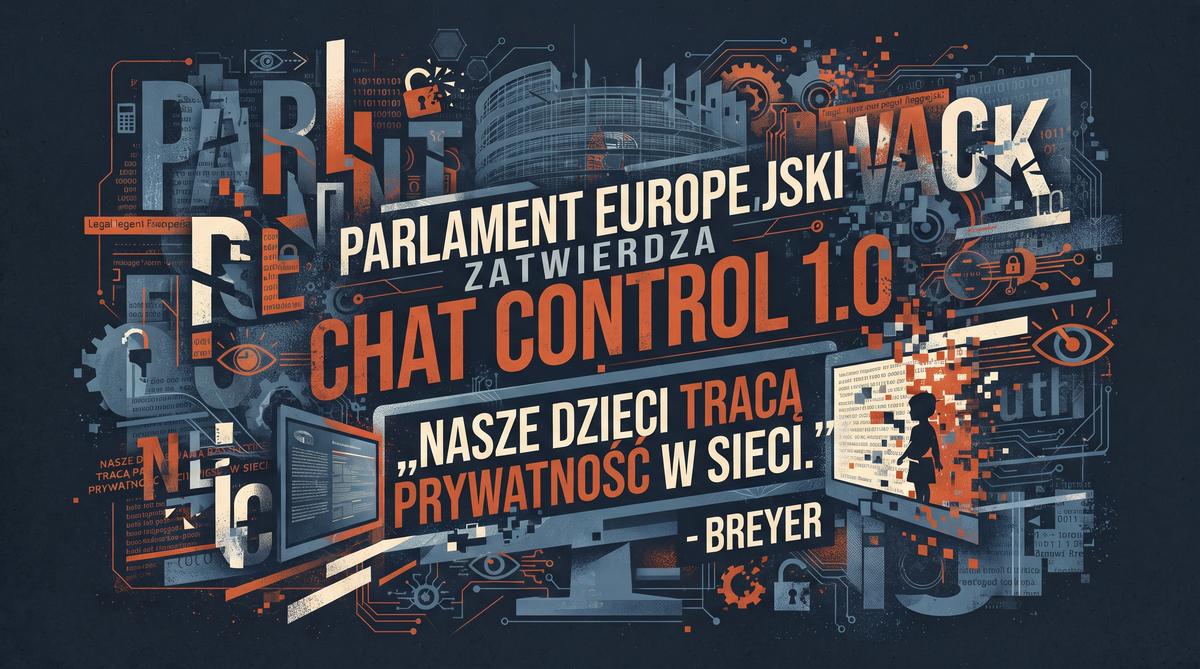
On the last plenary Thursday before the 2026 summer recess, the European Parliament approved the extension of Chat Control 1.0 by a vote of 322 in favor and 255 against. The vote fell short of the 361 absolute majority needed to reject the measure. Patrick Breyer, the MEP who coined the term “Chat Control,” responded bluntly: “Our children lose out.”
TL;DR: The EU Parliament approved Chat Control 1.0 with 322 votes in favor and 255 against, falling short of the 361 absolute majority threshold needed to reject it. The expedited vote occurred on the last plenary day before summer recess, catching many MEPs absent and unable to participate in the decision.
What Exactly Did the EU Parliament Vote On?
The European Parliament voted to extend a temporary exception rule that allows online platforms to voluntarily scan private chat messages and emails for child sexual abuse material, known as CSAM. This exception was originally introduced in 2022 as an interim measure under the ePrivacy Directive. It permits companies to scan communications despite existing encryption and privacy protections.
The measure passed with 322 votes in favor and 255 against, according to reporting from heise online and confirmed by Patrick Breyer’s office. However, a motion to reject the extension failed because it did not reach the 361-vote absolute majority required under the second-reading procedure. This means the extension proceeds without formal parliamentary endorsement of the rejection.
The vote effectively reactivates a surveillance framework that the Parliament had previously turned down. Brussels Signal reported that the extension applies to platforms that voluntarily participate in scanning programs. The scope covers both chat messages and email communications across participating services.
Critically, this is not the broader Chat Control 2.0 proposal, which would mandate scanning across all platforms. The 1.0 version relies on voluntary platform participation. That distinction matters for encryption policy.
How Did a Procedural Trick Force the Vote?
The vote was forced through an expedited procedure requested by the European People’s Party (EPP), as reported by heise online. The EPP submitted a request for urgent procedure on Tuesday, scheduling the vote for the final plenary session before summer recess. This timing was deliberate. Many MEPs had already left Strasbourg.
Patrick Breyer’s office described the maneuver as a “procedural trick” designed to push through a measure that had already been rejected once. The European Conservative reported that the EP had previously voted against the mass surveillance regime. By calling a second vote on the last day, when attendance was low, proponents ensured the rejection motion would fail to reach the 361-vote threshold.
The strategy relied on simple arithmetic. With fewer MEPs present, opponents needed a higher proportion of those remaining to block the extension. Tichyseinblick reported that the expedited procedure bypassed the normal deliberative process, preventing meaningful debate on the privacy implications.
The European Conservative characterized the episode as “Democracy in Action” — a sarcastic reference to the Parliament’s inability to stop a measure it had already rejected once. The procedural mechanism allowed a minority of present MEPs to override the Parliament’s earlier position.
Why Did Patrick Breyer Say ‘Our Children Lose Out’?
Patrick Breyer, a German MEP and privacy advocate who originally coined the term “Chat Control,” issued a statement immediately after the vote declaring that “our children lose out.” His argument rests on a specific critique: the measure does not effectively protect children while simultaneously undermining digital privacy for all citizens.
In an interview with Xataka Móvil, Breyer explained that voluntary scanning programs create a false sense of security. Platforms that choose not to participate face no consequences under the 1.0 framework. Meanwhile, the mass scanning of private communications affects every user of participating platforms, regardless of whether they are under investigation.
Breyer’s office emphasized that the real beneficiaries are surveillance technology companies, not children. The scanning infrastructure deployed under voluntary programs normalizes mass surveillance of digital communications. Once installed, these systems can be repurposed for other forms of monitoring.
The term “our children lose out” refers to the opportunity cost. Resources spent on indiscriminate scanning could instead fund targeted law enforcement operations. Breyer has consistently argued that focused investigations, undercover work, and victim rescue operations are more effective than dragnet surveillance.
Heise online noted that Breyer’s critique extends to the democratic process itself. By forcing the vote through procedural maneuvering, the Parliament bypassed the scrutiny needed to evaluate whether the measure actually serves children’s interests.
How Does Chat Control 1.0 Differ From the Original Proposal?
Chat Control 1.0 and the broader Chat Control 2.0 proposal differ fundamentally in scope and compulsion. The 1.0 framework allows platforms to voluntarily scan private communications for CSAM. Participation is optional. The 2.0 proposal, which remains under negotiation, would mandate scanning across all messaging platforms regardless of consent.
According to Patrick Breyer’s analysis, the original Chat Control proposal would have required tech companies to scan all messages, photos, and emails — including end-to-end encrypted communications. That mandate faced sustained opposition from privacy advocates, cybersecurity experts, and member states concerned about encryption backdoors.
The 1.0 extension preserves the voluntary nature of the 2022 interim measure. Brussels Signal reported that platforms choosing to participate scan user communications and report suspicious content to authorities. Platforms that decline face no penalties under this framework.
The distinction between voluntary and mandatory scanning has significant technical implications. End-to-end encrypted services like Signal and WhatsApp have stated they would rather shut down operations in the EU than compromise their encryption. Under the voluntary 1.0 framework, these services can continue operating without implementing scanning.
However, Breyer and other critics warn that voluntary frameworks often serve as a stepping stone. Once the infrastructure exists and participation becomes normalized, the political pressure to make scanning mandatory increases substantially.
What Are the Technical Requirements for Messaging Platforms?
Under Chat Control 1.0, participating platforms must implement scanning technologies capable of detecting known CSAM in private communications. The technical requirements apply only to services that voluntarily join the program. Non-participating platforms face no obligations.
The scanning typically involves several distinct technologies:
- Hash matching: Platforms compare uploaded images and videos against databases of known CSAM hashes, such as the NCMEC hash list maintained by the National Center for Missing and Exploited Children.
- URL scanning: Messages are scanned for links pointing to known CSAM distribution sites identified by law enforcement agencies.
- Keyword detection: Some platforms implement keyword-based filtering to flag suspicious conversations for human review.
- Metadata analysis: Communication patterns, frequency, and network connections are analyzed to identify potential grooming behavior.
- AI-based detection: Machine learning models flag previously unseen content that may contain CSAM, though accuracy rates remain contested.
- Client-side scanning: Some proposals require scanning on the user’s device before encryption, though this approach faces significant technical criticism.
- Reporting pipelines: Platforms must establish secure channels to report detected CSAM to the appropriate national authorities.
- Data retention: Scanned communications and metadata may be retained for varying periods depending on national implementations.
The technical feasibility of scanning end-to-end encrypted communications remains the central controversy. Current scanning methods require access to unencrypted content, which fundamentally conflicts with end-to-end encryption architectures.
| Requirement | Voluntary (1.0) | Mandatory (Proposed 2.0) |
|---|---|---|
| Platform participation | Optional | Required for all services |
| Encrypted communications | Exempt if E2E encrypted | Must implement scanning workaround |
| Penalties for non-compliance | None | Regulatory sanctions possible |
| Scope of scanning | Platform-defined | EU-mandated categories |
| User consent | Implicit via terms of service | No opt-out available |
| Reporting obligations | Voluntary reports to NCMEC | Mandatory reports to EU centers |
| Audit requirements | Self-reported metrics | External compliance audits |
| Implementation timeline | Self-determined | EU-set deadlines |
Heise online reported that the technical debate over client-side scanning remains unresolved. Security researchers have demonstrated that any scanning system integrated into end-to-end encryption creates exploitable vulnerabilities. The tension between surveillance capabilities and encryption guarantees remains the defining technical challenge.
How Will End-to-End Encryption Be Affected?
End-to-end encryption remains directly in the crosshairs of the new scanning rules, even though Chat Control 1.0 technically operates on a voluntary basis. The regulation reinstates a derogation from the EU’s ePrivacy Directive, allowing platforms to scan private communications for child sexual abuse material (CSAM) without facing legal penalties for breaking encryption. With 322 votes in favor and 255 against (Patrick Breyer, 2026), the Parliament ensured this exception continues.
The core problem is technical. Scanning encrypted messages requires access to their contents before or after transmission. That means platforms must either bypass encryption on the client side or decrypt messages on their servers. Neither approach preserves true end-to-end confidentiality. The derogation creates legal cover for this practice.
Privacy advocates argue this undermines the entire purpose of encryption. If a platform can scan message contents, the encryption no longer guarantees that only the sender and recipient can read them. Breyer, who coined the term “Chat Control,” warned that the real losers are children whose private communications become subject to mass surveillance (Xataka Móvil, 2026). The scanning applies indiscriminately, not just to suspected accounts.
Critically, the voluntary nature of the scanning creates a compliance dilemma. Platforms that choose not to scan may face reputational pressure or future regulatory consequences. Those that do scan must compromise their encryption architecture. This is a fundamental tension.
Which Platforms Fall Under the New Scanning Rules?
The scanning rules apply broadly to online communications services operating within the EU, including email providers, messaging apps, and hosting platforms. The derogation covers any service that processes user communications, regardless of size or market position. Major platforms like Meta’s WhatsApp and Messenger, Google’s Gmail, and Microsoft’s Outlook all fall within scope (heise online, 2026).
The regulation does not distinguish between encrypted and unencrypted services. Any platform offering electronic communications in the EU can voluntarily implement scanning technologies. The key provisions include:
- Email services scanning attachments and message content for known CSAM hashes
- Messaging applications deploying client-side scanning on photos and videos before encryption
- Cloud storage platforms monitoring uploaded files against databases of illegal material
- Social media platforms scanning direct messages and shared media content
- Hosting providers examining user-uploaded content across their infrastructure
- Forum and chat platforms implementing automated detection on private channels
- File-sharing services scanning transferred files against hash databases
- Video communication platforms potentially monitoring shared screens or files
The scope is deliberately wide. EU lawmakers designed the derogation to cover the full spectrum of digital communications, ensuring no platform category escapes potential monitoring obligations.
| Platform Type | Scanning Method | User Notification |
|---|---|---|
| Email providers | Server-side hash matching | None required |
| Messaging apps | Client-side scanning | None required |
| Cloud storage | Automated file analysis | None required |
| Social media DMs | Content hash comparison | None required |
| File-sharing services | Transfer interception | None required |
| Hosting platforms | Upload monitoring | None required |
| Forum/chat platforms | Message scanning | None required |
| Video platforms | Shared content analysis | None required |
Users have no right to be informed whether their communications are being scanned. The rules operate silently.
What Happens Next After the Parliament’s Approval?
The European Parliament’s approval sends the derogation back to the EU Council for formal adoption. The Council had already approved the extension, so the procedural path is now clear. The regulation will be published in the EU Official Journal and take effect immediately, closing the legal gap that would have left platforms without scanning authorization (Brussels Signal, 2026).
The expedited procedure bypassed the normal consultation process. The European Parliament had previously rejected the extension, but the EPP group forced a second vote using an urgency mechanism. On the last plenary Thursday before the summer recess, with reduced attendance, the motion passed with 322 votes — short of the 361 needed for an absolute majority to block it (European Conservative, 2026).
Several procedural steps remain before full implementation:
- Formal Council confirmation of the Parliament’s position
- Publication in the EU Official Journal
- Entry into force across all member states simultaneously
- Notification to platform operators of their renewed scanning authority
- Review period before the regulation expires and requires renewal
The derogation is temporary by design. It will need renewal again, setting up future political battles.
How Did Political Groups Align on the Vote?
The vote revealed sharp divisions within the European Parliament. The European People’s Party (EPP) led the push for approval, using procedural tactics to force a second vote after the Parliament had initially rejected the extension. The EPP scheduled the vote for the final plenary session before summer recess, when attendance was lower and opposition harder to mobilize (heise online, 2026).
Patrick Breyer and his allies in the Pirates and Greens opposed the extension but could not muster the 361 votes needed for an absolute majority. The procedural rules of the second-reading procedure required an absolute majority to reject the Council’s position — a threshold the opposition failed to reach with only 255 votes against (Patrick Breyer, 2026).
The political breakdown exposed uncomfortable realities. Many MEPs had already left Strasbourg for the summer break. The EPP calculated that reduced attendance would favor passage. This strategy worked. The European Conservative described the scene as “Democracy in Action” — a parliament unable to stop a measure it had previously rejected, simply because not enough members remained to vote (European Conservative, 2026).
Breyer condemned the tactic sharply. He argued that scheduling a critical privacy vote on the last day before recess, when most MEPs had departed, was a deliberate manipulation of parliamentary procedure. The result: 322 votes in favor, 255 against, and dozens of absent members who might have changed the outcome.
What Are the Long-Term Implications for Digital Privacy?
The long-term implications extend far beyond this single derogation. Chat Control 1.0 normalizes mass scanning of private communications as an acceptable regulatory tool. Privacy advocates warn this creates a precedent for expanding surveillance powers under future legislation, particularly the still-pending Chat Control 2.0 proposal (Patrick Breyer, 2026).
The most immediate concern is the erosion of end-to-end encryption as a reliable privacy guarantee. If platforms can scan message contents — even voluntarily — the cryptographic promise of confidentiality becomes conditional. Users cannot verify whether their communications are being scanned. This breaks trust in encrypted services.
The precedent also weakens the EU’s regulatory position globally. Other governments may cite the EU’s scanning derogation as justification for their own surveillance programs. The EU has long positioned itself as a defender of digital privacy through GDPR and related legislation. Approving indiscriminate chat scanning undermines that stance.
Several long-term risks emerge from this decision:
- Normalization of mass surveillance as standard regulatory practice
- Weakening of encryption guarantees across commercial messaging platforms
- Expansion of scanning mandates through future legislation like Chat Control 2.0
- Precedent for bypassing parliamentary opposition through procedural tactics
- Loss of user trust in European digital communications services
Breyer’s assessment was blunt: “Our children lose out.” He argued that the measure fails to protect children effectively while subjecting all citizens to surveillance. The scanning technologies produce false positives, flagging innocent communications and potentially exposing private content to review by platform employees or contractors.
The political precedent may prove most damaging. By demonstrating that procedural tricks can override substantive opposition, the vote invites similar tactics on future digital rights legislation.
Frequently Asked Questions
Does Chat Control 1.0 break end-to-end encryption?
Yes, effectively. The derogation allows platforms to scan private communications for CSAM, which requires accessing message contents before or during transmission. With 322 votes in favor, the Parliament reinstated this exception to the ePrivacy Directive, enabling platforms to bypass encryption protections without legal penalty (Patrick Breyer, 2026). The scanning can occur through client-side technology that examines content before encryption is applied.
Can users opt out of chat scanning?
No. The regulation provides no opt-out mechanism for individual users. Platforms that choose to implement scanning do so across all communications on their service, not selectively. The 322-to-255 vote ensured that the derogation applies platform-wide, leaving users with no way to exempt their messages from monitoring (heise online, 2026). The only alternative is to use platforms that decline to implement scanning.
When does Chat Control 1.0 take effect?
The derogation takes effect after formal Council confirmation and publication in the EU Official Journal. The Council had already approved the extension before the Parliament’s vote, so adoption is expected within weeks of the July 2026 plenary session (Brussels Signal, 2026). The rules apply immediately upon publication across all EU member states.
Will Chat Control 2.0 still be pursued?
Yes. Chat Control 2.0 remains under negotiation as a separate, more comprehensive proposal that would make scanning mandatory rather than voluntary. The 322 votes approving Chat Control 1.0 demonstrate continued political support for surveillance measures despite opposition from privacy advocates and 255 votes against (European Conservative, 2026). Chat Control 2.0 would expand scanning obligations and remove the voluntary framework entirely.
Summary
The EU Parliament’s approval of Chat Control 1.0 marks a significant shift in European digital privacy policy. Several key takeaways emerge:
- The derogation passed with 322 votes to 255, falling short of the 361 absolute majority needed to reject it, on the last plenary day before summer recess when many MEPs had already departed
- End-to-end encryption is functionally compromised, as scanning requires access to message contents that encryption is designed to protect
- All major communications platforms — email, messaging, cloud storage, and social media — fall within the scope of the scanning rules, with no user opt-out available
- The EPP used procedural tactics to force a second vote after the Parliament had initially rejected the extension, scheduling it when attendance was low
- Chat Control 2.0 remains pending and would make scanning mandatory, expanding the surveillance framework significantly
The fight over digital privacy in Europe is far from over. The temporary nature of the derogation ensures this debate will return. Subscribe to the newsletter for continued coverage of EU digital policy developments.