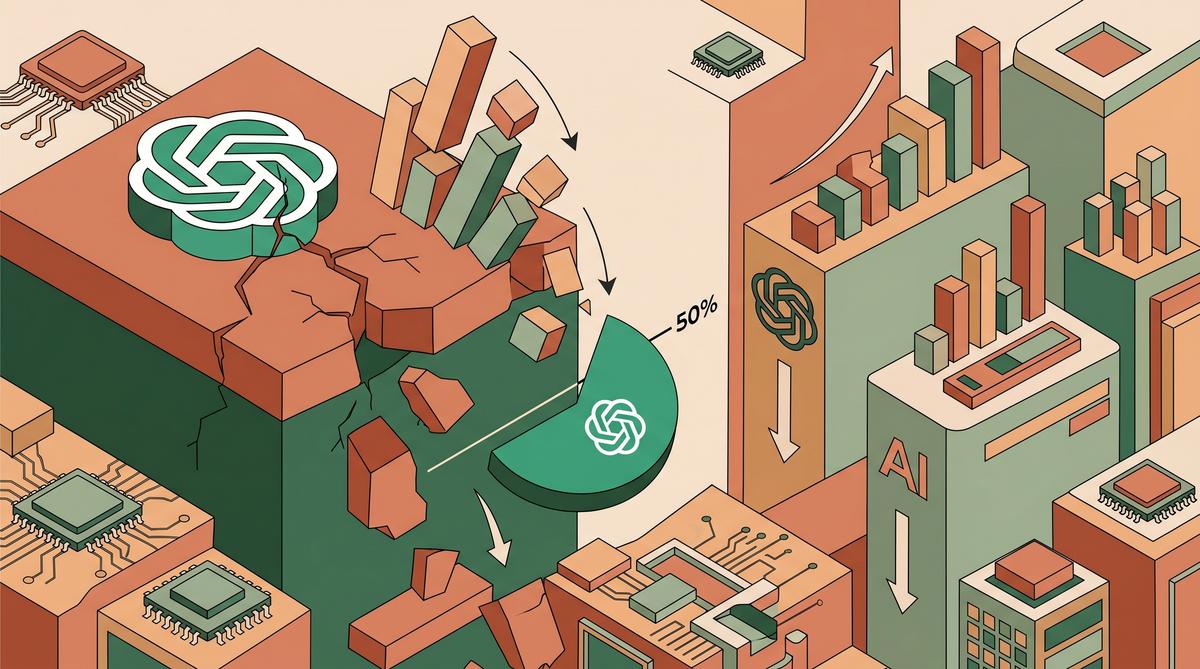
ChatGPT’s share of the AI assistant market dropped below 50% for the first time in July 2024, according to data from Similarweb and analytics reported by TechCrunch. OpenAI’s chatbot still holds the number one position globally. The competitive gap is closing rapidly.
TL;DR: ChatGPT’s market share fell under 50% for the first time in July 2024, signaling the end of its near-monopoly in the consumer AI sector. Google Gemini and Anthropic’s Claude are capturing users at accelerating rates. According to Similarweb data cited by Gizmodo, rival platforms are now actively diverting web traffic away from OpenAI’s once-dominant ecosystem.
How Far Has ChatGPT’s Market Share Fallen?
ChatGPT’s market share fell below the symbolic 50% threshold for the first time in July 2024, marking a definitive shift in the consumer artificial intelligence landscape. According to web traffic analysis from Similarweb, reported by Gizmodo and TechCrunch, the OpenAI platform still commands the largest single audience in the sector. However, the total percentage of users interacting exclusively with ChatGPT has shrunk considerably over the past twelve months. The numbers tell a clear story. Competitors are no longer niche alternatives.
Throughout early 2024, OpenAI maintained a dominant position that frequently exceeded 60% of all AI assistant web traffic. By mid-2024, that majority status evaporated. Analytics indicate that users are increasingly distributing their queries across multiple platforms rather than defaulting to a single interface. This diversification suggests that brand loyalty in the AI sector remains exceptionally fragile. Consumers actively chase the best available output.
The decline does not reflect a drop in absolute user numbers for OpenAI. The platform continues to register hundreds of millions of visits every single month. Instead, the shrinking percentage highlights the rapid expansion of the overall market. Google, Anthropic, and Microsoft are successfully attracting entirely new demographics to their respective products. The total user pie is growing much faster than OpenAI’s slice.
Which Competitors Are Gaining the Lost Market Share?
Google Gemini and Anthropic’s Claude represent the two primary beneficiaries of ChatGPT’s market share contraction. Google’s assistant has leveraged deep integration across Android devices and the Workspace productivity suite to capture mainstream users. Meanwhile, Claude has built a dedicated following among software developers, researchers, and enterprise customers who require advanced reasoning capabilities. Both platforms offer distinct advantages over the established incumbent.
Google deployed Gemini to replace the older Bard interface, immediately benefiting from existing search engine traffic pipelines. The tech giant directed significant promotional resources toward Gemini Advanced, bundling the artificial intelligence tool into its standard cloud storage subscriptions. This distribution strategy dramatically accelerated user acquisition without relying solely on organic discovery. Google simply embedded its model where consumers already spent their time.
Anthropic adopted a different approach by focusing heavily on coding performance, document analysis, and safety-aligned conversational interactions. Claude’s reputation for producing natural-sounding text gave it a strong foothold in professional writing applications. Recent updates expanded the context window dramatically, allowing the assistant to process entire codebases or lengthy financial reports simultaneously. These specific technical improvements drew power users away from generic alternatives.
Perplexity AI and Microsoft Copilot also absorbed a meaningful percentage of departing users. Perplexity carved out a niche in real-time web search integration, appealing to users frustrated by hallucinated facts. Microsoft continued pushing Copilot into Windows and the Edge browser, ensuring massive baseline distribution across desktop operating systems. The competitive field is getting crowded fast.
What Is Driving Users Away From OpenAI’s Platform?
Several distinct factors contribute to the ongoing migration away from ChatGPT, despite its continued status as the leading artificial intelligence assistant. Market saturation plays a significant role; early adopters who experimented exclusively with OpenAI’s interface are now comfortable testing alternative models. Users have realized that different large language models excel at entirely different tasks. No single tool dominates every category anymore.
Performance fatigue also drives the shift. Many professionals report that ChatGPT’s responses have become increasingly verbose or predictable compared to newer competing models. Anthropic’s Claude frequently receives praise for maintaining a more direct, factual tone in complex analytical tasks. Google Gemini often generates superior formatting for visual data presentations. These specialized competencies encourage users to maintain accounts across multiple services.
Pricing structures influence consumer behavior significantly. Google’s decision to bundle Gemini Advanced with Google One Premium storage plans provides massive value that a standalone ChatGPT Plus subscription cannot match. Users already paying for cloud storage effectively receive a high-tier artificial intelligence assistant at no additional marginal cost. This bundling tactic aggressively undercuts OpenAI’s standard twenty-dollar monthly fee.
Finally, concerns regarding data privacy and training methodologies push certain demographics toward alternative providers. Anthropic emphasizes a “constitutional AI” approach designed to minimize harmful outputs through strict internal rules. This focus on ethical alignment appeals strongly to academic institutions and regulated enterprises. OpenAI’s close partnership with Microsoft occasionally raises questions about long-term data independence.
How Accurate Are the Web Traffic Analytics Behind These Reports?
The reports regarding ChatGPT’s shrinking market share rely primarily on third-party web traffic estimation tools, with Similarweb serving as the central data source cited by TechCrunch and Gizmodo. These analytics platforms track desktop and mobile website visits to estimate overall user engagement. While Similarweb provides valuable directional insights, the methodology inherently involves statistical modeling rather than precise server-side measurement. The data captures trends rather than exact figures.
Web traffic analysis faces limitations when measuring application usage. Millions of individuals interact with artificial intelligence assistants exclusively through dedicated smartphone applications rather than web browsers. Similarweb’s mobile app analytics attempt to bridge this gap, but the underlying estimates remain less reliable than direct developer disclosures. OpenAI, Google, and Anthropic rarely publish exact active user counts for their consumer products. The competitive landscape remains somewhat opaque.
Despite these methodological caveats, the directional trend remains undeniable. Multiple independent analytics firms confirm that OpenAI’s share of search queries and direct web visits has contracted throughout 2024. The introduction of Apple Intelligence and its integration with Siri further complicates the tracking ecosystem. iPhone users now access large language models without visiting traditional chatbot websites at all.
What Role Does API Usage Play in These Market Calculations?
API usage represents a massive blind spot in the current market share calculations heavily reliant on consumer web traffic. Many developers and enterprises access OpenAI, Anthropic, and Google models exclusively through backend application programming interfaces. These automated queries never register on traditional web analytics platforms. The actual volume of processed tokens often tells a completely different story.
OpenAI historically dominated the developer API market, establishing itself as the default infrastructure provider for artificial intelligence startups. However, Anthropic has aggressively captured developer mindshare by offering highly competitive pricing for Claude’s API access. Google’s Vertex AI platform provides seamless scaling for enterprises already embedded in Google Cloud. The backend battle intensifies daily.
A startup might build its application using Claude’s API for complex reasoning tasks while simultaneously utilizing GPT-4o for basic generation through OpenAI’s endpoint. This multi-model approach means that raw consumer traffic statistics fail to capture the full scope of artificial intelligence deployment. Enterprise contracts, often negotiated privately, determine the true financial health of these providers. Public web metrics only reveal part of the picture.
Why Are Users Migrating to Gemini and Claude?
Google’s Gemini captured significant market share by leveraging its deep integration across Android devices and Google Workspace applications. The assistant gained traction because it comes pre-installed on millions of Pixel phones and Samsung devices. Distribution matters. Users get Gemini without installing anything extra, which drives adoption at scale.
Anthropic’s Claude attracted developers and enterprise customers through its reputation for producing cleaner code. Claude also offers a larger context window in its premium tier, allowing professionals to process lengthy documents in a single prompt. The assistant handles complex programming tasks with notable accuracy. These specific capabilities pulled power users away from ChatGPT throughout 2025.
Both competitors also benefited from aggressive pricing strategies. Google bundles Gemini Advanced into its Google One AI Premium plan, which includes 2 TB of cloud storage. That bundle creates value beyond the AI assistant itself. Anthropic priced Claude Pro competitively at $20 per month, matching OpenAI’s offering while differentiating on output quality.
How Does Pre-Installation on Devices Affect Market Share?
Pre-installation deals directly accelerated Gemini’s market share growth by removing friction from the user acquisition process. When manufacturers ship devices with an AI assistant already configured, users rarely seek alternatives. Default settings win. According to the reported market data, Gemini’s integration into the Android ecosystem gave Google an immediate distribution advantage that OpenAI cannot replicate.
Apple’s decision to integrate ChatGPT into iOS 18 helped OpenAI maintain some mobile presence, but the arrangement is non-exclusive. Reports indicate that Apple continues discussions with Google about adding Gemini as an alternative Siri-powered option. Multiple assistants on one device fragment user loyalty. This fragmentation pressures OpenAI’s dominance further.
Samsung’s Galaxy AI suite also relies partially on Google’s infrastructure, pushing users toward Gemini when they use AI features on Galaxy phones. The line between native assistant and downloaded app blurs. Consumers increasingly use whatever tool their hardware manufacturer chose for them.
What Role Does Enterprise Adoption Play?
Enterprise contracts represent a growing portion of the AI assistant market, and competitors are winning deals that previously went to OpenAI. Anthropic positioned Claude as the assistant of choice for regulated industries because of its constitutional AI approach to safety. Companies worry about data exposure. Claude’s enterprise tier includes features designed to satisfy compliance requirements in healthcare and finance.
Google pushes Gemini into its existing Google Cloud customer base, bundling AI capabilities with productivity suites that corporations already pay for. The strategy converts existing Google Workspace subscribers into Gemini users without a separate procurement process. Procurement friction disappears. This approach captured enterprise users who never actively chose an AI assistant.
OpenAI still holds strong enterprise relationships, particularly through Microsoft Azure OpenAI Service. However, the overall enterprise pie is growing, which means OpenAI’s absolute enterprise revenue can increase while its percentage of market share decreases.
Which Demographics Show the Strongest Shift Away from ChatGPT?
Developer communities show the most pronounced migration toward Claude, driven by the assistant’s coding performance. GitHub repositories and developer forums increasingly reference Claude in tutorials and project documentation. Programmers switch tools fast. When an assistant generates more accurate code, developers adopt it for daily work without hesitation.
General consumers with Android devices represent another demographic shifting toward Gemini, largely because of pre-installation rather than active preference. These users interact with Gemini through voice commands and camera features built into their phones. Convenience drives behavior. Many of these users do not consciously choose Gemini over ChatGPT.
Students and academic users represent a contested segment. ChatGPT remains popular in education, but Claude’s document-handling capabilities attract researchers processing lengthy papers. The academic market splits between multiple tools depending on specific use cases.
What Does This Mean for OpenAI’s Business Valuation?
OpenAI’s valuation depends on sustained growth, and losing majority market share introduces pressure on revenue projections. The company was valued at approximately $157 billion in its latest funding round, with investors pricing in continued dominance. Market share erodes that thesis. Competitors gaining ground means OpenAI must spend more on retention.
The AI market itself is expanding rapidly, which cushions the financial impact. Even with a smaller percentage of market share, OpenAI’s absolute revenue continues growing because the total number of users adopting AI assistants increases monthly. Revenue grows regardless. However, investors typically reward market leadership over participation.
OpenAI’s subscription revenue from ChatGPT Plus, Team, and Enterprise tiers remains strong, but the competitive landscape limits pricing power. If Gemini or Claude offer comparable features at lower prices, OpenAI faces pressure to reduce subscription costs.
Frequently Asked Questions
What specific market share did ChatGPT lose?
ChatGPT’s market share fell below 50% for the first time, according to data reported by TechCrunch and Gizmodo. The assistant previously held a dominant position that exceeded 50% of the total AI assistant market. Google’s Gemini and Anthropic’s Claude absorbed the largest portions of that lost share throughout the period.
Is ChatGPT still the most used AI assistant?
Yes, ChatGPT remains the single most used AI assistant globally despite losing its majority position. The assistant still ranks first in total active users and app downloads. However, the combined user base of all competing assistants now exceeds ChatGPT’s individual share.
How much does Gemini cost compared to ChatGPT Plus?
Google prices Gemini Advanced at $19.99 per month as part of the Google One AI Premium plan, which also includes 2 TB of cloud storage. ChatGPT Plus costs $20 per month. The pricing is nearly identical, but Google’s bundle adds storage value that OpenAI does not match.
Will OpenAI lose more market share in the coming months?
Market analysts expect continued share fragmentation as Apple integrates additional AI providers into iOS and as enterprise customers adopt multi-assistant strategies. The trend suggests further pressure on ChatGPT’s position. However, OpenAI’s upcoming model releases could stabilize or reverse the decline if they deliver meaningful capability improvements.
Summary
- ChatGPT lost its majority hold on the AI assistant market, dropping below 50% share as Gemini and Claude absorbed users through distribution deals and differentiated capabilities.
- Google’s Gemini leverages Android pre-installation and Google Workspace bundling to capture consumers who never actively chose an AI assistant.
- Anthropic’s Claude attracts developers and regulated enterprises through superior coding output and safety-focused architecture.
- Enterprise adoption increasingly splits across multiple providers as companies adopt multi-assistant strategies rather than standardizing on OpenAI.
- OpenAI’s absolute revenue continues growing despite share loss, but the competitive landscape limits future pricing power and valuation upside.
The AI assistant market entered a new phase where no single provider dominates. For deeper analysis of how these shifts affect developer workflows and enterprise strategy, follow the ongoing coverage here as the landscape continues evolving.