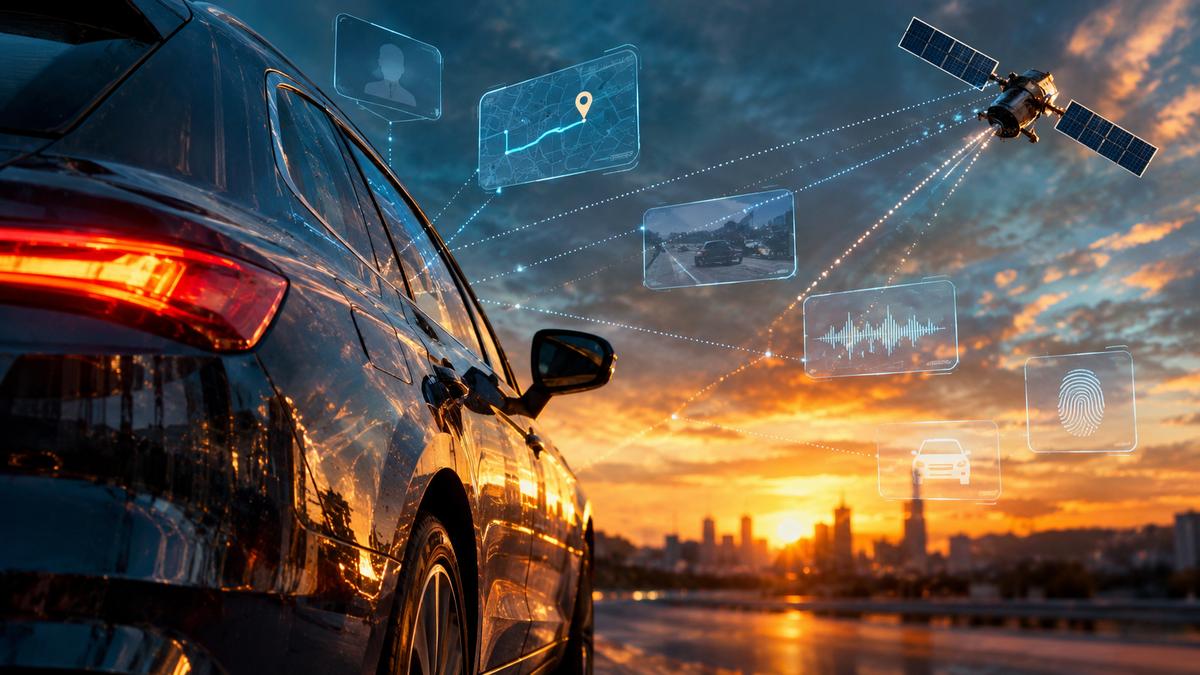
Twenty-one connected vehicles. Thirty companion apps. One study that traced where all of that driver data actually goes — and the results confirm what privacy researchers have long suspected about the cars sitting in our driveways.
The study, called Automatic Transmission, examined how connected cars and their companion apps collect and share information about drivers. Sources describing the findings report widespread communication with third-party advertising and analytics companies. Cars sent data to Big Tech companies, including locations, VINs, and other identifiers. The companion apps added another layer of trackers on top of that.
TL;DR: The Automatic Transmission study examined 21 connected vehicles and 30 companion apps, finding widespread data sharing with outside companies, including advertisers and analytics firms. Cars sent locations, VINs, and other identifiers to Big Tech companies, while companion apps added another layer of trackers on top of the vehicles themselves.
What Is the Automatic Transmission Study?
Automatic Transmission is a study focused on data privacy in connected vehicles, examining how and with whom these cars share driver information. Coverage indicates the researchers looked at 21 connected vehicles and 30 companion apps — the smartphone applications that pair with modern cars to offer remote controls, diagnostics, and other services.
The premise is simple. Modern cars are computers on wheels, and like any computer with a network connection, they transmit data. The question the study set out to answer: where does that data actually end up?
The answer, according to the findings, is that it ends up in a lot of places owners may not expect. Between the cars and their companion apps, a driver is exposed to a significant number of trackers. The study is notable for looking at both sides of the equation — the vehicle itself and the app ecosystem around it — rather than treating the car as an isolated device.
Why does this matter? Because most people have no realistic way to audit what their car is doing. Unlike a phone, where privacy tools and permissions are at least visible, a connected vehicle’s data flows are largely opaque. Studies like this one do that audit work for the owner.
What Data Do Connected Cars Actually Collect?
Connected cars collect a broad set of driver and vehicle data, and the study found this information being sent to outside companies. According to Consumer Reports’ coverage of the findings, the data sent to Big Tech companies includes locations, VINs, and other identifiers.
That combination deserves attention. A location tells where you are. A VIN ties the data to one specific vehicle. Other identifiers help connect that vehicle to you as a person. Together, these pieces form a fairly complete picture of a driver’s movements and habits.
Think about what location data alone reveals. Where you live. Where you work. Which clinics you visit, which places of worship, which addresses you stop at repeatedly. Sources covering the study describe this data flowing from the vehicles without owners fully understanding the scope of the exchange.
The study’s framing, echoed across multiple write-ups, is that connected cars share far more data with companies than owners may realize. The vehicle is not just reporting telemetry for navigation or emergency services — the findings point to this data reaching advertising and analytics companies as well.
Who Receives the Data From Your Car?
Third-party advertising and analytics companies are among the recipients of connected car data, according to the study of 21 vehicles. The findings describe widespread communication between the vehicles and these outside firms.
The recipients fall into a few categories based on the coverage. Advertising companies appear prominently — your driving data has commercial value, and the study found it flowing toward firms whose business is targeting ads. Analytics companies also receive vehicle data, collecting and processing information about how cars and their drivers behave.
Big Tech companies are in the loop too. Consumer Reports’ write-up on the study states that cars send driver data to Big Tech companies, with the shared information including locations, VINs, and other identifiers. That means the ecosystem of recipients is not limited to automotive-industry players; the largest technology companies are part of the data flow.
And then there are, per one write-up, strangers — the Gadget Review coverage notes connected cars share your data with advertisers and strangers, a phrasing that underscores how little control owners have over the downstream path of their information once it leaves the vehicle.
How Do Companion Apps Fit Into the Privacy Problem?
Companion apps add a second, separate layer of data collection on top of what the cars themselves do. The study examined 30 of these apps alongside the 21 vehicles, and sources say the apps exposed drivers to a lot of trackers — as Ars Technica puts it, between the cars and their companion apps, you’re exposed to a lot of trackers.
These apps are the smartphone tools most connected-car owners install without a second thought. They let you lock the doors remotely, check the fuel or battery level, locate the car in a parking lot, or start the climate system. That convenience comes with a data cost the study set out to measure.
The key insight from including apps in the analysis: even if a vehicle’s own data practices were constrained, the companion app operates on your phone, where it can collect information using all the permissions a mobile app typically requests. Two devices, two collection surfaces, one driver.
For the full picture of what the researchers found in the apps — how many trackers were involved and how the app layer compares to the vehicle layer — the study’s tracker counts, covered in the next section, are the revealing part.
How Many Trackers Were Found Across Cars and Apps?
The study found trackers present across both the vehicles and the companion apps, with the combined exposure described as significant. Coverage of the findings emphasizes that between the cars and their companion apps, the number of trackers a driver encounters is high — though the sources available for this article report the 21-vehicle and 30-app scope rather than a single total tracker count.
The structure of the finding matters more than any single number. Trackers were not confined to one channel. The cars themselves communicated with third parties, and the apps added their own tracking on top. A driver who avoided the app would still be exposed through the vehicle. A driver who skipped connectivity features would still carry a phone running the app.
How did the researchers establish this? The study examined how and with whom connected cars share data — a network-level analysis of the actual communications rather than a reading of privacy policies. That distinction is important, because privacy policies describe intentions, while network traffic shows what actually happens.
The direction of the findings is consistent across the coverage: widespread communication with third-party advertising and analytics companies, data reaching Big Tech, and a tracker presence that spans both hardware and software. Sources describe the state of connected car data privacy in blunt terms, with one write-up calling it abysmal.
For drivers, the practical takeaway from this part of the study is that the problem is layered. No single setting or single device accounts for the exposure. The full scope of what the study recommends — and what owners can actually do about it — is covered in the second half of this article.
Why Are VINs and Location Data So Sensitive?
VINs and location data sit at the top of the sensitivity list because together they can identify both the vehicle and the person driving it. The study found that cars send driver data to Big Tech companies, including locations, VINs, and other identifiers (Consumer Reports). That combination is uniquely dangerous. A VIN is a permanent, unique fingerprint of a specific car, and it can be linked to service records, insurance claims, and ownership databases. Location data, meanwhile, reveals where someone lives, works, shops, and worships. Sources covering the study emphasize that this is not abstract data — between the cars and their companion apps, owners are exposed to a lot of trackers (Ars Technica). When a third-party advertising company receives a location stream tied to a VIN, it can potentially reconstruct daily routines without ever needing the driver’s name. Privacy researchers have long warned that precise movement data is among the hardest categories to de-anonymize. A car that reports both its position and its identity, repeatedly and automatically, effectively hands over a behavioral profile. The study’s findings suggest this is happening broadly, not in isolated cases.
What Can Drivers Do to Protect Their Data?
Drivers are not powerless, but the study makes clear that full protection is difficult once a connected vehicle is on the road. The 21-vehicle study explains what is collected and how to protect yourself (Gadget Review), and the general recommendations fall into a few practical buckets:
- Review the privacy settings in both the infotainment system and the companion app
- Decline optional data-sharing consent during setup where the interface allows it
- Audit the permissions granted to companion apps on your phone, especially location access
- Consider disconnecting or not pairing the companion app if connected features are not needed
- Read the manufacturer’s privacy policy before enabling telematics services
- Ask the dealer which data flows can be disabled at the account level
- Delete your connected-car account when selling the vehicle
- Follow ongoing coverage, since the study’s practical guidance is aimed at ordinary owners
None of these steps guarantees that data collection stops entirely, because much of it is built into the vehicle’s baseline connectivity. Still, the study’s authors and coverage of it frame these measures as meaningful friction. Reducing app permissions and trimming consent settings shrinks the number of trackers a driver is exposed to, even if it cannot reduce them to zero.
Why Is Car Privacy Still So Bad?
Car privacy remains poor because the economics favor data sharing at every level of the industry. The study of 21 connected vehicles found widespread communication with third-party advertising and analytic companies (InsideEVs). Manufacturers have strong financial incentives: driver and vehicle data can be monetized through advertising partnerships, analytics deals, and data brokerage arrangements, often with little direct cost to the automaker. Meanwhile, the driver rarely sees any of this happen. The recent study found that 21 connected vehicles and 30 companion apps sent driver and vehicle data to outside companies (Motor1). That scale matters. It is not one brand or one app behaving badly — the pattern appears across the vehicles studied.
Why has the market not corrected this? Because the data flows are invisible at the point of sale. A buyer choosing between two cars cannot compare their data practices the way they compare horsepower or cargo space. Consent, where it exists, is buried in terms of service rather than presented as a real choice. And companion apps add a second, often-overlooked channel: coverage of the study notes that between the cars and their apps, owners are exposed to many trackers (Ars Technica). Without transparency or competitive pressure, manufacturers have little reason to change.
How Does Car Data Collection Compare to Smartphones?
The comparison to smartphones is unavoidable, and in some ways the car may be worse. New findings show cars send driver data to Big Tech companies, including locations, VINs, and other identifiers (Consumer Reports). Smartphones do collect location and identifiers, but mobile operating systems at least offer visible permission prompts, app-level controls, and indicators when location is in use. A connected car typically offers no such visibility. Data collection happens in the background through the telematics connection, with no on-screen cue and no per-trip consent.
One coverage of the study went further, framing the car as potentially the most invasive device a person owns (Gadget Review). That framing rests on a simple difference in context: a phone knows where you go, but a car knows where you drive, how you drive, and — through the VIN — exactly which physical vehicle is involved. The study also highlights the companion app layer. Between the cars and their companion apps, you are exposed to a lot of trackers (Ars Technica), meaning the driver’s phone becomes a second collection point on top of the vehicle itself. In total, the research examined 21 vehicles and 30 companion apps (Motor1), a broader surface than most smartphone privacy audits ever cover.
Will Regulation Catch Up With Connected Cars?
Regulation has not yet kept pace with what the study documents. The study of 21 connected vehicles found widespread communication with third-party advertising and analytic companies (InsideEVs), yet none of the coverage ties these practices to specific enforcement actions or penalties. That gap illustrates the core regulatory problem: data practices in vehicles are expanding faster than the rules that govern them.
What would catching up require? A few building blocks come to mind, and the study indirectly points to each:
- Transparency requirements forcing automakers to disclose exactly which third parties receive data
- Meaningful, granular consent rather than blanket terms of service
- Limits on sharing sensitive categories such as precise location and VIN-linked records
- Enforcement mechanisms with penalties that outweigh the revenue from data deals
- Standards for companion apps, which the study shows are a major tracker source
Until such rules exist, the effective regulator is public attention. Studies like this one, which examined 21 vehicles and 30 companion apps (Motor1), play that role by making invisible data flows visible. Whether lawmakers respond is an open question. The study itself documents the practices; it does not document any regulatory response, and coverage so far focuses on the findings rather than pending legislation. Drivers concerned today will need to rely on the self-protection steps above.
Frequently Asked Questions
What is the Automatic Transmission study?
It is a research study examining how and with whom connected cars share driver data. The study analyzed 21 connected vehicles and their 30 companion apps, documenting that driver and vehicle data — including locations, VINs, and other identifiers — is sent to outside companies, including advertising, analytics, and Big Tech firms.
How many vehicles and apps were analyzed?
The study covered 21 connected vehicles and 30 companion apps. Researchers found that all of these vehicles and apps sent driver and vehicle data to outside companies, making the pattern widespread across the sample rather than isolated to one brand.
What kind of data do connected cars share?
According to the study, connected cars send locations, VINs, and other identifiers to third parties. The recipients include Big Tech companies, third-party advertising companies, and analytic companies, and the companion apps add an additional layer of trackers on top of the vehicle’s own data flows.
Can drivers stop their car from collecting data?
Drivers can reduce exposure but likely cannot eliminate it. The 21-vehicle study includes guidance on what is collected and how to protect yourself, with practical steps such as tightening companion app permissions, adjusting in-car privacy settings, and declining optional data-sharing consent where possible.
Summary
The Automatic Transmission study pulls back the curtain on an industry that collects far more than most owners realize. Here are the key takeaways:
Scale: 21 connected vehicles and 30 companion apps were analyzed, and all were found to send driver and vehicle data to outside companies.
Recipients: Data flows to third-party advertising companies, analytics firms, and Big Tech companies — not just the manufacturer.
Sensitivity: Locations, VINs, and other identifiers are among the data shared, a combination capable of building detailed behavioral profiles of individual drivers.
Double exposure: The companion apps add their own trackers, so the privacy surface extends from the driveway to the driver’s phone.
Protection is partial: Drivers can trim app permissions and tighten settings, but baseline telematics collection is difficult to escape, and regulation has not yet caught up.
If you own a connected car, spend thirty minutes today reviewing your companion app permissions and your vehicle’s privacy settings. And if this topic matters to you, share the study’s findings — visibility is currently the only force pushing automakers toward change.