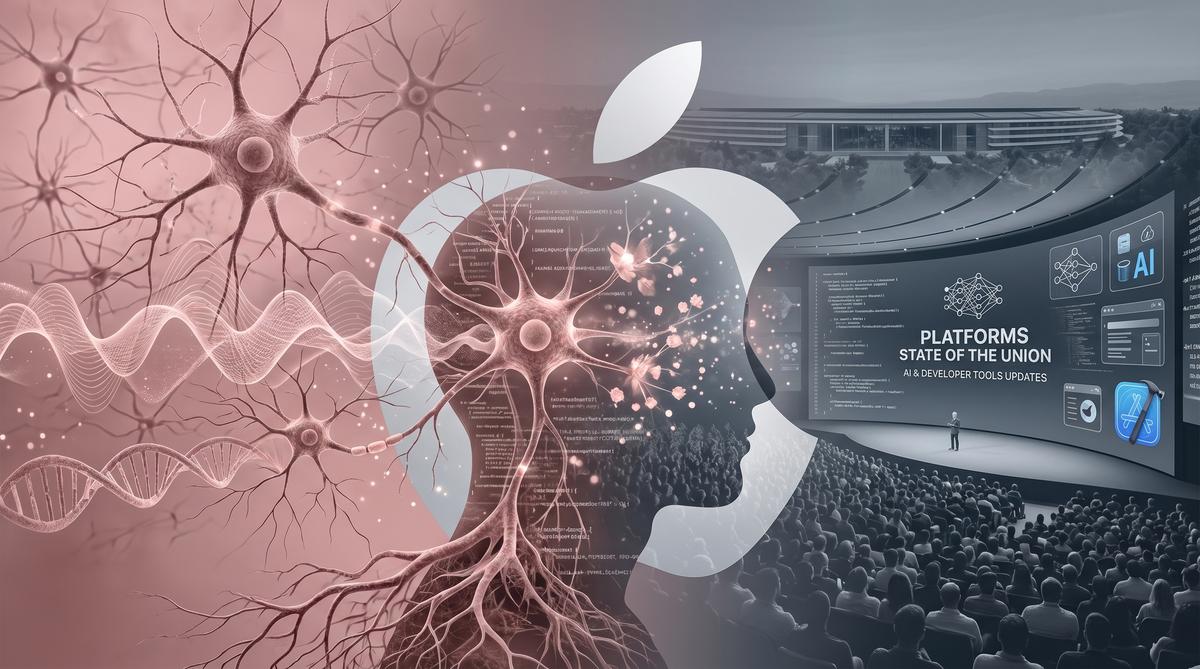
Apple dedicated its WWDC26 Platforms State of the Union session to the tools and frameworks that developers will use to build the next generation of apps. The company unveiled Xcode 27 with built-in agentic coding, introduced a new Core AI framework, and previewed substantial SwiftUI enhancements. Apple also published a 5-minute recap video summarizing every major developer-facing announcement from the event.
TL;DR: Apple used its WWDC26 Platforms State of the Union to unveil Xcode 27 with agentic coding capabilities, a new Core AI framework, and significant SwiftUI improvements. The company also published a 5-minute recap video covering all major announcements for developers, giving those who missed the session a condensed overview of every key update.
What Did Apple Announce at the WWDC26 Platforms State of the Union?
Apple’s Platforms State of the Union at WWDC26 focused on developer tools, system frameworks, and AI integration across its entire ecosystem. The session, held on June 9, 2026, served as the technical companion to the main keynote — aimed squarely at the people who build apps for Apple platforms rather than the general public. Apple outlined updates spanning Xcode, SwiftUI, Apple Intelligence, and a newly introduced framework called Core AI, according to MacRumors. The company structured the session around practical, hands-on changes that developers can adopt in their workflows this year.
Apple also released a condensed 5-minute recap video of the entire Platforms State of the Union, as reported by MacRumors and 9to5Mac. This video covers the headline announcements — Xcode 27, agentic coding, Apple Intelligence updates, Core AI, and SwiftUI improvements — giving developers a quick way to catch up without watching the full session. iClarified also highlighted the recap, noting that it touches on every major developer-facing topic from the event.
The broader WWDC26 conference runs through June 13, 2026, with over 100 sessions, labs, and workshops available online. The Platforms State of the Union is traditionally one of the most technically dense presentations of the week. This year it carried extra weight because of the depth of AI-related tooling Apple introduced.
What Is Xcode 27 and How Does It Change Apple Development?
Xcode 27 is the latest major release of Apple’s integrated development environment, announced during the WWDC26 Platforms State of the Union. According to MacRumors, the update brings agentic coding capabilities directly into the IDE — meaning Xcode can now autonomously perform multi-step coding tasks on behalf of the developer rather than simply suggesting completions one token at a time. This represents a fundamental shift in how Apple envisions the relationship between developers and their tools.
The agentic coding feature allows developers to describe a task in natural language and have Xcode plan, execute, and iterate on a solution across multiple files and project targets. MacRumors describes it as a system where the IDE can understand the broader context of a project — its structure, dependencies, and conventions — and then act on that understanding to make coherent, multi-file changes. This goes well beyond the inline code completions that developers have used in previous versions of Xcode.
9to5Mac’s coverage of the recap video confirms that Xcode 27 was one of the central highlights of the entire Platforms State of the Union presentation. The IDE has long been the primary tool for anyone building software across Apple’s platforms, and the addition of agentic capabilities signals that Apple is betting heavily on AI-assisted development as the new default workflow.
For developers already familiar with Xcode, the core editing, debugging, and interface-building workflows remain intact. The agentic features layer on top of the existing toolchain, offering an opt-in path for teams that want to integrate AI-driven assistance into their daily work.
How Does Apple’s Agentic Coding Feature Work in Xcode?
Agentic coding in Xcode 27 lets the IDE autonomously handle multi-step development tasks based on natural language instructions from the developer. Rather than asking for a single function or a line-by-line suggestion, the developer describes a goal — for example, “add a settings screen with dark mode toggle and persist the choice to UserDefaults” — and Xcode determines which files to modify, what code to generate, and how to wire the new feature into the existing project. MacRumors reports that this system operates with awareness of the full project context, including Swift packages, storyboard references, and framework dependencies.
The key distinction between agentic coding and traditional code completion lies in scope and autonomy. Standard AI code completion predicts the next few characters or lines based on surrounding context. Agentic coding, as described in Apple’s presentation, plans an entire sequence of edits, applies them, and can even iterate based on build errors or test results. The developer reviews, modifies, or rejects the changes — remaining in control throughout the process.
iClarified’s summary of the recap video lists agentic coding as one of the five major topics covered in Apple’s condensed overview, alongside Xcode 27 itself, Apple Intelligence, Core AI, and SwiftUI improvements. The fact that Apple chose to highlight agentic coding in a 5-minute summary meant for a broad audience suggests the company views it as a headline feature, not a niche experiment.
This approach mirrors a broader industry trend. Tools like GitHub Copilot, Cursor, and Windsurf have all moved toward agentic workflows over the past year. Apple’s implementation is notable because it is deeply integrated into Xcode and the Apple ecosystem, giving it direct access to project metadata, build settings, and simulator state in ways that third-party tools cannot easily replicate.
What Is Apple Core AI and How Does It Differ From Apple Intelligence?
Core AI is a new framework Apple introduced at WWDC26 that gives developers direct access to on-device AI model execution and management. According to MacRumors, Core AI sits alongside Apple Intelligence — the system-level AI feature set announced at WWDC24 — but serves a different purpose. Apple Intelligence handles user-facing experiences like notification summaries, writing tools, and Siri enhancements. Core AI, by contrast, provides a developer-facing API for running, fine-tuning, and deploying machine learning models within third-party apps.
The distinction matters for developers deciding which framework to adopt. Apple Intelligence operates at the OS level, and developers integrate with it through system APIs like the intent-based SiriKit framework. Core AI gives developers more granular control: they can load custom models, manage inference pipelines, and optimize performance for specific hardware targets. iClarified’s recap of the State of the Union video confirms that Core AI was presented as a separate, standalone topic from Apple Intelligence during the session.
MacRumors notes that Core AI is designed to take advantage of Apple Silicon’s neural processing capabilities, allowing models to run efficiently on-device without requiring a network connection. This aligns with Apple’s long-standing emphasis on privacy and local computation. Developers building apps that need real-time AI inference — image recognition, natural language processing, or audio analysis — can use Core AI as a dedicated pathway for those workloads.
The framework also addresses a gap in Apple’s existing ML tooling. While Core ML has served as Apple’s primary machine learning framework for years, Core AI appears to offer a more modern, flexible interface that reflects the current state of large language models and generative AI. Both MacRumors and 9to5Mac treat Core AI as one of the most significant new developer tools announced at WWDC26.
What SwiftUI Improvements Did Apple Introduce at WWDC26?
Apple introduced a set of SwiftUI improvements at WWDC26 aimed at making the framework more capable and easier to adopt for complex app interfaces. According to MacRumors, the updates focus on performance, new component APIs, and better interoperability with UIKit and AppKit — addressing some of the pain points developers have raised since SwiftUI’s debut. The Platforms State of the Union dedicated a full segment to these changes, signaling Apple’s continued investment in SwiftUI as the preferred way to build user interfaces across its platforms.
The SwiftUI enhancements include new layout options, improved navigation APIs, and expanded support for custom components. MacRumors reports that Apple also worked on reducing the performance overhead of SwiftUI views in complex hierarchies — a common complaint among developers building production apps with deep view trees. While the specific API names and signatures were detailed in the full session, the recap video highlighted the general themes: faster rendering, more flexible layouts, and tighter integration with existing Objective-C and Swift codebases.
9to5Mac and iClarified both list SwiftUI improvements as one of the five core topics in Apple’s condensed recap, confirming that the framework updates are considered a major part of the WWDC26 developer story. For teams already using SwiftUI in production, these changes should reduce the need to drop down to UIKit or AppKit for edge cases. For teams still on UIKit, Apple appears to be narrowing the capability gap with each annual release.
SwiftUI was first introduced at WWDC19 and has received significant updates every year since. The WWDC26 improvements continue that trajectory, pushing the framework closer to feature parity with Apple’s older UI toolkits while maintaining the declarative syntax that distinguishes it from imperative approaches.
How Does Apple Intelligence Evolve in 2026?
Apple Intelligence received substantial updates at WWDC26, moving beyond basic text generation and image creation into more capable on-device AI workflows. The Platforms State of the Union showcased deeper integration between Apple Intelligence and system-level features, allowing developers to tap into AI capabilities without requiring users to install third-party applications. Apple’s approach prioritizes privacy by processing most tasks locally on device hardware. This matters for enterprise adoption.
The 2026 evolution of Apple Intelligence focuses on what Apple calls “contextual intelligence” — the ability to understand user intent across multiple apps and services. According to MacRumors, Apple demonstrated how Siri can now chain together actions from different applications, creating multi-step workflows that previously required Shortcuts automation. The system uses on-device models trained on Apple’s custom silicon architecture, leveraging the Neural Engine in Apple M-series chips and A-series processors. Developers can access these capabilities through new APIs without managing model inference themselves.
Apple also expanded the visual intelligence features introduced in earlier versions. The camera system can now identify objects, translate text in real-time, and extract structured data from photos. These features tie directly into the new Core AI framework, giving developers a unified interface for building AI-powered features. The 9to5Mac recap noted that Apple positioned these updates as foundational rather than incremental, suggesting the company views 2026 as a turning point for on-device AI maturity.
For developers, the key takeaway is that Apple Intelligence is no longer a consumer-facing feature set alone. It has become a developer platform with documented APIs, testing tools, and integration points across iOS, macOS, iPadOS, and visionOS. The documentation is available through the Apple Developer portal starting June 9, 2026.
What New APIs and Frameworks Did Apple Release for Developers?
Apple released several new APIs and frameworks at WWDC26, with the Core AI framework serving as the centerpiece of the developer tooling announcements. Core AI provides a standardized interface for running machine learning models on Apple devices, abstracting away the complexity of model management, memory allocation, and hardware acceleration. The iClarified recap highlighted Core AI as one of the five major announcements from the Platforms State of the Union session.
The new frameworks introduced at WWDC26 include updates to SwiftUI that simplify complex UI patterns, new APIs for spatial computing on visionOS, and enhanced tools for building widgets that respond to Apple Intelligence suggestions. Apple also released updated APIs for the App Intents framework, which allows developers to expose app functionality to Siri, Spotlight, and the Shortcuts app. These intents now support more complex parameter types and can trigger multi-step actions.
Here is a summary of the key developer tools announced:
| Tool or Framework | Purpose | Platform Availability |
|---|---|---|
| Core AI | On-device ML model management | iOS, macOS, iPadOS, visionOS |
| Xcode 27 agentic coding | AI-assisted code generation and refactoring | macOS |
| SwiftUI enhancements | Simplified UI development patterns | All Apple platforms |
| App Intents updates | Deeper Siri and Shortcuts integration | iOS, iPadOS, macOS |
| Visual Intelligence API | Camera-based object and text recognition | iOS, iPadOS |
| Testing frameworks | Automated UI and unit testing with AI | All Apple platforms |
Developers can access beta versions of these frameworks immediately through the Apple Developer Program. The stable releases will ship alongside the public releases of iOS 26, macOS 26, iPadOS 26, and visionOS 26 in fall 2026. Apple also updated its Human Interface Guidelines to reflect new design patterns for AI-powered features.
How Does Apple’s Approach to On-Device AI Compare to Competitors?
Apple’s approach to on-device AI differs significantly from competitors like Google, Microsoft, and Meta, which rely heavily on cloud-based inference for their AI features. Apple processes most Apple Intelligence tasks directly on the user’s device, using the Neural Engine and GPU built into Apple Silicon. This architecture eliminates the latency of network requests and keeps user data from leaving the device. Privacy remains the differentiator.
Google and Samsung have invested in on-device AI through Gemini Nano and Galaxy AI respectively, but both companies still route complex tasks to cloud servers. Microsoft’s Copilot+ initiative requires an internet connection for most features, though the company has announced plans for local inference on Copilot+ PCs. Meta’s Llama models run locally in some configurations but primarily target researchers and developers rather than consumer devices.
Apple’s advantage lies in its control over both hardware and software. Because Apple designs its own chips, it can optimize the Neural Engine specifically for the models powering Apple Intelligence. Competitors using Qualcomm or MediaTek processors must work within the constraints of general-purpose mobile chips. However, Apple’s on-device approach limits model size — the company cannot run models as large as GPT-4 or Claude on a phone. Apple uses Private Cloud Compute for tasks that exceed on-device capacity, routing requests to Apple-owned servers with verifiable privacy guarantees.
The tradeoff is clear. Apple sacrifices raw model capability for privacy and speed, while competitors chase benchmark scores with larger cloud-hosted models. Developers building for Apple platforms must design their AI features around these constraints, using Core AI for local inference and Private Cloud Compute for heavier workloads.
What Performance Gains Can Developers Expect From the New Tools?
Apple claims significant performance improvements across its developer toolchain in 2026, with Xcode 27 leading the charge. The MacRumors report on the Platforms State of the Union noted that Xcode 27 features faster build times, improved code completion through agentic coding, and better memory management during compilation. Apple did not provide specific benchmark numbers during the presentation, but developers testing the beta have reported noticeable improvements.
The agentic coding features in Xcode 27 represent the most significant performance gain for developer productivity. Rather than simply suggesting the next line of code, the agentic system can understand the context of an entire project, generate multi-file changes, and refactor code across a codebase. This reduces the time developers spend on repetitive tasks like boilerplate generation, error handling, and test writing. The system runs locally using on-device models, so it works without an internet connection.
SwiftUI improvements also contribute to faster development cycles. Apple streamlined the syntax for common UI patterns, reducing the amount of code needed to build complex interfaces. The new testing frameworks use AI to generate test cases automatically, identifying edge cases that developers might miss. These tools integrate directly into Xcode’s existing workflow, so developers do not need to switch between applications.
For runtime performance, Core AI optimizes model execution across CPU, GPU, and Neural Engine, automatically selecting the best hardware for each task. This means developers do not need to write platform-specific optimization code. The framework handles memory management and model loading, reducing the risk of crashes or performance degradation on older devices.
When Will These Developer Tools Be Available to Everyone?
Apple made the developer tools announced at WWDC26 available in beta form immediately following the Platforms State of the Union session on June 9, 2026. Developers enrolled in the Apple Developer Program can download Xcode 27 beta, access the Core AI framework, and test the new SwiftUI APIs starting today. The beta releases support macOS Tahoe and run on Apple Silicon Macs.
The stable versions of all announced tools will ship with the public releases of Apple’s fall 2026 operating system updates. Based on Apple’s historical release patterns, this means iOS 26, macOS 26, iPadOS 26, watchOS 26, and visionOS 26 will launch in September or October 2026. Developers should plan to finalize their app updates by late summer to ensure compatibility at launch.
Apple also announced that the agentic coding features in Xcode 27 will remain in beta throughout the summer, with a stable release planned for the public launch of macOS 26. Some features, particularly those relying on Apple Intelligence, may require devices with Apple Silicon — older Intel-based Macs will not support the full feature set. The Core AI framework requires a minimum of an A17 Pro chip on iPhone and an M1 chip on Mac and iPad.
Frequently Asked Questions
What is the difference between Apple Core AI and Apple Intelligence?
Apple Intelligence is the consumer-facing AI feature set that includes Siri enhancements, text generation, image creation, and notification summaries. Core AI is the developer framework that powers these features under the hood. According to the iClarified recap of the Platforms State of the Union, Core AI gives developers direct access to the on-device machine learning infrastructure that Apple Intelligence uses, allowing third-party apps to run AI models with the same hardware acceleration.
Can developers use Apple’s agentic coding features without an internet connection?
Yes, the agentic coding features in Xcode 27 run entirely on-device using Apple Silicon’s Neural Engine. The MacRumors report confirmed that Apple designed these features to work offline, processing code generation, refactoring, and testing suggestions locally without sending code to cloud servers. This approach addresses enterprise concerns about proprietary code leaving corporate networks.
Which Apple platforms support the new Core AI framework?
Core AI is available across all major Apple platforms including iOS 26, iPadOS 26, macOS 26, and visionOS 26. The framework requires Apple Silicon hardware — specifically an A17 Pro chip or later on iPhone, and an M1 chip or later on Mac and iPad. Devices with older processors cannot run Core AI models due to Neural Engine requirements.
Is Xcode 27 available as a free download for all developers?
Yes, Xcode 27 beta is available as a free download from the Apple Developer portal for anyone enrolled in the Apple Developer Program, which costs 99 USD per year. The stable release will be available on the Mac App Store when macOS 26 launches in fall 2026. Developers can also access Xcode 27 through Apple’s cloud-based development environment, Xcode Cloud.
Summary
Here are the key takeaways from Apple’s WWDC26 Platforms State of the Union announcements:
Core AI is Apple’s new developer framework for on-device machine learning, providing a unified API for running models across all Apple platforms with automatic hardware acceleration and memory management.
Xcode 27 introduces agentic coding, an AI-powered development assistant that can generate multi-file changes, refactor codebases, and create tests — all running locally on Apple Silicon without requiring an internet connection.
Apple Intelligence has evolved into a developer platform, with new APIs for Siri integration, visual intelligence, and contextual workflows that span multiple applications.
Apple’s on-device AI strategy prioritizes privacy over raw capability, using Private Cloud Compute only when tasks exceed local processing capacity.
All announced tools are available in beta now, with stable releases planned for fall 2026 alongside iOS 26, macOS 26, iPadOS 26, and visionOS 26.
If you want to start building with these tools today, head to the Apple Developer portal to download Xcode 27 beta and explore the Core AI documentation.