Australia passed its Online Safety Amendment in late 2024, banning social media access for users under 16. The law required platforms to implement age verification systems within months. According to BitHub.pl’s analysis, the ban proved ineffective in practice while successfully building surveillance infrastructure that governments can repurpose.
TL;DR: Australia’s social media ban for under-16s created surveillance infrastructure that proved ineffective in practice, with the government responding by expanding the same approach despite documented failures. The BitHub.pl analysis reveals how age verification mandates establish identity-attribution systems that governments can repurpose for monitoring all online speech.
How Do Age Verification Laws Create Surveillance Infrastructure?
Age verification mandates force platforms to collect identity documents from every user, creating centralized databases of personal information linked to online behavior. According to BitHub.pl’s November 2025 analysis, Australia’s Online Safety Amendment Act established a framework where platforms must verify user ages through government-issued identification, biometric scanning, or third-party authentication services. Each method requires collecting sensitive personal data that previously remained private.
The infrastructure built for age verification does not disappear when verification completes. Once a platform collects identity documents, stores biometric data, or integrates with government authentication systems, that infrastructure persists. The databases remain. The APIs stay active. The surveillance capability becomes permanent.
This creates what privacy researchers call “function creep” — systems designed for one purpose get repurposed for others. A verification system built to check whether a user is 16 can equally check whether they are 18, 21, or a specific individual. The technical difference between age verification and identity attribution is essentially zero.
Governments understand this perfectly. When Australia’s government proposed the social media ban, civil liberties organizations warned that age verification requirements would create exactly this kind of infrastructure. Those warnings went unheeded.
What Did Australia’s Social Media Ban Reveal About Verification Systems?
BitHub.pl reported in 2025 that Australia’s social media ban for minors proved ineffective in practice, with young users bypassing verification through VPNs, parental accounts, and fabricated credentials. The government’s response was not to reconsider the approach but to expand it further. This pattern — failure followed by expansion — reveals how the policy’s true purpose may extend beyond protecting children.
The ban required platforms like Instagram, TikTok, and Snapchat to implement age verification or face fines up to 49.5 million AUD. Platforms complied by adding verification steps. Users found workarounds within days. VPN usage among Australian teenagers spiked. Parents created shared accounts. The technical measures failed to achieve their stated goal.
Yet the government declared the policy a success and proposed extending similar requirements to other platforms and services. If the goal were genuinely protecting minors, documented failure would prompt policy revision. Instead, failure prompted expansion. This behavior aligns with a different objective: normalizing identity verification as a prerequisite for online access.
The BitHub.pl analysis noted that dystopian social media restrictions, theoretically for children’s protection, effectively create surveillance infrastructure regardless of their stated effectiveness. The policy succeeds at building infrastructure even when it fails at protecting minors.
Why Is Age Verification Technically Impossible Without Identity Checks?
Age verification without identity confirmation is mathematically impossible in a distributed system. Any user can claim any age. Platforms cannot distinguish a truthful 15-year-old from a lying 17-year-old without checking identity documents, biometric data, or third-party records. This technical reality means every effective age verification system must collect and verify personal information.
The Australian government’s own eSafety Commissioner acknowledged this challenge in guidance documents. The commission outlined acceptable verification methods including government digital identity integration, credit card verification, facial age estimation, and document scanning. Every single method requires users to provide identifying information to either the platform or a third-party verifier.
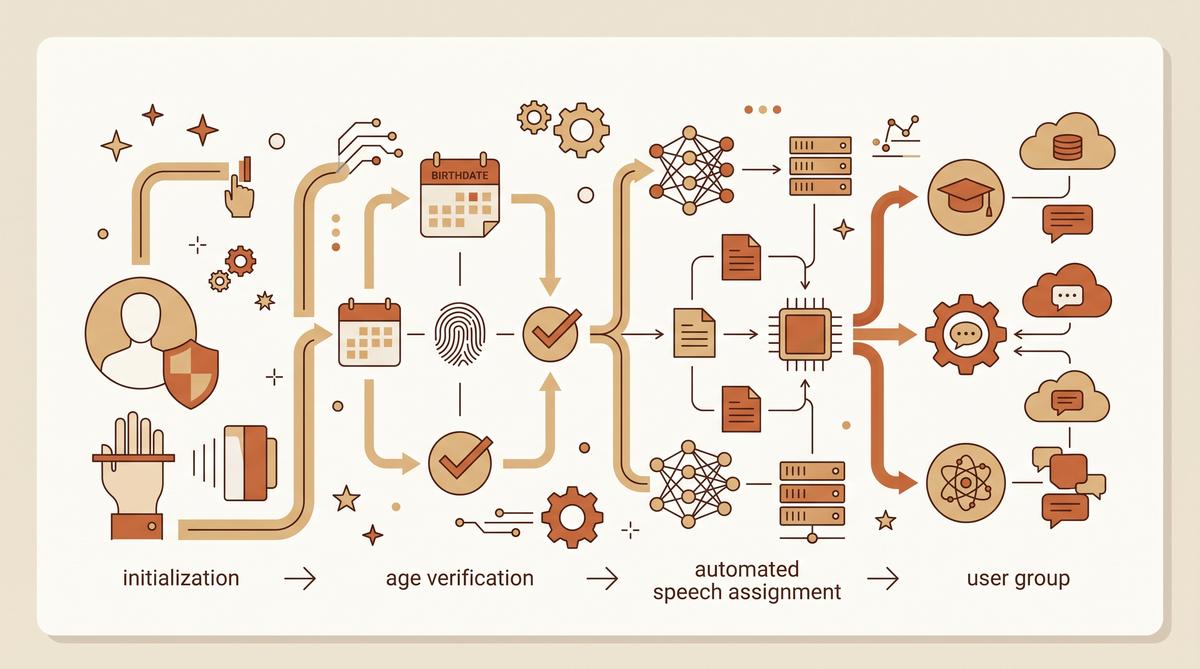
Consider the technical flow. A user attempts to access a social media platform. The platform must verify their age. It requests a government ID, a credit card, a selfie for biometric analysis, or integration with a national digital identity system. The user provides this data. The platform or verifier confirms the user’s age — and identity. The platform now holds verified identity data linked to the user’s account, their posts, their messages, their browsing behavior.
This is not a side effect. It is the only way the system can function.
How Does Automated Attribution Follow From Age Verification Mandates?
Once age verification infrastructure exists, extending it to speech attribution requires minimal additional engineering. The system already links verified identities to user accounts. It already stores this linkage in databases. Adding automated content analysis — scanning posts, messages, comments for prohibited speech — becomes a straightforward extension of existing capability rather than a new system.
The BitHub.pl analysis highlighted that Australia’s approach normalizes the expectation that users must prove identity before accessing online platforms. Once this expectation becomes standard, governments can mandate that platforms attribute all speech to verified identities. The technical infrastructure already supports this. The legal framework for requiring it follows the same logic as age verification mandates.
Several countries have already proposed or implemented variants of this approach. South Korea’s real-name commenting system required identity verification before posting on major platforms. China’s internet regulations mandate real-name registration for numerous online services. These systems demonstrate the trajectory: age verification establishes the infrastructure, then speech attribution mandates follow using the same technical and legal frameworks.
The progression is predictable. First, verify age to protect children. Then verify identity to enforce age restrictions properly. Then attribute speech to verified identities to enforce content laws. Each step builds on the infrastructure and legal precedent of the previous one.
What Technical Components Enable Speech Attribution at Scale?
Speech attribution at scale requires several technical components that age verification systems already establish or naturally extend. Understanding these components reveals how close current infrastructure already sits to enabling comprehensive speech monitoring.
The core components include:
- Identity verification databases storing government ID data, biometric templates, and credential records linked to user accounts
- Account-to-identity mapping maintained by platforms that have completed age verification for their user base
- Content analysis pipelines that platforms already operate for content moderation, scanning text, images, and video against policy rules
- API integrations connecting platforms to government identity systems, enabling real-time verification queries
- Logging infrastructure recording user activity, timestamps, IP addresses, and device fingerprints alongside verified identity
- Legal compliance frameworks establishing data retention requirements, government access procedures, and reporting obligations
- Behavioral tracking systems monitoring user interactions, engagement patterns, and social connections across platforms
- Automated flagging algorithms identifying suspicious content or behavior patterns for human review or automated action
| Component | Age Verification Purpose | Speech Attribution Extension |
|---|---|---|
| Identity database | Confirm user meets age threshold | Link speech to specific verified person |
| Biometric data | Estimate or confirm age | Identify individuals across accounts |
| Account mapping | Prevent underage registration | Attribute anonymous speech to real identity |
| Content scanning | Detect prohibited content for minors | Detect prohibited speech for all users |
| Government APIs | Verify credentials | Report flagged speech to authorities |
| Activity logs | Audit compliance | Build behavioral profiles for investigation |
| Data retention | Meet regulatory requirements | Enable historical speech analysis |
| Device tracking | Prevent circumvention | Track speech across devices and locations |
Each component serves the stated purpose of age verification. Each component equally serves comprehensive speech attribution. The overlap is not coincidental — it is structural. Building one system builds the other.
Which Countries Are Leading the Push Toward Attribution Infrastructure?
Australia passed the Online Safety Act amendments in late 2024, requiring social media platforms to verify user ages through government-approved methods. The legislation targets users under 16, but the verification infrastructure applies to everyone accessing covered platforms. Australia’s eSafety Commissioner oversees compliance, and platforms face fines up to 50 million AUD for violations (BitHub.pl, 2025).
The United Kingdom followed with the Online Safety Act 2023, which mandates age assurance for services likely to be accessed by children. Ofcom, the UK regulator, published guidance specifying acceptable age verification methods including photo ID matching, facial age estimation, and credit card verification. These mechanisms create persistent identity checkpoints across the digital ecosystem.
Poland introduced social media restrictions framed as child protection measures. According to BitHub.pl, the government’s ban on social media for minors proved ineffective in practice but successfully established surveillance infrastructure. The Polish government now seeks expanded verification mandates despite the initial policy’s documented failure. Officials frame each expansion as safety enhancement.
France, Germany, and Norway have similar proposals at various legislative stages. The European Union’s Digital Services Act includes age verification provisions for online platforms. Each national framework builds on shared technical foundations: identity document scanning, database cross-referencing, and persistent session tracking.
| Country | Legislation | Verification Method | Penalty for Non-Compliance |
|---|---|---|---|
| Australia | Online Safety Act 2024 | Government-approved systems | 50 million AUD |
| United Kingdom | Online Safety Act 2023 | Photo ID, facial estimation | 18 million GBP or 10% revenue |
| Poland | Social media ban (2025) | Unspecified | Administrative fines |
| France | SREN Bill (2024) | France Connect integration | 4% of global revenue |
| EU | Digital Services Act | Platform-determined | 6% of global revenue |
How Do Corporations Benefit From Mandatory Age Verification?
Major technology companies extract significant commercial value from age verification mandates. Identity verification creates structured demographic data that advertising platforms monetize through precise targeting. When users submit government identification, platforms gain confirmed age, location, and legal identity data far more accurate than self-reported profiles.
Age verification also raises barriers to entry for smaller competitors. Implementing compliant verification systems requires substantial infrastructure investment, legal expertise, and ongoing compliance costs. Startups and independent platforms struggle to match the resources of established companies. The compliance burden consolidates market power among existing tech giants.
Verification providers themselves profit enormously. Companies specializing in identity verification services — including Yoti, AgeID, and Veriff — positioned themselves as mandatory intermediaries. Every verification transaction generates revenue. The verification industry projected growth reflects legislative momentum, as each new mandate expands their addressable market.
Social media companies also benefit from reduced accountability. When governments mandate verification, platforms can deflect criticism about harmful content by pointing to compliance requirements. The framing shifts responsibility from platform design choices to regulatory obligations. Meanwhile, verified user data improves ad targeting precision, increasing revenue per user session.
Additional corporate benefits include:
- Reduced pseudonymous accounts — verified identities discourage sock puppet campaigns but also eliminate whistleblower protections
- Higher advertising rates — confirmed demographic data commands premium pricing from advertisers seeking precision targeting
- Legal liability reduction — compliance with age verification laws creates a regulatory shield against certain content-related lawsuits
- Competitive moat — verification infrastructure costs lock in incumbent platforms and deter new market entrants
- Law enforcement cooperation leverage — maintaining verification databases positions platforms as necessary partners for government requests
- Cross-platform tracking — shared verification providers enable correlation of user activity across multiple services
- Payment integration — age verification systems overlap with payment processing, enabling frictionless in-app purchases
- Data broker revenue — aggregated verification metadata becomes a commercial product sold to data analytics firms
What Are the Privacy Implications of Attributed Online Speech?
Attributed speech creates a permanent record linking individuals to every statement they make online. Unlike physical conversation, digital attribution persists indefinitely, searchable and correlatable across platforms. Every comment, post, and interaction becomes evidence tied to legal identity. This permanence fundamentally changes how people communicate.
Privacy erosion occurs through database aggregation. Verification systems maintained by platforms, third-party providers, and government agencies create multiple repositories of identity-linked activity data. Each breach exposes comprehensive profiles. The 2024 National Public Data breach compromised 2.9 billion records including Social Security numbers — demonstrating that centralized identity databases represent catastrophic single points of failure.
Attribution enables behavioral profiling at unprecedented scale. When speech links to verified identity, machine learning systems correlate language patterns, political views, purchasing behavior, and social connections. This creates detailed psychological profiles useful for manipulation, discrimination, or surveillance. Insurance companies, employers, and government agencies can access or purchase such data.
The chilling effect on speech represents perhaps the most significant privacy implication. Research consistently shows that observation changes behavior. When people know their words link permanently to their legal identity, they self-censor. Minority viewpoints, legitimate dissent, and unpopular but important perspectives disappear. Democratic discourse degrades when surveillance becomes the default condition.
Can Anonymous Speech Survive Age Verification Mandates?
Anonymous speech faces existential pressure under current verification frameworks. Technical architectures that verify age typically require identity document submission, biometric scanning, or database cross-referencing — each method links the verification event to a persistent identifier. True anonymity becomes structurally impossible when access requires prior identity proof.
However, cryptographic alternatives exist in theory. Zero-knowledge proofs can demonstrate that a user meets age requirements without revealing their actual identity or birth date. The mathematics allows verification without disclosure. Unfortunately, legislative frameworks rarely mandate privacy-preserving implementations, instead accepting whatever verification methods platforms choose to deploy.
The BitHub.pl analysis of Poland’s social media ban reveals the practical reality: governments pursue verification mandates despite documented ineffectiveness because the infrastructure itself serves broader surveillance objectives. Poland’s ban failed to prevent minors from accessing social media but successfully normalized identity requirements for online participation. The policy’s stated goal and actual function diverge completely.
Anonymous speech historically enables essential democratic functions. Whistleblowers expose corruption. Dissidents organize against authoritarian regimes. Marginalized communities discuss experiences without fear of retribution. Investigative journalists protect sources. Each of these functions requires the ability to communicate without attribution. Age verification infrastructure, once built, can be repurposed to eliminate these protections entirely.
What Alternatives Exist to Identity-Based Age Verification?
Several technical approaches can verify age without creating attribution infrastructure. Each method balances verification accuracy against privacy preservation, though none has achieved widespread legislative adoption.
Cryptographic age tokens represent the most privacy-preserving approach. A trusted authority issues a digital token confirming the holder meets age requirements. The token uses zero-knowledge proofs to validate age without revealing identity, birth date, or any correlating information. The user presents this token to platforms, which verify its authenticity without learning who the user is. This approach requires no database lookups during verification.
Device-level parental controls shift verification from centralized infrastructure to local devices. Operating systems can enforce time limits, content restrictions, and app access based on device-level configuration. Apple’s Screen Time and Google’s Family Link demonstrate this model. No platform-side verification occurs. The approach keeps age-related decisions within families rather than government databases.
Credit card verification without storage uses existing financial infrastructure. The verification process confirms a valid payment method exists without storing card details or transaction records. This approach leverages existing age correlation — credit card holders must be 18 or older in most jurisdictions. However, this method excludes legitimate adult users without credit cards and creates financial barriers to access.
Additional alternatives include:
- Facial age estimation with immediate deletion — AI estimates age from a photo, then permanently deletes the image without storage
- Peer verification networks — trusted contacts vouch for a user’s age without central authority involvement
- School enrollment verification — educational institutions confirm student status through federated identity systems
- Progressive account features — platforms grant additional capabilities as accounts age, reducing the need for upfront verification
None of these alternatives received serious legislative consideration in any major jurisdiction. Policymakers consistently choose identity-document verification, the approach most conducive to building permanent attribution infrastructure.
Frequently Asked Questions
Does age verification actually require government ID submission?
Current legislative frameworks do not explicitly mandate government ID submission, but accepted verification methods overwhelmingly rely on identity documents. The UK’s Ofcom guidance lists photo ID matching as a primary verification method. Australia’s eSafety Commissioner approved systems including document scanning and database cross-referencing (BitHub.pl, 2025). In practice, platforms choose document-based verification because it provides legal defensibility and generates valuable user data.
Which countries currently mandate social media age verification?
Australia enacted the most aggressive mandate through its Online Safety Act amendments, covering users under 16 with penalties reaching 50 million AUD. The UK Online Safety Act 2023 requires age assurance across platforms likely accessed by minors. Poland implemented a social media ban for minors that proved ineffective but established verification infrastructure (BitHub.pl, 2025). France’s SREN Bill integrates verification through the government’s France Connect identity system.
Can age verification systems work without storing personal data?
Technically, yes — zero-knowledge proofs and cryptographic age tokens can verify age requirements without storing identity data. However, no major legislative framework mandates these privacy-preserving approaches. Platforms consistently implement document-based verification that creates persistent data repositories. The 2024 National Public Data breach, exposing 2.9 billion records, demonstrates the catastrophic risk of centralized identity databases that current verification mandates produce.
How does age verification lead to speech attribution?
Age verification infrastructure creates identity-to-session mappings that enable permanent attribution of all online activity. Once a user verifies their identity to access a platform, every subsequent statement, interaction, and behavior links to that verified identity. The BitHub.pl analysis of Poland’s social media ban confirms that governments pursue these mandates despite documented ineffectiveness at their stated goals, suggesting attribution infrastructure represents the actual objective rather than child protection.
Are there privacy-preserving alternatives to current age verification?
Several alternatives exist including cryptographic age tokens using zero-knowledge proofs, device-level parental controls like Apple Screen Time, and facial age estimation with immediate image deletion. Each approach verifies age without creating persistent identity databases. However, legislative bodies have systematically ignored these alternatives in favor of document-based verification systems that build attribution infrastructure suitable for surveillance purposes.
Summary
- Age verification mandates create permanent identity infrastructure that can be repurposed for speech attribution and surveillance, regardless of stated child protection goals
- Poland’s social media ban demonstrates the pattern — the policy failed to protect minors but successfully normalized identity requirements for online participation (BitHub.pl, 2025)
- Corporate interests align with government surveillance objectives — verification generates monetizable demographic data while raising competitive barriers against smaller platforms
- Privacy-preserving technical alternatives exist but receive zero legislative attention because they do not produce the attribution infrastructure policymakers actually seek
- Anonymous speech faces structural elimination as verification requirements make pseudonymous participation technically impossible on major platforms
The trajectory is clear. Each new mandate builds infrastructure that outlasts its stated purpose. The systems constructed to protect children today will attribute speech tomorrow. Resistance requires demanding privacy-preserving verification methods before the infrastructure becomes irreversible. Contact your representatives. Support organizations fighting for digital rights. The window for meaningful intervention is closing.